


What Prompted the Spectacular Growth in Office Construction?

The government’s most recent report on construction spending in the U.S. fell short of expectations, with spending actually falling 0.1 percent in June instead of rising the forecasted 0.3 percent. The prior month’s data was revised down from 0.1 percent monthly growth to flat. Compared with a year ago, construction spending is down 3.2 percent.

One big exception comes from an unlikely category of growth: office construction. The private sector’s outlays on office construction rose 2.8 percent in June. Year-to-date it is up 7.3 percent. Compared with June of last year, it is up 15.1 percent.

That seems crazy. In our age of low workforce growth and remote work, who would be building offices at such an accelerated pace? It’s not the government. Public office construction spending is down three percent year to date.

It turns out that the source of growth is not the traditional office. General office construction spending is down 12.1 percent from a year earlier and fell 2.2 percent in June. The financial sector’s spending on offices declined 10.8 percent in June compared with May and is up just 1.9 percent compared with a year ago. And, in any case, the financial sector’s contribution to overall office spending is tiny—just $2.7 billion at an annualized, seasonally adjusted rate in June compared with $115.8 billion for the private sector overall.

O.K. Robot

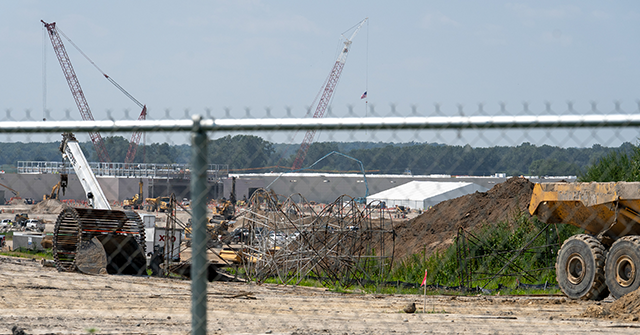
What’s fueling the growth is data center construction. This jumped seven percent in June alone and is up 45.8 percent from a year ago, coming in at an annualized pace of $68.3 billion. It now towers over traditional office construction, which is on an annualized pace of $44.2 billion.

The growth of data center construction is breathtaking. A few years ago, it was not even its own category in the Census Bureau’s construction spending report. The government only started releasing broken-out figures when it released the May construction spending data in July of 2024. That year, data center construction grew 74 percent, from just under $20 billion to around $34.8 billion.


Fortunately, the Census Bureau also released estimates on data centers going back to 2014. From 2014 through 2021, data center construction spending grew from $1.8 billion to around $10 billion. That amounts to an impressive rate of growth of around 27.7 percent. As a share of overall construction spending in the U.S., data centers went from 0.18 percent to 0.60 percent.

In the years since then, however, growth has accelerated at an astonishing 58 percent annualized rate. The June 2026 pace is more than five times the 2022 total. The first-half annualized pace was 22 percent above the 2025 total, while the June rate was 37 percent above the average pace during 2025—and 45.8 percent above June 2025. Data centers now account for almost three cents of every dollar spent on construction in the United States.

Of course, residential construction is so large that this obscures the centrality of data centers. If we exclude housing, data centers account for five percent of total spending in the first half of this year. If we look only at private nonresidential construction—that is, excluding housing and government—it is 8.3 percent. At the June pace, data centers were 9.2 percent of private nonresidential construction.

This illustrates how much larger a role the AI investment boom is playing in economic growth today than is commonly understood. Some of the spending is likely drawing down funds that would be spent otherwise—crowding out other spending, as economists would put it. And these figures capture only construction. They exclude the servers, racks, and other specialized equipment installed inside data centers. But the crowding-out effect is likely dwarfed by the additional investment that would likely otherwise be socked away in cash and cash-equivalents on corporate balance sheets.

What we know is that a meaningful share of growth in construction spending is coming from the build out of data centers.

Read the full article here

Share.
Leave A Reply

Exit mobile version