

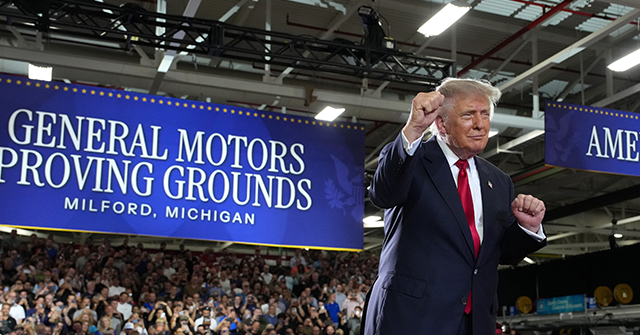
Durable Goods Factory Jobs Are Expanding at a Fast Pace for the First Time in Years
The best-kept secret in the U.S. economy right now is that we’re experiencing a manufacturing renaissance.
Durable goods manufacturing added 18,000 jobs in July, its best month of the year. Over the three months through July, durable goods payrolls rose 44,000. Motor vehicles and parts accounted for 7,900 of the July gain. Machinery added 2,600, fabricated metals 2,500, and computers and electronics 2,900, including 1,700 semiconductor jobs.
During the first four months of the year, durable goods added 28,000 jobs, an average of 7,000 a month. May, June, and July produced 44,000 jobs, an average of nearly 15,000. The pace of hiring has more than doubled.
Durable goods payrolls have now risen in every month of 2026, adding 72,000 jobs and averaging better than 10,000 a month. That is the first run of seven consecutive monthly gains since the streak that ended in January 2023. Year-over-year employment turned positive in June and widened to 35,000 in July, the first positive readings after 30 consecutive months of decline.
A genuine drought has ended. Prior to July, the last three-month gain of this size came in the period ending in December 2022. The next 42 monthly reports came and went without another strong three-month period.
The Bad Old Days of George Bush and the China Shock
To be sure, this is nowhere near as long as the manufacturing jobs drought that lasted from July 2000 and ran through May 2010, with the sole exception of a few good months in the middle of 2004. The period covered the Presidency of George W. Bush and the ascendancy of globalist Republicans, the 2001 recession, the great China shock, the fruitless and prolonged wars in Iraq and Afghanistan, the housing bubble, and the financial crisis. Over the first decade of the 2000s, durable goods manufacturing lost 3.84 million jobs, an average decline of 32,000 a month for an entire decade.
The recovery that followed during the Obama era was thinner than advertised. From January 2010 through January 2017, durable goods added 694,000 jobs, but 518,000 of that came during the first three years, when employment was bouncing off the crisis floor. The last two years of the Obama administration went in reverse, shedding 55,000 durable goods jobs. Across 2015 and 2016, there was not a single three-month gain matching the current one. From January 2015 and October 2017, we never had a hot streak that brought us above 40,000 over three months.
The Trump Revival 1.0
Beginning in August 2017, durable goods employment rose for 18 consecutive months, adding 340,000 jobs through January 2019. The economy was already more than eight years removed from the recession trough. This was no traditional rebound. Instead, the economy was responding to the new priorities of the Trump administration. You have to go back to the 21-month run ending in April 1998 to find a longer streak that also began outside the first two years of a recovery.
From December 2017 through January 2019, the sector strung together 15 consecutive three-month gains of at least 40,000, the longest such stretch of the 21st century. By January 2019, durable goods employment had reached 8,025,000, its highest level since December 2008.
The gains now are concentrated in durable goods. Nondurable manufacturers lost 13,000 jobs in July and are down 49,000 over the year. That points toward a shift into capital-intensive production. It is the sort of shift one would expect when labor is scarce and tariffs tilt demand toward domestic production.
Output confirms it. The Federal Reserve’s index of durable manufacturing production rose 3.2 percent in the year through June and 5.8 percent since January 2025. May’s reading was the highest since December 2018. Output per worker is up 5.9 percent.
Compare that with the first Trump term. From January 2017 to the September 2018 peak, durable output rose 4.7 percent while employment rose 3.7 percent. Output per worker gained less than a point. That expansion ran on headcount at a time when the workforce was still growing rapidly. This one is running on capital, reflecting the slowdown in workforce growth.
The hours data point the same way. Production workers in durable goods logged 42.3 hours a week in July, up from 41.3 a year ago. Overtime rose to 4.1 hours from 3.7. Manufacturers are adding workers and working the ones they already have longer.
And this is paying off for manufacturing workers. Average hourly earnings for production and nonsupervisory employees in durable goods rose 4.7 percent over the year, against 3.2 percent for all private workers. Add the longer week and weekly earnings for those workers climbed 7.2 percent, beating the rate of inflation by 3.7 percent. That is what capital deepening looks like from the shop floor. Fewer hands, more machines, more output per hand, and a raise that beats the rest of the economy by a wide margin.
Trump said he was going to bring about a Golden Age for American manufacturing. The July data confirms the dawn of that era has arrived.
Read the full article here
