

Close Menu
The Politic ReviewThe Politic Review
  • News
  • U.S.
  • World
  • Politics
  • Congress
  • Business
  • Economy
  • Money
  • Tech
  • More Articles
Trending

Poll: Strong Majority of U.S. Voters Approve of Trump’s Iran Deal

June 19, 2026

Kelly: SAVE America Act Isn’t Going to Happen — ‘There’s Not Even Republican Support’

June 19, 2026

Finland shreds nuclear weapons ban

June 19, 2026
Facebook X (Twitter) Instagram
  • Donald Trump
  • Kamala Harris
  • Elections 2024
  • Elon Musk
  • Israel War
  • Ukraine War
  • Policy
  • Immigration
Facebook X (Twitter) Instagram
The Politic ReviewThe Politic Review
Newsletter
Friday, June 19
  • News
  • U.S.
  • World
  • Politics
  • Congress
  • Business
  • Economy
  • Money
  • Tech
  • More Articles
The Politic ReviewThe Politic Review
  • United States
  • World
  • Politics
  • Elections
  • Congress
  • Business
  • Economy
  • Money
  • Tech
Home»Economy»Breitbart Business Digest: The Hidden Cost of America’s Trade Deficit Is a Permanent Budget Deficit
Economy

Breitbart Business Digest: The Hidden Cost of America’s Trade Deficit Is a Permanent Budget Deficit

Press RoomBy Press RoomOctober 29, 2025No Comments6 Mins Read
Share Facebook Twitter Pinterest Copy Link LinkedIn Tumblr Email VKontakte Telegram

The Real Story Behind America’s “Harmless” Deficits

The economists’ case in Learning Resources v. Trump gets the causality wrong.

When a group of economists filed an amicus brief in Learning Resources v. Trump, one of the cases brought against the Trump administration’s tariff policies, they offered a confident defense of America’s trade deficits. These imbalances, they said, are nothing to fear. A deficit in trade is merely the mirror image of a surplus in capital inflows. It simply means foreigners are eager to invest in the United States. In this view, America runs trade deficits because it is an attractive place to put money—a mark of strength, not weakness.

The argument has the virtue of neatness and the vice of being detached from economic reality. It confuses an accounting identity with an economic mechanism. The fact that trade and capital balances must offset tells us nothing about which drives which—or what the real-world consequences are when the books balance by leaking domestic income abroad.

In today’s Breitbart Business Digest, we’ll unpack the deep flaws in the economists’ case for treating America’s trade deficits as harmless. Tomorrow, we’ll look at what follows—how the imbalance shapes fiscal policy, what it really means to call a policy “protectionist,” and what’s at stake in Learning Resources v. Trump.

The Economists Who Mistook an Equation for an Economy

In the simplest closed-economy model, everyone’s spending is someone else’s income. A household’s purchase becomes a firm’s revenue; the firm’s payroll becomes another household’s income. So long as spending and production remain in balance, the economy hums along at full employment.

When we open that system to trade, nothing essential changes. Americans buy imports, giving foreigners income to buy our exports. Foreigners buy our products, giving us income to buy theirs. So long as the flows are balanced, global spending still equals global income.

Persistent imbalances change everything. When Americans buy more from abroad than foreigners buy from us, more spending leaves the domestic income stream than returns to it. Each dollar of U.S. consumer spending now generates less revenue for U.S. producers. The difference shows up as slower output growth, lower wages, and, unless something offsets it, higher unemployment. The United States is not consuming too much; it is earning too little relative to what it spends.

The economists behind the brief treat this outcome as a matter of taste. Americans, they imply, simply prefer present consumption to future consumption and therefore borrow the difference. But the direction of causality runs the other way. We do not run a trade deficit because the American public collectively decides to live beyond its means. We run one because our productive capacity is held back by the persistent surpluses of others.

Surplus countries—China, Germany, Japan, and their imitators—pursue policies that maximize employment and sustain export surpluses. They restrain domestic consumption, manage exchange rates, and channel national savings into foreign assets. By producing more than they consume, they create a surplus of goods and of savings that must find an outlet somewhere else. In a world of open markets, that “somewhere else” is the United States.

We play the accommodating partner. Our markets are open, our currency is the reserve currency, and our financial system is the world’s safest depository for foreign savings. The U.S. does not choose a trade deficit. It permits one. By allowing others to overproduce, we accept the corresponding role of over-consuming, not out of excess appetite but out of structural necessity. Our spending provides the demand that surplus economies suppress at home.

A Post-World War II Strategy That Lasted Nearly 80 Years

This did not happen by accident. And it wasn’t something others inflicted on us, at least at first. When we emerged from World War II as the world’s greatest economy, in part because the war was almost exclusively fought outside of the continental U.S. while Europe and Asia were ravaged, we set out to rebuild the economies of our allies. In part, the hope was that sharing our prosperity would create markets for our products. And the Cold War added a strategic imperative. We wanted the noncommunist world to be wealthy enough to turn a deaf ear on the siren song of communism.

This was not supposed to be a permanent arrangement. The idea was that the trade imbalances would cure themselves as the world marched toward free and more open trade, greater efficiency, and a world order dominated by liberal democracy. But that idea didn’t work out. Instead, we’ve run 54 years of trade deficits, and our manufacturing capacity has degraded. When Ronald Reagan was president, we manufactured around 90 percent of the goods we consumed. Today, it is closer to 75 percent. And until Trump came along, there was no end in sight.

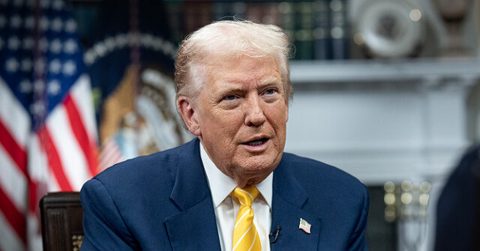
President Donald Trump gives remarks in the Oval Office on May 28, 2025. (Joyce N. Boghosian/Official White House Photo via Flickr)

The persistent trade asymmetry has a simple consequence: it starves the United States of income. When foreign nations deliberately under-consume, the demand that would have sustained their own workers is instead met by American consumers. Our spending crosses borders, but the income that would have come back through exports does not. A portion of every dollar Americans spend ceases to circulate in the domestic economy. The gap must be filled, or the economy contracts.

The filling comes through borrowing. When private credit expands—say, during a housing boom—household debt temporarily replaces the missing income. When private credit collapses, the government steps in. Washington’s fiscal deficit is not primarily a discretionary act of stimulus. It is the almost-automatic counterpart of the external deficit. Politicians who do not want to oversee rising unemployment and falling income will use deficit spending to keep the economy afloat. Dollars that leave the country through trade eventually re-enter through Treasury auctions and federal spending.

In that sense, the U.S. fiscal deficit is the mirror of the trade deficit. Attempts to close one without addressing the other merely shift the imbalance around the balance sheet. Cut government spending while imports still exceed exports, and national income falls until tax revenue declines and the deficit reopens. The external imbalance makes the fiscal imbalance inevitable.

This, not the accountants’ symmetry, is the real dynamic at work. The trade deficit is not a benign reflection of global confidence or a desire to hold U.S. assets. It is a continuing drain on domestic income offset by debt. The capital inflows celebrated by the amici brief are not gifts but the financial record of that drain being recycled back into our economy as borrowing.

In today’s Breitbart Business Digest, we took apart the economists’ favorite myth—that America’s trade deficit is nothing more than the world’s compliment. Tomorrow, we’ll follow the money: how the dollars leave, how they return as debt, and what that means for U.S. policy and the Supreme Court.

Read the full article here

Share. Facebook Twitter Pinterest LinkedIn Tumblr Email Telegram Copy Link

Related Articles

Economy

Breitbart Business Digest: Kevin Warsh and the End of Monetary Policy Story Hour

June 19, 2026
Economy

Nolte: 37-Year-Old James ‘God Is Nonbinary’ Talarico Shares His Only Checking Account with Mommy

June 18, 2026
Economy

Feds Indict Eight Illegals Who Used Stolen Social Security Numbers to Work in Kentucky

June 18, 2026
Economy

Wall St. Journal: Illegal Migration Drains Public Support for Legalized Migration

June 18, 2026
Economy

Jobless Claims Fall, Signaling Ongoing Strength in Labor Market

June 18, 2026
Economy

Gasoline Drops Below $4 A Gallon

June 18, 2026
Add A Comment
Leave A Reply Cancel Reply

Editors Picks

Kelly: SAVE America Act Isn’t Going to Happen — ‘There’s Not Even Republican Support’

June 19, 2026

Finland shreds nuclear weapons ban

June 19, 2026

Dem Rep. Goldman: Soleimani Strike Was Distraction from Impeachment

June 19, 2026

Couple in IVF Swap Reach Agreement with Biological Parents to Keep Baby

June 19, 2026
Latest News

Iran stood its ground, and Washington got nothing

June 19, 2026

Dem Rep. Goldman: Iran Didn’t Follow ‘Very Strict’ JCPOA Terms

June 19, 2026

President Trump to Breitbart: Democrats Performing Poorly in Generic Polls Because They’re Running ‘Lunatics’

June 19, 2026

Subscribe to News

Get the latest politics news and updates directly to your inbox.

The Politic Review is your one-stop website for the latest politics news and updates, follow us now to get the news that matters to you.

Facebook X (Twitter) Instagram Pinterest YouTube
Latest Articles

Poll: Strong Majority of U.S. Voters Approve of Trump’s Iran Deal

June 19, 2026

Kelly: SAVE America Act Isn’t Going to Happen — ‘There’s Not Even Republican Support’

June 19, 2026

Finland shreds nuclear weapons ban

June 19, 2026

Subscribe to Updates

Get the latest politics news and updates directly to your inbox.

© 2026 Prices.com LLC. All Rights Reserved.
  • Privacy Policy
  • Terms of use
  • For Advertisers
  • Contact

Type above and press Enter to search. Press Esc to cancel.