




The Economy That Never Came in from the Cold
Four score years ago, the United States brought forth a new economic system, dedicated to the proposition that we would rebuild the world from the wreckage of the Second World War and stand athwart communism. For 40 years, that system worked. Germany and Japan, economically devastated, got rebuilt. In return, the United States accepted persistent trade deficits and the gradual hollowing out of our manufacturing base. The logic was coherent: we needed these allies secure and prosperous.
Then the logic expired in 1989, but we never stopped. For the past 30 years, we’ve been running the same policy for no reason at all. That’s the mistake.
Mainstream macroeconomists argue endlessly about why America runs trade deficits. The answers they give are deeply unsatisfactory because they are so far removed from reality. Some say it’s because Americans prefer to consume more than they produce. Others blame the reserve currency system—as if the structure of global finance fell from heaven like gravity. The best economists dance around the real point: we built this system, maintained it through policy choices, and created an elite class whose interests depend on keeping it alive. When the geopolitical rationale for the system expired, the system persisted anyway. That’s what makes Trump the necessary correction.
Let’s start with a question economists rarely ask: Why do foreign countries want to run persistent trade surpluses? The answer is not mysterious. Germany wants full employment. Japan wants full employment. They want this because employment is politically essential and because their citizens want to save—to accumulate wealth, build pensions, create security. These are rational desires. But here’s the constraint: you cannot simultaneously have full employment and savings if you only have your own population to sell to. Your production capacity exceeds domestic demand. The excess has to go somewhere.
After World War II, America answered that question by volunteering. We said, in effect: Go ahead. Run your surpluses. We’ll absorb your excess production. We’ll take your exports. We’ll run the corresponding deficits. In return, we get your alliance in the Cold War. Your prosperity is our goal because we believe it will tether you to the free world. And it was not coincidental that this prosperity also made them economically dependent on access to U.S. consumers. It was a coherent geopolitical bargain. We bombed Germany and Japan into submission and felt a moral obligation to rebuild them. We feared communism and knew that prosperity was the antidote. So we opened our markets to their exports and accepted the deficits that naturally resulted.
Aerial view of the ruins of Berlin, Germany, circa 1945, following the Allied bombing campaign. (Roger Viollet/Getty Images)

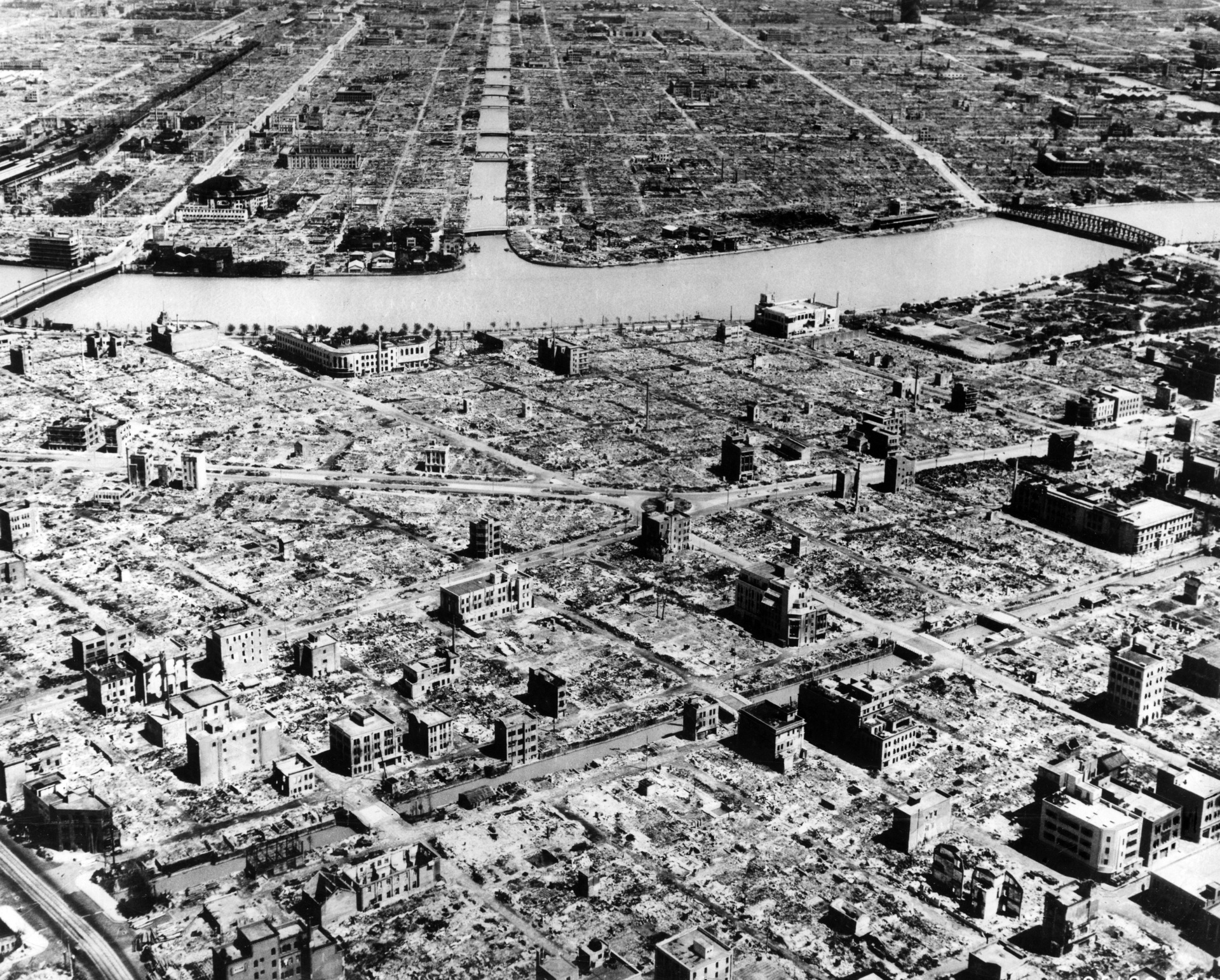
Aerial view of Tokyo, Japan, razed by the American bombing campaign carried out on the evening of March 9, 1945, by 334 B-29 Super Flying Fortresses. (Mondadori/Getty Images)
The mechanism was elegant. Foreign countries export to America, accumulate dollars, and park those dollars in American financial assets—Treasury bonds, real estate, equities, later mortgage-backed securities. This creates the accounting identity: trade deficit mirrors capital inflow. Americans don’t “prefer” to consume more than they produce. Rather, Cold War foreign policy required that we absorb their production. To make this politically viable, we couldn’t let wages and employment collapse. So our government runs fiscal deficits—borrowed from those same foreign savers and domestic wealth-holders—and our central bank encourages credit expansion to maintain enough domestic demand to keep unemployment from rising too far.
The Real Cause of Trade Imbalances: Domestic Policy
Now here’s the part that economists get backward. They observe that foreigners eagerly buy U.S. financial assets, and they conclude that the attractiveness of these assets is what drives the trade deficits. The logic runs: Deep U.S. financial markets and safe U.S. assets are a magnet for global capital. Foreigners want to invest in America. This desire to invest creates the trade surpluses that generate the capital to invest. In this story, the U.S. financial system is the cause of the trade deficit. Our deep financial markets act like a magnet for investment and somehow cause the trade imbalances.
But the causality runs the other way. Germany and Japan wanted full employment and savings—this required running trade surpluses. We wanted them to achieve this. In fact, we encouraged them to want these things because we believed it was the best bulwark against communism. So we facilitated it. The question was: how do we absorb their surpluses without destroying our own economy? The answer was to deliberately build a financial system deep enough, liquid enough, and safe enough to absorb the capital flows their surpluses would create. We engineered the attractiveness of U.S. assets specifically to make it politically viable for us to run trade deficits. The trade deficits came first, as a policy choice. The financial markets came second, as the infrastructure to sustain that choice. Foreigners didn’t demand trade surpluses because U.S. assets were attractive. Rather, their desire for full employment and savings required trade surpluses, and we built financial markets attractive enough to make that arrangement work.
All of this required a supporting cast. A financier class had to emerge to intermediate the flows, manage the liabilities, extract fees from the continuous cycling of capital. Asset prices had to appreciate (stocks, real estate) to create a financial return for those holding assets. We drafted Wall Street into our scheme to keep the world safe from the Marxist-Lennists. We erected a huge federal government that would churn out safe assets. We expanded housing credit and securitized it so that foreign investors would find a home for their trade surplus-created dollar savings.
Over decades, this system created its own reality. Institutions adapted to the system we built. Individual preferences and social norms formed around the system’s infrastructure. Germans, for instance, built a culture around the idea that full employment and savings were achievable—because their system made them so. Our stories became self-fulfilling prophecies. And more importantly, the elites who profited from this system—financiers, multinational corporations, exporters abroad—developed every incentive to defend it. They became true believers because the system rewarded belief.
Then came 1989. The Cold War ended. The geopolitical rationale for the whole arrangement simply vanished. Germany wasn’t going communist. Japan wasn’t going communist. The moral imperative to rebuild our defeated enemies had been more than satisfied. We’d kept the system running for 40 years successfully—our allies were prosperous, stable, allied. Mission accomplished. But the system didn’t stop. Instead, we kept it running, and then we integrated China into it at massive scale. China, with production capacity orders of magnitude larger than Japan or Germany, with wages lower, with no Cold War alliance justification whatsoever. The justification was what you might think of as a preemptive Cold War: we’ll do for China what we did for Europe and Japan to guide China into becoming a reasonable economic and political partner.
And here’s the problem: the system that had accommodated German and Japanese surpluses couldn’t accommodate Chinese surpluses without catastrophic damage to American workers. The scale was different. The rationale was gone. But the machinery kept grinding. And China, rather than liberalizing through trade as the original logic suggested, used the system to build military and economic power against American interests. So the question became obvious: Why are we still doing this?
The elites had an answer: You can’t stop. The system is eternal. It’s how global finance works. The dollar is the reserve currency. Everyone wants our assets. This is inevitable. The system we had constructed now looked to them like a law of nature. And they have no financial interest in changing it. And they had the intellectual firepower to bully anyone who registered dissent from the left or the right.
The Triumph and Promise of Donald Trump
But here’s what they couldn’t control: the redistribution mechanism that made the system politically viable started to break. The government couldn’t tax wealth enough to redistribute the costs downward. Or more precisely, it wouldn’t. So working-class Americans began to directly bear the costs of the system—deindustrialization, wage stagnation, job insecurity—without the buffer of transfers and services that had previously made it survivable. The political coalition that supported free trade collapsed, not because Americans became irrationalist, but because the deal stopped working for them. The elites got richer. Workers got poorer. And nobody was explaining why. People were told it was inevitable. Learn to code. Adjust your expectations downward. Manage the decline.
Into this moment came a rascally real estate investor and builder named Donald Trump, who asked the unfashionable question: Why? Why are we still doing this? What’s the upside for America? If China is a rival, not a partner, if the Cold War is over, if the moral obligation to rebuild Europe and Japan has been fulfilled 30 years ago, then what’s the reason to continue absorbing their surpluses? What do we get? The intellectuals had no answer that didn’t sound like rationalization. So they fell back on: You can’t change it. It’s the system. Tariffs would hurt consumers. Trade wars are bad. The math doesn’t work.
Except the math absolutely works, if you change the structure. If you make it more profitable to produce in America than to produce offshore and import, companies will produce in America. If you require market access to come with manufacturing obligation—as China does—then manufacturing locations shift. The fact that China produces cheaply isn’t a law of nature; it’s a result of policy architecture that says: “Access our market, and you have to build here.” The U.S. policy architecture said the opposite: “Build wherever you want; we’ll buy whatever you send us.” That wasn’t destiny. That was a choice.
Trump is the correction to 30 years of policy inertia — not because he’s perfectly right about everything, but because he’s asking the fundamental question that needs to be asked: If the rationale for this system is gone, why continue it? If it’s destroying American workers, what’s the upside? If we could build things here instead of importing them, why wouldn’t we? Importantly, Trump dared to dream about what can come next, what the next chapter in the American experiment could look like. The fact that this seems radical shows how thoroughly the old system captured the intellectual and political consensus.
It’s time to demobilize our economy from the long war that ended four decades ago. We can come home again. We won.
Read the full article here


