




The Weekly Wrap: Greenland Belongs to Us!
Welcome back to Friday!
This week the U.S. finally acquired Greenland, more or less. Take that, nattering NATO nabobs of negativity! The bond market decided that it wasn’t getting enough attention in our age of AI doomerism, so it climbed to the top of Mount Five Percent and then sprouted wings and flew off cackling. The economy, meanwhile, continues to boom, with core capital expenditures recording a double digit gain from a year ago. Even the services sector has joined the party.
Let’s go.
This Land Is Greenland, This Land Is Our Land
When President Donald Trump first started casting his gaze on Greenland, his critics seethed that he had become a madman. “It’s bananas. It’s insane,” Democratic U.S. Representative Jim Himes told CNN.
Trump’s rationale was easy to understand. “We need Greenland for national security purposes,” Trump said at a press conference way back in January. “I’m talking about protecting the free world. You look at — you don’t even need binoculars — you look outside. You have Chinese ships all over the place. You have Russian ships all over the place. We’re not letting that happen. We’re not letting it happen.”
But nobody listened. Stephen Colbert—he used to have a television show, if we recall correctly—accused Trump of wanting to invade a “frozen gravel pile” and said that there was a risk of winding up in a war against NATO.
Here was a pretty typical exchange from the legacy media’s coverage:
CNN’s Anderson Cooper: “Well, it seems like European leaders’ strategy so far has been to basically try to deescalate, reason with the president, find some kind of an off-ramp. Do you think there is an off-ramp?”
Sen. Ruben Gallego (D-NM): “No, and I’ve been very clear. He is a madman. He is insane. He’s only thinking about himself.”
Cooper: “And you know that he’s insane?”
Gallego: “Yes, I’m sorry, where are we at this moment where we don’t understand what’s happening in this country? The man is threatening war against a NATO ally. We all think this is rational, right? Let’s accept what’s happening here. He is not rational right now… He is destroying our world reputation or potentially our economic opportunity or economic mighty power around the world because he is being petty. None of this is rational. Everyone needs to stop pretending this is rational.”
Okay. It’s a bit of an exaggeration to say nobody listened. We listened. We even figured out how much it would cost to buy Greenland. Our top estimate was $300 billion. We suggested that a better plan would be to lease Greenland, which we figured should cost around $2.5 billion a year.
As it turns out, Trump struck an even better deal for the United States.
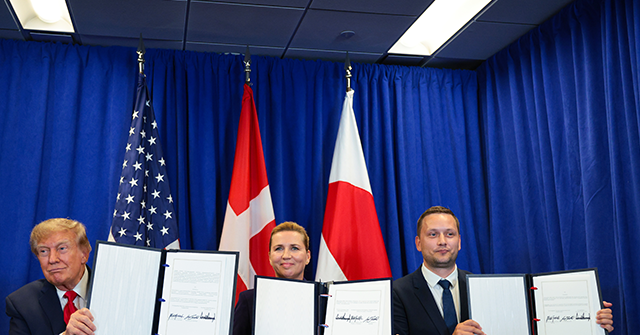
The September 22 agreement between the U.S., Denmark, and Greenland is a major strategic win. The U.S. gets permanent basing, access, and overflight rights, and the pact has no expiration date and persists even if Greenland eventually becomes independent from Denmark. This fixes a major weakness of the prior arrangement set down in 1951, which was tied to the NATO treaty and could have lapsed. We didn’t acquire Greenland, but we get to do what we want with it forever.
The deal also allows for the development of two additional U.S. military sites and a proposed “Golden Dome” missile defense system. It bars rival bad guy nations, such as China and Russia, from establishing a military footprint in Greenland and prohibits sensitive investments by non-allies, which protects the island’s minerals and new shipping lanes as the Arctic opens.
This was better than a purchase or a lease. Why buy the cow when you can get the milk for free?
People Are Worried About the Bond Market
While everyone was fretting about the possibility that artificial intelligence—sorry, superintelligence—would wipe out humanity, the bond market seized on our collective distraction to remind us all of the truth of James Carville’s observation that it has the ability to intimidate anybody.
The yield on the 10-year Treasury has surged 50 basis points over the past month to around 5.2 percent on Friday. All along the way, market pundits weighed in with forecasts of doom. In particular, the five percent threshold was treated as a kind of pale along the borderlands, with everything beyond being chaos and savagery. It was a line that hadn’t been crossed since 2007—19 years ago! Every five- or six-basis-point step up was presented as a mounting crisis. Headlines blared that the “bond market rout” was getting “worse.”
Yet on Friday, with yields still climbing, each of the major equities indices were up for the day and above the week earlier levels. The Doom of Five Percent turned out to be a figment of the imaginations of Trump-deranged analysts and pundits.
One of the alleged reasons the bond story was supposed to be so frightening was the notion that it reflected rising fears of inflation. But this was a misdiagnosis. While short-term consumer inflation expectations have climbed due to rising gas prices, market-based measures of inflation expectations have barely moved at all. Inflation breakevens are just around where they’ve been for the past five years. The rise in real yields accounts for the entire increase in nominal yields.
Alternatively, we were told that yields were rising because the rest of the world was “balking” at U.S. financial paper. But that is just wishful thinking on the part of those afflicted with Trump Derangement Syndrome. Foreign demand for U.S. equities has surged and demand for Treasuries is still robust. There’s likewise no evidence that AI-related debt issuance is crowding out Treasuries (which, by the way, is the opposite of what deficit hawks have always claimed would happen: namely that public debt would crowd out private debt).
What’s really happening is simple. The yields on longer-term bonds reflect expectations of the path of yields of short-term bonds—and, ultimately, the expected path of Fed policy. With the economy booming, thanks in part to the business investment boom built around AI and enabled by Trump’s signature One Big Beautiful Bill’s tax reforms, the policy rates can move higher without stifling growth. The Fed can push harder against inflation without fear of sending the economy into a recession. To put it differently, growth expectations are rising as are expected returns on investments, and bond yields are simply reflecting those expectations.
Importantly, bond yields are now free to reflect economic expectations in a way they have not been for nearly 20 years because Kevin Warsh has taken the Fed out of the business of financial repression. In the past, when yields climbed rapidly, Fed officials and even official Fed policy would stomp them back down into submission through forward guidance and large-scale asset purchases. The Fed has finally removed the cap on rates, and so they are moving toward a market equilibrium. QE is over.
The Economy Is Booming
“US business activity growth accelerated for a fourth successive month in September to reach the fastest rate for over five years,” S&P Global announced this week.
Its composite flash PMI rose to 58.4 from August’s 56, the highest in 62 months and above even the most bullish expectations. The manufacturing side jumped to 57.0, from the previous month’s upwardly revised 53.9. Forecasters had it remaining flat. Services 58.7, up from 65.6, defying expectations for a slowdown.
Here’s how Chris Williamson, the chief business economist at S&P Global Market Intelligence put it:
“US business continues to boom, with output growing at the fastest rate for over five years in September. Historical comparisons suggest that the latest survey data point to annualized growth of around 5% with a 4% gain now signalled for the third quarter as a whole.
To put the growth surge in context, barring the spike in demand following the opening up of the economy after the COVID-19 lockdowns, the latest improvement in business activity is the greatest recorded since early 2015. Business is clearly booming now in both manufacturing and services.”
The hard data is confirming the boom. The August durable goods orders showed non-defense, ex-transportation orders up 1.6 percent for the month. That follows a 0.6 percent gain in July and a 1.7 percent gain in June. Compared with a year ago, these so-called core capital goods orders are up 10.6 percent.
As of Friday, the Atlanta Fed’s GDPNOW has the economy growing 5.0 percent in the third quarter.
Yet consumer sentiment continues to sink. Never have so many felt so bad about an economy that is so good.
Breitbart Business History: Henry Ford Invents the Weekend
On September 25, 1926, Henry Ford announced that his factories would shift to a five-day, 40-hour workweek.
The eight-hour day was already old news at Ford. The company had adopted it in January 1914 along with the famous $5 daily wage, cutting shifts from nine hours to eight and roughly doubling pay. What was new in 1926 was dropping Saturday. The company had tested the shorter week in some departments earlier that year before Ford made it official policy. At the time, the six-day week was standard in American industry, and many workers still put in considerably more than 48 hours.
Henry Ford with his Model T. (Getty Images)
In other words, Ford was inventing the modern weekend. Instead of just resting on Sunday, workers would now have Saturday off as well. It was the first time that Friday was really the end of the week for industrial workers.
In Ford’s mind, the invention of the weekend was not an act of charity. He argued that people with time off would consume more. They would buy clothes for going out, travel, take up hobbies, and, not incidentally, drive cars. In his view, a mass-production economy needed mass leisure to absorb what it made, and a worker who had only Sunday free had little reason to own an automobile.
Not coincidentally, the announcement came on the eve of the anniversary of the first Model T rolling out of Ford’s Piquette Avenue plant in Detroit in 1908.
Importantly, the creation of the weekend was not an act of government. Congress did not make the 40-hour week the federal standard until the Fair Labor Standards Act of 1938, which phased it in by 1940.
Read the full article here


