




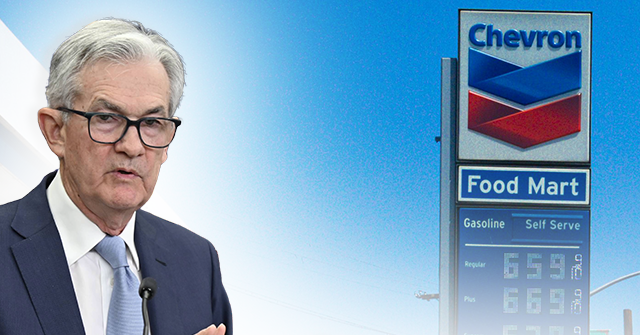
Jerome Powell Says Higher Oil Prices Won’t Lead to a Fed Hike
Jerome Powell did some good today.
The Breitbart Business Digest levels a lot of criticism at the soon-to-be-former Federal Reserve chairman. There’s no need to rehearse our criticism of his leadership now. Instead, the chair’s remarks to students at Harvard University on Monday give us an opportunity to praise the chairman.
The most important thing Powell said Monday is that the Fed is inclined to look past the energy shock stemming from the war in Iran. He argued that energy disruptions tend to be short-lived and that monetary policy’s famously long and variable lags make it a poor fit for addressing the economic dislocations.
“By the time the effects of a tightening in monetary policy take effect, the oil price shock is probably long gone, and you’re weighing on the economy at a time when it’s not appropriate. So the tendency is to look through any kind of a supply shock,” Powell said.
Powell was taking aim at what was a growing conviction in the bond market that the Fed was likely to raise rates in response to energy prices moving headline inflation up. The CME Group’s Fedwatch tool, which uses derivatives to assess the implied odds of changes in Fed policy rates, was giving better than one-in-five odds on Friday that the Fed would hike by the end of year, with a weight of the market forecasting a hike in September.
The trouble with this view is that higher energy prices are a drag on the economy, at least in the short-and-medium term. The money households use to fill their cars and trucks is money that is not spent into the rest of the economy. Demand moves away from non-energy goods and services and into the energy sector. While this is no longer a pure tax on the U.S. economy because we are now such a large energy producer, the diversion of demand threatens to slow growth. The recycling of dollars back into the non-energy sectors occurs but only with delays.
A big question for markets last week was how well the Fed understands this. If the Fed were to view higher energy prices as something likely to be passed-through by other businesses to consumers, it might take an inappropriately hawkish stance in reaction to rising oil and gas prices. That’s a mistake we have argued the Fed is unlikely to make because the central bank understands that absent monetary stimulus, a general and sustained rise in inflation is impossible. Higher prices at the fuel pump will tend to mean less pricing power by merchants in other parts of the economy.
Similarly, the decline in equity prices that tends to accompany rising energy prices results in tighter financial conditions, which is itself a contractionary and deflationary force. So the closure of the Strait of Hormuz not only directly puts downward pressure on growth and prices outside of the energy sector—it also acts as an indirect drag through the stock market.
Powell’s remarks helped pull the market back from the oil-tightening panic of last week. On Monday, shortly after Powell’s talk, the implied odds of a rate hike this year fell below five percent. The odds of a rate cut, which had fallen to three percent on Friday, were close to 15 percent.
Powell did not go full dove, of course. He was clear that the Fed remains in thrall to the theory of inflation expectations and worries that a rise in energy prices could lead to a self-fulfilling expectation of higher inflation. But he also noted that this hasn’t happened so far. Inflation expectations remain “well-anchored.” Indeed, in the latest University of Michigan consumer sentiment survey, the five-year expectation for inflation ticked down.
Powell’s Rebuke to Monetary Policy Progressives
Powell’s restraint was visible not only in monetary policy but also in his account of what the Fed should not try to do through supervision. The chair, whose term ends May 15, also insisted that it is important for Fed officials to “stick to your knitting”—meaning monetary policy and its effects on prices and employment. This is a quiet rebuke to those who have been arguing for years that the Fed should attempt to address climate change under the guise of monitoring “transition risk” or pressure lenders and the businesses that borrow from them to pursue DEI policies to avoid “reputational risk.” Powell pointed out that this smuggling of non-monetary policy into Fed policy would undermine Fed independence and effectiveness.
Powell also indicated that he understood that the Fed’s supervisory and regulatory functions should be somewhat responsive to policy coming out of the White House. While monetary policy is rooted in the Congress’s constitutional authority over the creation of money, the Fed’s supervision of banks is essentially an executive function. Congress recognized this when it created the role of Vice Chair for Supervision and gave the president the authority to remove anyone holding that office. When it comes to supervision, Powell said the role of the chair was to be one vote on the seven-member Fed board while the president’s vice chair takes the lead.
Powell’s chairmanship will end in six weeks, and the Breitbart Business Digest will not pretend that we’ll miss it. But credit where it is due: Monday’s performance was a reminder that Powell is at his best when he resists the temptation to do too much. By signaling that the Fed will not compound an energy shock with a monetary shock, he likely spared the economy a bout of unnecessary pain. And by insisting that the Fed confine itself to its actual mandate, he offered his successor a cleaner house than many expected. If this is the beginning of Powell’s farewell tour, he’s chosen a good opening number.
Read the full article here


