






Xi Jinping Is Counting China’s Chips
Chinese regulators’ guidance to banks on limiting U.S. Treasury exposure takes on new meaning when read alongside Beijing’s recent resistance to American semiconductor sales. Together, the two stories sketch the outlines of an emerging Chinese strategy: systematic reduction of exposure to American financial and technological dependencies, even when doing so requires accepting near-term costs.
Bloomberg reported Monday that Chinese regulators have been verbally instructing major banks to limit their holdings of U.S. Treasuries, citing concentration risk and market volatility. The guidance came before last week’s call between President Trump and Chinese President Xi Jinping and was framed as prudent risk management rather than a geopolitical move.
But read alongside recent developments in semiconductors, a clearer pattern emerges.
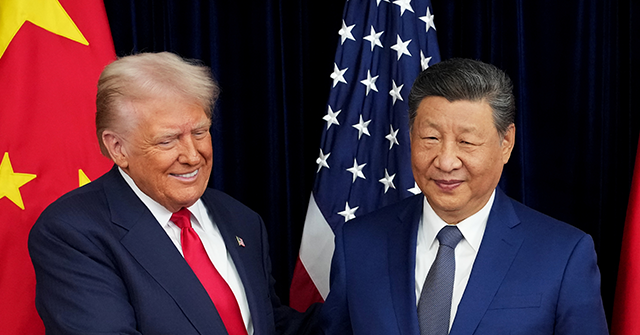
U.S. President Donald Trump greets Chinese President Xi Jinping ahead of a bilateral meeting on October 30, 2025, in Busan, South Korea. (Andrew Harnik/Getty Images)
Xi Seeks a China Bunker
Xi Jinping has decided that self-reliance in advanced chips and artificial intelligence is worth sacrificing immediate competitive advantage. When the Trump administration reversed export controls and authorized Nvidia to sell its H20 and H200 chips to China—with Commerce Secretary Howard Lutnick saying the goal was to get Chinese developers “addicted to the American technology stack”—Chinese regulators pushed back hard. They ordered tech companies not to acquire the chips, citing “serious security issues,” and issued guidance that firms should avoid purchasing Nvidia chips and instead double down on domestic alternatives.
This response came despite the fact that Chinese AI firms desperately want access to advanced American semiconductors. Nvidia’s H200 is six times more powerful than the H20. Chinese-made chips perform less well and cannot be produced at comparable scale. DeepSeek’s CEO complained that the “embargo on high-end chips” was limiting his firm’s success, and Chinese Premier Li Qiang admitted that “insufficient supply of computing power and chips” was a bottleneck for the country’s AI sector.
Yet Xi is willing to force Chinese tech firms to use inferior domestic chips rather than risk dependency on American technology that could be cut off at Washington’s whim. Earlier in 2025, he instructed China’s Politburo to “concentrate resources to overcome challenges in core technologies such as high-end chips” and to ensure that China’s AI system was “independent” of undue reliance on foreign suppliers. Beijing subsequently banned foreign chips from new state-funded data centers and pressured DeepSeek to use Huawei rather than Nvidia chips, causing delays in the company’s second model release.
Long Memories of Foreign Dependence
Chinese leaders have a long memory about the dangers of strategic dependency. In 1960, Khrushchev abruptly withdrew all Soviet technical advisors and aid during the Sino-Soviet split, leaving major industrial projects incomplete and forcing China into painful self-reliance. The lesson burned into Communist Party doctrine: never depend on a geopolitical rival for critical inputs.
That experience echoes an even older Chinese anxiety. The Song Dynasty (960-1279) lost control of northern pasture lands and became dependent on importing horses from the Khitan Liao and Jurchen Jin—often enemies—for the cavalry the dynasty desperately needed for defense. Despite enormous payments in silver and silk and attempts at domestic breeding programs, the Song never achieved self-sufficiency. The strategic vulnerability contributed to their eventual conquest by the Mongols.
Advanced semiconductors are the modern equivalent of Song horses or Soviet technical assistance: a critical strategic input China cannot yet produce at scale, that it must buy from a rival, and that leaves it vulnerable if supply gets cut off.
The Treasury guidance shows the same strategic logic. Chinese banks presumably would value the liquidity and safety of large U.S. government bond holdings. But Beijing is willing to override these commercial preferences to reduce strategic exposure to American financial assets, particularly after both the Trump and Biden administrations demonstrated a willingness to weaponize our control of global dollars to achieve our foreign policy aims.
What’s notable in both cases is the discipline Beijing is demonstrating. In semiconductors, Chinese companies are being forced to turn down technology they badly want. In Treasuries, banks are being told to limit holdings of what has traditionally been the world’s safest, most liquid asset. These aren’t easy calls driven by immediate crisis—they’re strategic decisions to accept costs now to avoid vulnerabilities later.
Maneuvering at a Quiet Time in a Dark Forest
The timing matters too. The Treasury guidance preceded Trump’s conciliatory call with Xi. The semiconductor self-reliance push has been underway since well before Trump’s return to office. These moves are happening during what amounts to a trade truce between Washington and Beijing. China isn’t waiting for tensions to flare. It’s using the calm to methodically reduce points of American leverage, like moving soldiers through a dark forest while keeping an eye on far-off campfires.
China’s overall Treasury holdings have declined steadily over the past decade, dropping to $683 billion in November from a peak in 2013, though some analysts believe the actual decline may be smaller if holdings have migrated to European custodian accounts. Belgium’s Treasury holdings have quadrupled since 2017 to $481 billion, and analysts believe Chinese custodial accounts contribute to that figure.
Both the Treasury guidance and the semiconductor restrictions suggest Beijing has concluded that the era of economic interdependence that enabled China’s rise is over. Rather than assume tensions with the United States will ease, Chinese leaders appear to be planning for a future where any dependency on America represents a critical vulnerability—whether in finance or technology.
Xi’s approach reflects what Harvard sociologist Ya-Wen Lei calls China’s “techno-development” regime, a model where advanced technology is seen as fundamental to the country’s development and security. As Lei writes in her recent book The Gilded Cage, Chinese leaders see technology as the country’s lifeblood. Relying on a hostile United States to sustain areas so fundamental to China’s development makes no strategic sense from this perspective.
Xi is betting that China can build domestic alternatives to American semiconductors and reduce its dollar exposure before either becomes a crisis. He’s willing to accept years of slower AI development and less optimal financial holdings to get there. China is reportedly considering as much as $70 billion in additional support for its chip industry.
While American pundits remain focused on Trump’s tariffs as disrupting the status quo global economic order, China is already moving beyond the fight over barriers to the next stage: building national technological independence.
Read the full article here


