


The Price of Peace May Be a Persian Gulf Oil Toll
Welcome back to Friday! This is our toll-free selection of news items from the past seven days that we thought deserved more attention.
This week, the war almost escalated into the destruction of an ancient civilization; but instead it turned into an argument about toll collection. Progress and peace!
War Is Over if You Want It
The U.S. and Iran agreed to a ceasefire this week. It was almost immediately declared a failure by the legacy media and the Democrats. What’s more, many declared that Iran had somehow won the war even though its senior political and military leadership have been shuffled off into the great beyond, its navy lies at the bottom of the Persian Gulf, its nuclear and drone capacity has been destroyed, and its ability to project force beyond its borders had been degraded significantly.
Chris Murphy, the Democrat Senator from Connecticut, declared on X that the Iran campaign was a failure because an Islamist regime still runs the place. This is the kind of demented maximalist definition of victory that would result in the U.S. fighting a Forever War until we finally limped home in defeat. It was never the goal of Operation Epic Fury to unseat the Islamic militants in Iran. The point was to make them less dangerous to everyone else, especially America.
It’s hard to escape the impression that many of Trump’s critics are hoping the ceasefire fails because it undermines their narrative that we were somehow in an inescapable quagmire that was tearing apart the forces of the Make America Great Again right and bringing ruination to the U.S. economy. It’s super annoying to the TDS crowd that the U.S. military may have actually completed the mission in the six-week time frame President Trump set out when this thing started.
We expect the ceasefire will lead to a more persistent peace because neither the U.S. nor Iran has much of an upside in prolonging the fighting. There’s not really that many militarily significant targets left to bomb in Iran, and Iran would very much like to stop being bombed. They are not gaining anything by bombing their Persian Gulf neighbors, either. So, why keep it up when an end to the war is within their grasp?
The Hormuz Strait Toll
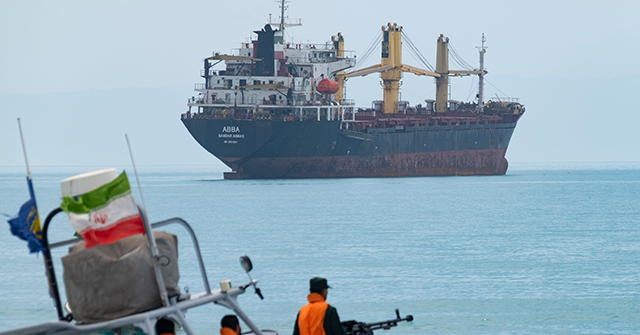
President Trump on Thursday warned Iran that it should not charge a toll for ships passing through the Strait of Hormuz, which seemed to contradict what he said to ABC’s Jonathan Karl earlier in the week. Maybe he was only joking when he said he was thinking of making the toll a “joint venture” with Iran and called it a “beautiful thing.” That might not seem like something you would joke about, but would you stand next to the Easter Bunny while making a speech about the war?
President Donald Trump speaks next to the Easter Bunny on the balcony of the White House during the Easter Egg Roll on April 6, 2026, in Washington, DC. (Andrew Harnik/Getty Images)
Iran has long had the ability to close the Strait of Hormuz. It held off for two reasons. First, because it viewed the option value of the threat to close the strait as a valuable deterrent against military strikes against it. Last month, it learned it had overestimated the deterrent value. Why was the closure threat less valuable than it thought? In part because the U.S. might not have found the threat credible. But also because the U.S. and the entire world is far less dependent on Persian Gulf oil than it was, largely thanks to the expansion of U.S. production.
The second reason it held off is that it likely overestimated the willingness of European nations to challenge its control of the strait. What it learned—and what the U.S. learned—is that Europe is unwilling to use kinetic force to defend its access to Persian Gulf oil or the principle of open navigation in international waterways. It turns out that the international law of the seas really does mean letters and memos.
So, what happens now? Europe and the Persian Gulf nations are declaring Iran’s tolls a violation of international law and completely unacceptable. The latest word from President Trump is that Iran had “better not” charge tolls. But Iran has shown it can close the strait altogether, and no one has the combination of will and ability to stop them. “This shall not stand!” they boldly declare—which sounds a lot like “I stand with Ukraine” but without the promise of gun-money and tactical support. Talking about standing isn’t the same thing as actually taking a stand.
“This cannot stand. The Iranian regime must not be allowed to turn the seven other states that border the Persian Gulf, most of them good friends of the United States, into its vassals. Nor should the rest of the world submit to Iran’s extortions,” Niall Ferguson, Richard Haass, and Philip Zelikow declared this week in the pages of the Free Press.
Tolls for Me But Not for Thee
Despite the protests, there is a lot of precedent for a toll in the strait. Egypt charges a toll for passage through the Suez Canal. The Panama Canal is tolled. The fact that those are canals rather than natural straits is an interesting distinction but not one that explains why those tolls would be acceptable but a Hormuz toll would not. If it ever made sense to distinguish between them on the grounds that we want to compensate the builders of canals for the expense of construction, that justification would not seem to apply a century later. What’s more, neither canal is still controlled by those who built it. What’s more, the Montreux Convention permits Turkey to collect fees for ships passing through Black Sea straits.
The international law of the seas is not something carved in stone tablets by Poseidon. It’s the result of pragmatic compromises by the world’s major naval powers, an agreement about what they think is fair game and what is not. It carries with it an implicit threat: if you violate these rules, you will be punished. This is a very old tradition. The U.S. didn’t secure its freedom in the Mediterranean by declaring Barbary piratism would not stand. It did by actually sending the marines to fight in Tripoli. Similarly, the British didn’t free the Persian Gulf from the control of the Qawasim confederation by writing letter of protests. They sent the British navy to fight. In any case, as circumstances change, the law of the seas changes. The tides of history, if you will.
We think there’s likely to be some kind of toll in the strait. And so do Ferguson and company. It will not be called a toll, of course. It will be something like a Persian Gulf Security and Navigation fee. Here’s how the Free Press describes the outcome:
President Donald Trump has said he is open to some kind of “joint venture” to manage the strait. Here is how it could work. Under a new convention, the Strait of Hormuz would be declared a permanently neutral waterway for all commercial traffic under the control of a new Strait of Hormuz Company (SOHCO). The signatories of the convention would be the eight coastal states, including Iran, and at least five outside maritime powers: the United States, China, India, Japan, and South Korea, reflecting the key naval role of the U.S. in the region and the heavy reliance of the Asian economies on trade through the strait. The UK and European Union may also wish to sign.
The company could assume obligations for assuring safe passage and shouldering relevant costs. The principal shareholders in the company should be the eight coastal states, including Iran, plus the United States. The shareholders can work out their voting rights on the principle of majority rule.
The company could administer a regulated fee system for passage through the Strait of Hormuz.
So, yeah. There’s probably going to be a toll.
When We Were Pirates
Around 250 years ago, the Continental Congress decided to enter the piracy business.
After Parliament passed the Prohibitory Act—basically a breakup letter backed by the world’s most powerful navy—Congress hit back on March 23, 1776, by authorizing privateering. The deal was simple. You bring the boat, we’ll give you a permission slip called a “letter of marque,” and you get to keep roughly half of whatever British ships you drag into port. The other half goes to the crew, which is a generous split for what amounted to legalized plunder with a patriotic excuse.
It worked spectacularly. When two of the first authorized privateers sailed back to Philadelphia in June 1776 with four captured British vessels, the owners pocketed the equivalent of about a million dollars. “Thousands of schemes for privateering are afloat in American imaginations,” John Adams wrote. He wasn’t exaggerating. Over the course of the war, Americans launched more than a thousand privateers and captured an estimated 1,500 British vessels.
Critics complained that privateering poached sailors from the Continental Navy, which was a bit rich given that the broke Continental Congress could barely keep a few dozen ships afloat. The privateers didn’t drain American sea power. They were American sea power.
George Washington understood the formula. He refused a salary himself but knew better than to expect everyone else to fight for glory alone. “A great and lasting war can never be supported on this principle alone,” he wrote. “It must be aided by a prospect of interest or some reward.”
Read the full article here