








The Weekly Wrap: Europe Can Eat Our Dust
Welcome back to Friday! This is the Breitbart Business Digest weekly wrap, where we take some time to dwell on the economic and financial news from the most recent seven days and then throw in a bit of history at the end. You know the deal.
Let’s go.
America’s Economy Is Lapping Europe’s
Remember when they told us that Trump’s immigration policies and tariffs would hurt U.S. growth? Well, that’s not quite how things are working out. The International Monetary Fund, which everyone refuses to call EH-MM-FF no matter how much we try to make that happen, released its updated projections for economic growth around the world. Our friends over in Europe are expected to grow by just 0.9 percent this year and 1.2 percent next year. France is seen as clocking in just 0.6 percent growth this year and 0.9 percent next year. Germany’s growth gets a 0.7 percent 2026 forecast and a 1.0 percent 2027 forecast.
The United States? The IMF says we’ll likely grow 2.3 percent this year and 2.2 percent next year. In other words, we’re lapping the Europeans. All their talk about international rules-based blah blah blah and openness to yadda-yadda-yadda puts them behind Trumpian Make America Great Again economics. Why? One reason is our energy production. While higher energy prices are basically a net drain on Europe’s economy, they tend to boost the U.S. economy over time because we are major energy exporters. Another reason is our leadership in technology investment, especially artificial intelligence.
President Donald Trump leaves after holding a press conference during the 2026 NATO Leaders Summit on July 08, 2026, in Ankara, Turkey. (Win McNamee/Getty Images)
Sluggish growth is a policy choice. Or, rather, the result of weird policy choices. Europe could produce vastly more energy than it does, but it prefers climate change pieties and imported energy (although natural gas extracted from the middle of America emits just as much carbon as gas extracted from Europe would). The AI thing is even weirder. The U.S. economy is expected to outperform because it is “closely integrated into the global technology value chain.” Europe lags because its dominant regulatory and cultural regimes resist innovation. And, also, because domestic energy production makes it easier to excel at technology and more resilient to supply shocks.
Costco Millionaires, FTW
Growth, of course, is not everything. We want shared prosperity and decent standards of living for all working Americans. The anti-capitalists and the Europeans—sorry for the redundancy—like to depict the U.S. as a social darwinist hellhole where people struggle to earn a living wage, cannot afford health care, and live in constant fear of layoffs. But they couldn’t be more wrong.
The Wall Street Journal this week told us the story of Tony Barzar, a 60-year old cashier at Costco with over $1 million in retirement savings. He earns $32.90 an hour. “In 2009, Barzar’s family bought a three-bedroom, two-bath house with a pool, and they have been able to travel to Europe twice over the past decade,” the Journal reports.
And Barzar is not alone. According to Costco, there are “many thousands” of Costco millionaire employees.
The health care plan is really good, too. A regular visit co-pay runs Barzar $15 and a specialty visit co-pay is $25. Meanwhile, over in the U.K., people are resorting to performing their own dentistry—including tooth extractions—because the waiting list for “free healthcare” is too long. Not the wealthy, of course. They pay for private care in the U.K. and across Europe because that’s how things work in socialist and social-adjacent countries.


Zombie Anti-Americanism
Hilariously, the day after the IMF forecasts were released and the Wall Street Journal published its piece on Costco millionaires, a guest essay by Stephen Marche appeared on the opinion pages of the New York Times declaring the “zombification of America” and celebrating a “post-American reality” where Trump’s policies have allegedly backfired. It claims that countries like Canada and Europe are now “optimistic” and “active,” successfully diversifying trade, boosting intra-European defense spending, and disentangling from U.S. tech/military influence.
Marche is a Canadian, and so we’ll try to be forgiving. It’s only natural to root for your home team, and Canada, under the leadership of Mark Carney, has lately taken the lead in western anti-Americanism. And he’s a novelist and podcaster who holds a PhD in early modern English drama from the University of Toronto, so it’s not really fair to expect reality-based dispatches from him. But if the Times is going to start running creative fiction on the opinion pages, it should label this stuff better.
Canada’s growth rate is projected to come in at 1.1 percent this year and 1.7 percent next year. We won’t quite call its economy a “lumbering zombie,” but it is among the limping wounded. Marche thinks he is making a case for a future free from a U.S. “strangle hold” over the world. In reality, he’s just whining that the old order in which the U.S. absorbed the external costs of the mercantilist policies of Canada, Europe, and China has come to an end.
El-Erian See the Future Clearly
Mohamed El-Erian’s recent guest essay for the New York Times (they stopped calling them op-eds a few years ago, for no good reason at all) provides an excellent counterpoint. In his essay titled “America Was Being Played. The Bessent Doctrine Says Those Days Are Over,” the Wharton professor, Allianz chief economic adviser, and Gramercy Funds chair delivers one of the most insightful analyses yet from a mainstream perspective of the Trump administration’s emerging economic worldview. He correctly understands that this represents a lasting shift rather than a temporary disruption.
And, contra Marche, understanding this is the key to understanding the future.
El-Erian, who has been a guest on Kudlow with us, rightly spotlights Treasury Secretary Scott Bessent’s June 23, 2026, speech at the Economic Club of New York as a pivotal, historic moment. What many on Wall Street had dismissed as ad hoc or reversible tariffs and sanctions—remember that TACO nonsense—is actually a coherent doctrine: a deliberate pivot from a world in which the U.S. asked little of its allies in exchange for access to U.S. markets and consumers to a robust economic statecraft. National security, reciprocity, domestic welfare, technological leadership, and leverage of the dollar system are no longer secondary considerations — they are the new operating principles.

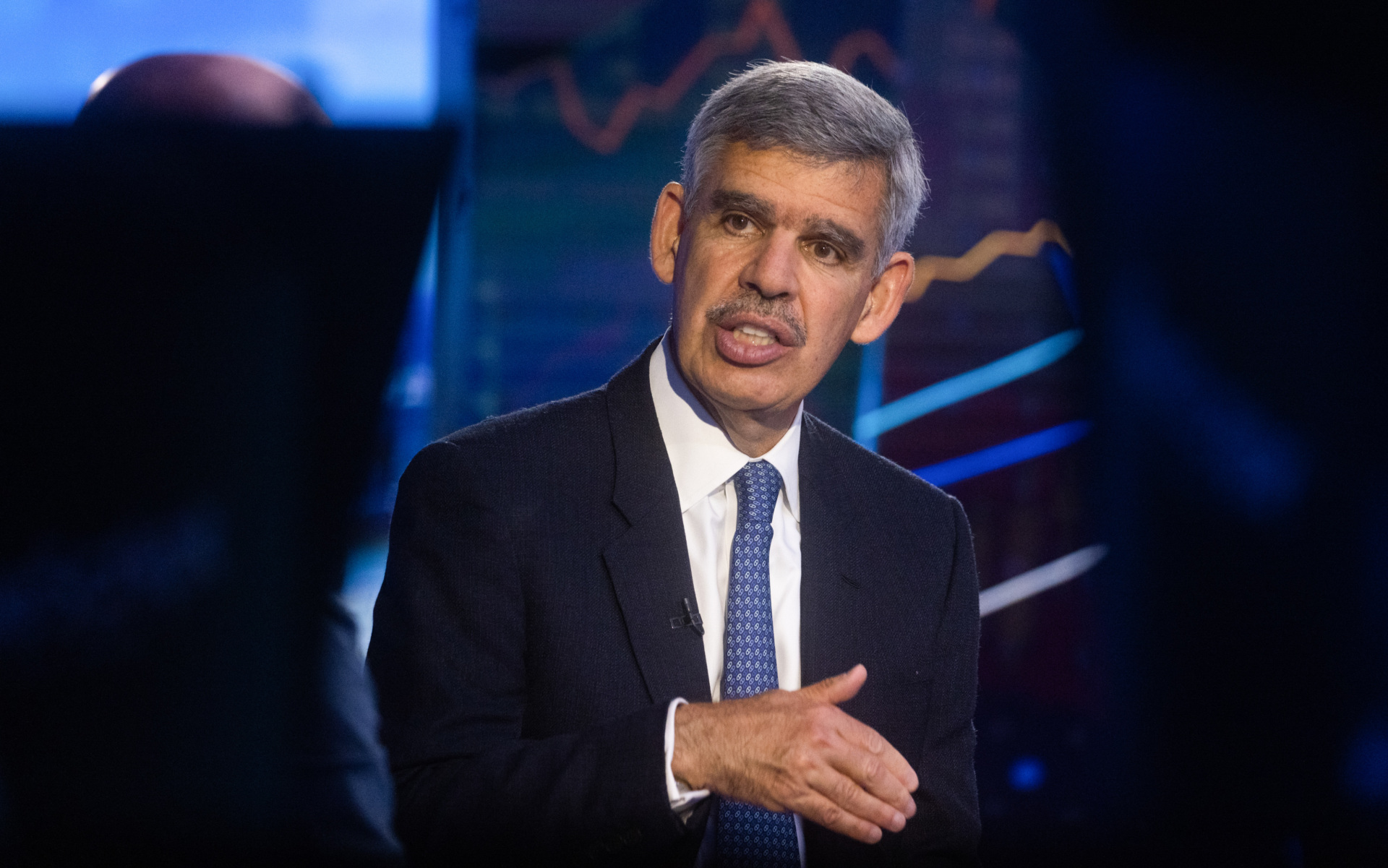
Mohamed Aly El-Erian, chief economic advisor for Allianz SE, during a Bloomberg Television interview in London on September 25, 2023. (Chris Ratcliffe/Bloomberg via Getty Images)
El-Erian’s diagnosis is spot-on and reflects arguments we’ve been making for years. As we’ve said countless times, the U.S. allowed itself to be exploited for decades in an asymmetrical trading system that prioritized cheap imports and just-in-time supply chains over resilience and fairness. We had good reason to do this in the aftermath of World War II and while struggling against communism. After that, however, the system became, well, a “lumbering zombie.” COVID, Russia’s war in Ukraine, and the Iran conflict exposed those vulnerabilities. The five core principles Bessent set forth in his speech— economic capacity as security, strict reciprocity in trade and investment, U.S. standard-setting in new technologies, active protection of dollar dominance, and tangible benefits for American households — provide a compelling framework for what comes next.
“The transition from an era driven by economic efficiency to one defined by geoeconomics and economic statecraft is no longer theoretical. It is the new operating system for the global economy and its markets. Those who fail to change risk being caught off guard by sudden policy shifts, punitive tariffs and systemic fragmentation. For leaders across all sectors, recognizing this reality and adapting to it will become a defining competitive advantage,” El-Erian writes.
Unfortunately, we have to dock El-Erian’s final grade on the essay for a couple of misfires. First, it’s not so much the Bessent doctrine as the Trump doctrine as translated by Bessent. Second, geoeconomics and economic statecraft were at work all along. That’s not new. What is new is that the U.S. no longer is willing to play the economic patsy because doing so no longer serves our national interest. The old system never was all that efficient because it was warped by the geoeconomics of Berlin, Beijing, and Brussels. Efficiency was the talking point while self-interest was the reality.
Is Mamdani an Undercover ICE Asset?
Zohran Mamdani’s administration put out a map of “immigrant enclaves” in New York City. It included a bunch of enclaves no one has every heard of—Little Guyana—while ignoring the historical enclaves such as Little Italy. Not surprisingly, this attracted backlash from New York’s Italian-American community, with accusations that Mamdani was trying to erase New York’s history.
Some folks defended the map on the grounds that Little Italy is not really an immigrant neighborhood these days. Many of New York’s Italians have moved out of the “old neighborhood” for other boroughs and the suburbs. Even the Italians who remain are descended through several generations. And many of the traditional Irish, German, and Jewish immigrant neighborhoods are no longer dominated by newcomers from those places.
The trouble with interpretation is that Mamdani’s map included “Little Ukraine” in the East Village, which is also now more of a historical immigration enclave than a real live one. Recent immigrants from Ukraine are more likely to end up in Brighton Beach than Manhattan’s Second Avenue. It seems more like Mamdani included neighborhoods for the immigrant groups he approves of. And, yes, it’s incredibly odd that Ukrainians are beloved on the American left out of a kind of displaced hatred for Donald Trump. It seems to work like this: they are still convinced Trump is a Russian stooge, Putin’s Russia invaded Ukraine, the Ukrainians are fighting the Russians, so siding with the Ukrainians is like fighting Trump.
But it occurs to us that Mamdani’s map is also a pretty accurate guide to the “enclaves” of illegal immigrants in New York. It would make an excellent field guide for ICE agents looking to round-up migrants for deportation. Maybe Mamdani is secretly working with Trump! Okay, probably not. Some reporting says the map actually originated during Eric Adams mayoralty and was only reposted by Mamdani—so maybe Adams was the undercover ICE agent.


A stand selling Mayor Zohran Mamdani merchandise is seen on January 23, 2026, in New York City. (Michael M. Santiago/Getty Images)
The Long View: Andrew Jackson Kills the National Bank
On July 10, 1832, President Andrew Jackson vetoed a bill to renew the charter of the Second Bank of the United States. The Bank, chartered in 1816 for a 20-year term, still had four years to run. Its allies in Congress—led by Senators Henry Clay and Daniel Webster—had pushed the recharter through early, in the middle of a presidential election year, calculating that Jackson would either sign a bill he detested or hand Clay a campaign weapon by rejecting it. The bill cleared the Senate 28 to 20 and the House 107 to 85.
Jackson said no to the bill. His veto message argued that the Bank was an unconstitutional concentration of financial power, a government-sanctioned monopoly that enriched a small class of shareholders—many of them foreign—at the expense of ordinary Americans. He famously wrote that when the laws undertake to make the rich richer and the potent more powerful, “the humble members of society” have a right to complain of the injustice of their government. It didn’t much matter to him that the Supreme Court had purported to settle the constitutional question in 1819’s McCulloch v. Maryland. Jackson pointed out that he was sworn to uphold the constitution and not just the judiciary branch’s view of it.
The Senate tried and failed to override the veto. The Bank became the central issue of the 1832 campaign, and Jackson won reelection decisively over Clay. The Second Bank’s federal charter lapsed in 1836, one of the greatest victories of American populism and a reform that set America’s economy on its unprecedented rise to global preeminence.
Read the full article here


