

The Weekly Wrap: What Are They Smoking?
Welcome Back to Friday!
This is the Breitbart Business Digest weekly wrap, where we run through the important news and analysis from the seven day period that is about to perish. This week saw consumers telling pollsters the economy is awful even while they continued to shop without dropping, Kevin Warsh sent his critics into a frenzy by refusing to say more, and too many people smoked weed. And we celebrate the anniversary of America’s first patent—and note how the inventor who received it lost it all in the bursting of our first financial bubble.
Let’s go.
Consumer Sentiment vs. Consumer Spending
Is it the best of times or the worst of times? If you believe the University of Michigan’s consumer sentiment survey, we’re close to the worst of times. Recently, the survey’s famed index hit an all-time low. After a sharp recovery in July—thanks to lower gasoline prices—sentiment is still historically low.
But if you are tracking actual consumer spending, these appear to be good times for consumers. Personal consumption expenditures rose at a 3.2 percent pace in the second quarter, much faster than the 0.5 percent pace of the first quarter or the 2.5 percent pace of the year-earlier period. Despite higher gasoline prices throughout most of the quarter, consumers continued to spend on big ticket items—durable goods purchases were up at a 6.8 percent pace—and discretionary categories like restaurants, hotels, and vacation travel.
That’s not normal. When consumer sentiment sinks low enough, consumer spending typically follows. People pull in the purse-strings when the economy appears to be bad. But this time we’re seeing the opposite: consumer sentiment falling to record lows while spending growth accelerates.
What’s going on? The best explanation is that the survey is broken. Survey responses are increasingly partisan. Democrats hate and fear Donald Trump and as long as he is in the White House they’ll insist everything is terrible. The survey over-samples Democrats, making this problem even worse. And it has moved entirely online. For whatever reason, people are more negative online then they are in person or on the phone.
The Country Is Going to Pot
This week the Substance Abuse and Mental Health Services Administration released the results from its latest National Survey on Drug Use and Health. These showed that around 21.4 million Americans used marijuana daily or near-daily last year. Compare that to the 19.9 million Americans who smoked daily and the 17.2 million who drank alcohol at least 20 days a month.
Can a country built on whiskey, beer, and tobacco thrive when it becomes a nation fueled by weed? Looks like we’re going to find out.
We Need to Talk About Kevin
On Wednesday, Kevin Warsh presided over his second press conference as Fed chairman. It was very clear from the questions coming from the press that many Fed reporters are not very happy with Warsh’s new “talk less” and give no forward guidance policy. Even Bill Dudley, once the president of the New York Fed and now a Bloomberg pundit, cried foul.
The case against Warsh goes like this. While it may be fine to stop giving formal forward guidance, the Fed chairman should at least let markets know more about the Fed’s “reaction function” so that markets can correctly price in future Fed moves as new data arrives. The underlying theory here is that longer-term interest rates reflect the expected path of the Fed’s policy rate, and anything that obscures the market’s vision of that path is very bad.
But is this theory right? What if the Fed promised never to move the fed funds rate at all? Would the bond market fall into a stasis, with yields never changing? Of course not. The bond market would continue to price in expected inflation, the perceived risks to that forecast, the opportunity costs of longer-term bonds, the relative benefits of a safe financial asset, and changes in the supply of bonds of various durations. When inflation is forecast to move higher, bond yields would move higher to compensate investors. Those higher yields would create a drag on the economy, possibly holding down inflation. In other words, the bond market can efficiently price economic developments without keeping both eyes on the Fed.
None of this makes the Fed redundant. The bond market will respond to changing economic conditions, but it cannot guarantee that its response will be sufficient to preserve price stability and maximum employment. If bond yields merely rise in line with expected inflation, for example, real borrowing costs have not increased at all. The Fed still controls overnight interest rates and remains responsible for ensuring that monetary conditions are tight or loose enough to keep inflation anchored. The narrower point is that the Fed can perform that function without narrating its future decisions to Wall Street in advance.
Happy Potash Patent Day
We’re awash in anniversaries of historic events today and over the coming week. Too many to detail, really. The signing of the Declaration of Independence in 1776. Abraham Lincoln signing America’s first income tax into law in 1861. The birth of Milton Friedman in Brooklyn in 1912. The death of Warren G. Harding in 1923, propelling Calvin Coolidge into the presidency. The atomic bombing of Hiroshima in 1945. Paul Volcker becoming Fed chair in 1979. The launch of MTV in 1981 and the start of the air traffic controllers strike a couple of days later (we’re assured these were unrelated).
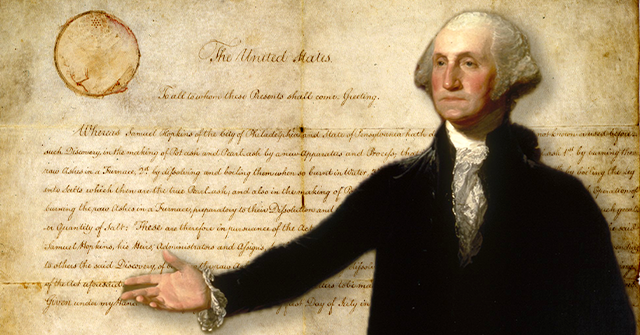
One too-little-noticed event took place on July 31 of 1790. That was the day the United States issued its first patent to a Maryland-born Philadelphia Quaker named Samuel Hopkins for a process of making potash and pearl ash, important commodities used in fertilizer, soap, textiles, glass, and baking. The patent was signed by George Washington, Thomas Jefferson, and Attorney General Edmund Randolph.
A copy of Samuel Hopkins’s patent signed by President George Washington, Attorney General Edmund Randolph, and Secretary of State Thomas Jefferson (on the reverse side). (Wikimedia Commons)
Hopkins initially tried to commercialize his patented potash process by licensing it to manufacturers. But demand was limited because the furnace required was relatively elaborate, his licensing fee was high, and manufacturers could continue using the traditional, cheaper process without infringing on his patent. So Hopkins shifted to building potash works for large land speculators. They would clear vast tracts of frontier land, monetizing the felled trees by burning the timber and processing the ash for sale overseas. Hopkins invention became part of what was arguably America’s first financial bubble, which was built around land speculation.
When the bubble collapsed, some of Hopkins’ business partners ended up in debtors’ prisons and others fled creditors. The potash operations were abandoned. By about 1800, Hopkins was insolvent and censured by his fellow Quakers for financial irresponsibility. He lived out the rest of his days with two daughters in Philadelphia and died in 1818.
But that was not the end of the indignities suffered by Hopkins. Because the early patent records burned in 1836, later historians confused him with a different Samuel Hopkins from Vermont. For much of the 20th century, historical markers in Vermont and New York honored the wrong man. The true Hopkins was firmly identified only through archival research published in 1998.
Read the full article here
