




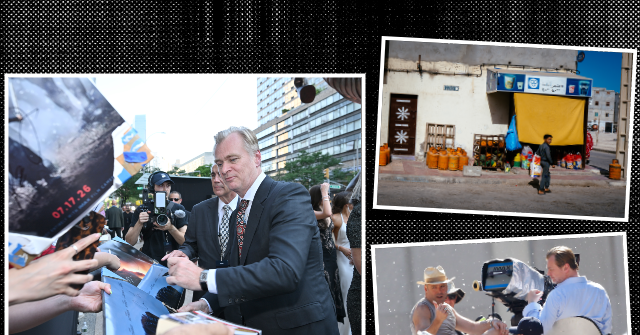
Activists for the indigenous people of Western Sahara are calling for a boycott of Christopher Nolan’s summer blockbuster The Odyssey over the director’s decision to film some scenes of the movie in Saharan territory now occupied by Morocco.
Nolan filmed a portion of his epic film in Dakhla, a city situated on a narrow peninsula of the Atlantic Coast, and sitting about 340 miles south of the area’s biggest city, Laayoune. The region has been militarily occupied by Morocco since the 1970s, but is also territory claimed by the indigenous Saharawi people. The two political rivals have been in a simmering dispute over the area for decades.
Now, Sahrawi journalist and filmmaker Mamine Hachimi, is calling for a boycott of the film as he advocates for his people in the face of what he calls Moroccan invaders and occupiers.
“This is not a campaign against cinema or artistic freedom – it is a call for ethical responsibility,” Hachimi told the media, according to MidEastEye.
Hachimi, whose films about the plight of the ethnic Saharawi people and how they are treated by Moroccan authorities have been blacklisted, says that his people face a lack of freedom and civil rights in Western Sahara. And he is outraged that Nolan would film in Moroccan-occupied territory and therby legitimizing Morocco’s control of the region.
“Two of my colleagues, Abdallah Lhafaouni, who is serving a life sentence, and Bachir Khadda, who is serving a 20-year sentence, are political prisoners simply because they documented human rights violations in occupied Western Sahara,” he explained.
“It is deeply disturbing that while Sahrawi journalists are imprisoned for exposing abuses, an international film production can use our homeland as a cinematic backdrop without addressing the reality of the occupation.”

Further, Sahrawi artist Mohamed Sleiman Labat, penned an op ed in The Guardian and slammed Nolan writing that “We the Sahrawi do not want our homeland to be the sanitized backdrop for western epics.” And he added that “Nolan’s choice to film in an occupied territory highlights the extractivist practices embedded in the western film industry.”
Western Sahara has been embroiled in unrest for decades.
After the country of Spain withdrew from the area, the Muslim country of Morocco forcefully took over the Western Saraha territory in 1975. Not long after, the region was partitioned between Morocco and the Saharawi people, who created the Saharawi Arab Democratic Republic to govern the remaining small percentage.
Morocco eventually erected a 2,700 km sand wall barricade system — called “The Berm” — secured by tens of thousands of land mines across the arid dessert region to separate its holdings from the Saharawi side. And Morocco keeps an extremely tight reign over its part of the region, even going so far as jailing Saharawi dissenters.
Others have also spoken out. Sahrawi filmmaker Mohamedsalem Werad told the media that he is “deeply disappointed” by Nolan’s decisions.
“Choosing to film in occupied Western Sahara was not a politically neutral production decision,” he said, “it meant operating with the permission of the occupying power in a territory where the indigenous Sahrawi people have long been denied the opportunity to exercise their right to self-determination.”
In another case, Sahrawi filmmaker, Abidin Mohamed Hamudi called Nolan “complicit” in the occupation of Western Sahara, and added, “Shame on them – history will put everyone in the place they deserve, and they will be in the dustbin of history, remembered as nothing but cultural parasites.”
Supporters of Western Sahara are not the only ethnic groups taking aim at Nolan’s epic film. Greeks have also risen up to blast the film for not having a single Greek actor in it despite being based on one of the most famous Greek tales of them all.
A Greek news site ripped the film for “excluding Greeks” from the famed story written nearly 3,000 years ago by Greek epic poet Homer.
“For years, Hollywood has lectured audiences about representation, inclusion, cultural sensitivity and the moral necessity of diversity in storytelling,” the Greek City Times wrote in May of Nolan’s film. “Studios, actors and filmmakers have repeatedly insisted that authenticity matters — that cultures should not merely be mined for content while the people connected to those cultures remain invisible.”
“Yet the upcoming adaptation of The Odyssey by Christopher Nolan appears to embody precisely that contradiction,” it continued, adding that there is “Not one prominent ethnic Greek actor. Not one Greek-American performer. Not even a symbolic acknowledgement of the culture from which the story originates.”
Follow Warner Todd Huston on Facebook at: Facebook.com/Warner.Todd.Huston, Truth Social @WarnerToddHuston, or at X/Twitter @WTHuston
Read the full article here


