



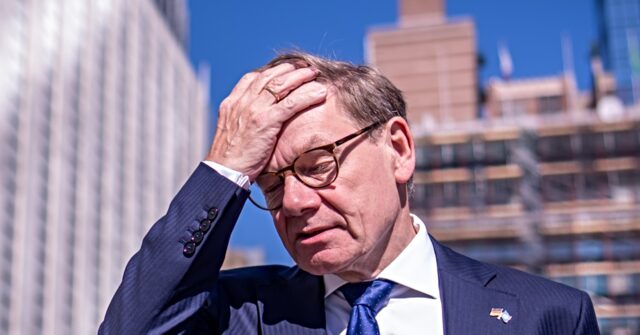
Germany, for the first time in its history, failed to secure a temporary seat in the U.N. Security Council on Wednesday in what Foreign Minister Johann Wadephul described as a “bitter defeat” for the European nation.
According to Wadephul, Russia “stirring up” sentiment against Germany led to Wednesday’s outcome at the United Nations.
The embattled government led by Chancellor Friedrich Merz suffered a new diplomatic setback during the U.N. Security Council’s election to renew five of the ten rotating non-permanent council seats. As per the rules of the Council, the ten temporary seats are chosen by secret ballot vote for staggered two-year terms. Germany had reportedly carried out an intense lobbying campaign for the election, hoping to secure a U.N. Security Council seat for the 2027-2028 period.
As the available seats are organized by geographical region, Germany competed against Portugal and Austria for one of the two seats of the Council’s Western European and Others Group up for vote this year. The U.S. and the U.K. occupy permanent Security Council seats alongside China, France, and Russia.
Despite Germany’s lobbying efforts, the country lost the secret ballot vote against Australia and Portugal — failing to secure a Security Council seat for the first time in its history ever since it joined it in 1973.
German Foreign Minister Johann Wadephul (CDU) attends the session of the United Nations General Assembly (UN), where he unsuccessfully promoted Germany’s candidacy for a non-permanent seat on the Security Council of the world organization at various meetings in and around the UN. ( Michael Kappeler/picture alliance via Getty Images)
Euronews reports that Germany only obtained 104 votes in Wednesday’s secret ballot election. Portugal, for its part, obtained 134 votes, while Austria received 131. Wednesday’s voting process at the U.N. also resulted in the election of Zimbabwe, Kyrgyzstan, and Trinidad and Tobago. The five elected nations will occupy seats at the Security Council starting on January 1, 2027 — replacing Pakistan, Somalia, Greece, Denmark, and Panama.
Speaking to reporters after the election, Foreign Minister Wadephul described the results as a “bitter defeat” and attributed the outcome at the Security Council to Germany’s support of Ukraine and Israel.
“There is our firm support for Ukraine, the fact that Russia does not want such a voice at the Security Council,” Wadephul said, per the BBC — adding it was “no secret” Russia, one of the five permanent U.N. Security Council members, had stirred up sentiment against Germany.
“We have always taken a clear stance on certain issues, and these are positions that not all member states share,” he stressed. “The fact that Germany must always assume a special responsibility for Israel in the Middle East conflict may also have cost votes.”
Moscow has not publicly commented on Wadephul’s remarks at press time.
The German Foreign Minister also attributed his country’s late entry into the Security Council race as contributing towards its defeat on Wednesday. Austria reportedly announced its bid in 2011, while Portugal did so two years later in 2013. Germany, on the other hand, made its announcement years later, in 2020.
Chancellor Merz congratulated Austria and Portugal through a two-part social media post in which he stated that Germany remains a reliable pillar of “multilateralism – with determination and responsibility.”
“The tasks facing us at the United Nations are not changed by this outcome. My thanks go to all those involved who have advanced our candidacy with great commitment and expertise,” Merz wrote.
According to Euronews, one of Wadephul’s main talking points in Germany’s now-failed campaign was the country’s role as one of the bigger financial contributors to the U.N. system. That specific point now appears to be the subject of questioning among German government officials.
Die Welt reports that Manfred Pentz, Minister of Federal, European and International Affairs, told the local newspaper Bild that if Germany does not have the influence at the U.N. “that we’re entitled to” then why should the country “continue to invest so much money in the U.N.”
Pentz reportedly argued that leaving Germany out of the Security Council meant that “one of the world’s largest economies will not be at the table when important decisions are made.” The Minister, much like Germany’s campaign did, pointed out that Germany is currently “one of the largest donors to the United Nations.”
Read the full article here