







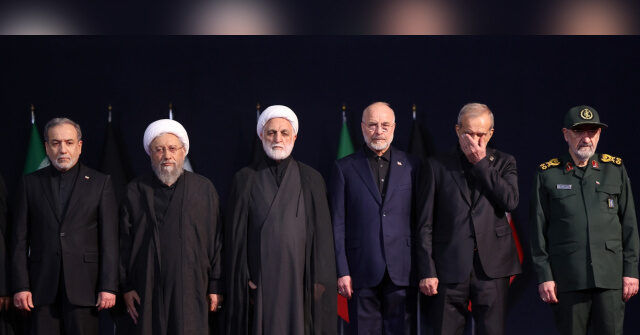
Treasury Secretary Scott Bessent declared Tuesday that Iran’s leadership is already “panicking” under President Donald Trump’s mounting economic offensive — pointing to stark warnings from Tehran’s own president and parliament speaker about the country’s deteriorating economy while vowing to continue severing the regime’s financial lifelines until it “stands alone.”
“Iran’s leadership is admitting what the world can now see: the pressure is working,” Bessent wrote on X, one day after the administration launched Operation Economic Outcast.
Bessent highlighted recent remarks made before Monday’s rollout from Iranian President Masoud Pezeshkian, who acknowledged the country’s mounting economic shortages while declaring that “the war must come to an end at some point.”
He also highlighted an even starker warning from Iranian Parliament Speaker and chief negotiator Mohammad Bagher Ghalibaf about whether Iran could sustain its military strength while its economy and living conditions continued to deteriorate.
“No matter how much military power we have, if people are hungry and we don’t have financial circulation, economic growth and domestic production, we will not endure,” Ghalibaf said.
Bessent pointed to the statements as evidence that Trump’s pressure campaign was already biting before Washington dramatically widened its economic offensive Monday with what officials have called an “Economic D-Day” designed to isolate Tehran and choke off the revenue streams sustaining the regime.
Operation Economic Outcast initially targeted more than 60 individuals, entities, and vessels tied to Iranian oil revenue, weapons and missile procurement, and cyber operations, while widening secondary-sanctions exposure across five sectors Tehran exploits abroad: digital assets, technology, gold, aviation, and shipping.
The administration has also put foreign governments, financial institutions, and businesses on notice that continued dealings with Tehran could see them cut off from the U.S. dollar-based financial system.
Bessent described the strategy Monday as the “economic asphyxiation” of the regime and said Washington would enforce a “zero-leakage approach” intended to leave Tehran with virtually no financial breathing room.
Trump reinforced that assessment Tuesday morning, asserting that the Islamic Republic is increasingly unable even to meet obligations to portions of its own armed forces.
“The failing Islamic Republic of Iran is not paying large segments of their military, while at the same time killing protesters, even when they are not protesting, at levels not seen before,” Trump wrote on Truth Social.
Calling the situation a “humanitarian crisis of epic proportions,” Trump demanded that it “must be stopped, NOW.”
The comments came amid mounting signs of strain inside Iran. The rial is trading at roughly 2 million to the U.S. dollar on the open market, while Iran’s prominent Donya-e-Eghtesad economic newspaper reported Monday that the currency had lost roughly 41 percent of its value since December. Long lines have also formed at gasoline stations in Tehran amid growing fuel constraints.
At the same time, Washington is moving to strip Tehran of another major source of leverage: its ability to disrupt commercial shipping and energy flows through the Strait of Hormuz.
Trump announced later Tuesday that the Navy had completed clearing mines from international waters in the strategic waterway — and warned that any Iranian vessel attempting to restore the threat would be destroyed.
“Iran has been notified that any ship or boat placing new mines will be immediately and systematically destroyed,” Trump warned.
Trump said Space Force was watching “every square inch of the Strait,” along with Pickaxe Mountain — the fortified underground nuclear complex near Natanz — and three other Iranian nuclear sites he says have already been destroyed.
“There is a Zero Tolerance policy on mine placement in full force and effect,” he declared.
Two U.S. officials with direct knowledge of the operation confirmed to Axios that the Navy had cleared the Traffic Separation Scheme (TSS), the central shipping lane between Iran and Oman that had remained heavily mined during the war.
U.S. Navy underwater drones spent months systematically scanning the area and located more than 100 objects suspected of being mines, after which private contractors were brought in to remove or detonate them, according to the report.
The development was separately confirmed by U.S. officials to Israeli media, with the Jerusalem Post reporting that CENTCOM had cleared both inbound and outbound shipping routes, opening an additional passage expected to increase maritime traffic through the chokepoint.
Washington had already been moving substantial maritime traffic through a southern channel closer to Oman, with more than 500 vessels passing through that route over the previous 30 days, according to U.S. officials. Clearing the central lane now allows protected vessels to move simultaneously in both directions, potentially expanding the volume of oil and commercial traffic moving through Hormuz.
That directly cuts into a pressure point Tehran has repeatedly sought to wield against Washington and the Gulf states.
In the run-up to Monday’s unveiling of Operation Economic Outcast, Iran’s Supreme National Security Council Secretary Mohsen Rezaei threatened any country that joined Washington’s economic offensive, warning that Tehran would regard such participation as an “act of war.”
“If the economic war continues, not a single drop of oil will be exported, neither through the Strait of Hormuz nor from anywhere in the Persian Gulf,” Rezaei declared Sunday.
The U.S. breakthrough comes as Iran and Oman pursue their own framework for restoring maritime traffic through the strait.
The two countries announced Tuesday that they had discussed a phased framework establishing a temporary joint navigation corridor and mine-clearing project, with technical negotiations continuing toward a permanent route and future arrangements for managing the strait.
Omani Foreign Minister Badr Albusaidi called his talks in Tehran with Iranian Foreign Minister Abbas Araghchi “constructive” and said he was hopeful that a temporary corridor and practical arrangements to restore safe navigation would soon be announced. Araghchi, meanwhile, pointed to the proposed corridor, joint mine-clearing and future management of Hormuz as a “case in point” of Iran’s “steadfast diplomacy with our neighbors.
The American mine-clearing operation, however, has already expanded the shipping routes available without a final agreement with Tehran, with U.S. officials reportedly viewing the combination of cleared mines and steadily increasing traffic through American-protected routes as a significant blow to Iran’s leverage over global energy markets and future negotiations over the strait.
The developments come as Pakistan continues trying to revive an indirect diplomatic track between Washington and Tehran. Army Chief Field Marshal Asim Munir met senior Iranian officials during a day-long visit to Tehran on Monday, with Islamabad subsequently saying the discussions produced “significant progress” toward preventing further escalation, reopening Hormuz, and ending the conflict.
Iranian officials said Munir carried a U.S. message aimed at reviving the stalled political process and that Tehran, in turn, provided its own conditions for returning to the June memorandum of understanding for Pakistan to relay to Washington.
A White House official stressed Tuesday, however, that there are currently “no talks or discussions” underway or scheduled directly with Iran and that the U.S. naval blockade remains firmly in force.
Tehran, meanwhile, has sought to project defiance in the face of Washington’s expanding economic offensive. Iranian Economy Minister Ali Madanizadeh insisted Tuesday that the government had anticipated additional sanctions for years, developed a two-year plan to withstand them, and possessed tools of its own to fight back.
“The enemies intend to launch an economic terrorist attack on us, but we also have our own tools and know how to play the game,” Madanizadeh said.
Ghalibaf predicted Tuesday that Washington would suffer another economic defeat, while Pezeshkian rejected any suggestion that worsening conditions would force Tehran to capitulate.
“Should we give in to problems and surrender? Of course not,” Pezeshkian said.
Bessent countered that those declarations of defiance do not erase the Iranian leaders’ own increasingly stark warnings about hunger, shortages, economic stagnation, and the need to end the war. Under Trump, he vowed, Treasury will continue severing the regime’s economic lifelines until Tehran stands alone.
Joshua Klein is a reporter for Breitbart News. Email him at jklein@breitbart.com. Follow him on Twitter @JoshuaKlein.
Read the full article here


