






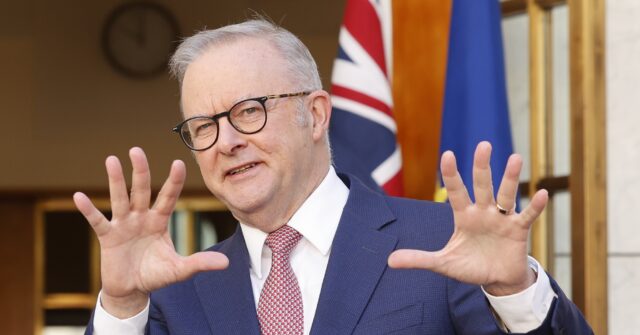
Left-wing Australian PM Anthony Albanese said Canberra has not received a request from the United States to help with its “unilateral” blockade of the Strait of Hormuz as announced by President Donald Trump.
“They’ve made this announcement overnight and they’ve done that in a unilateral way and we haven’t been asked to participate,” Albanese told Channel Nine’s the Today Show on Monday.
“We’ve received no requests that we haven’t agreed to. The request we’ve received was for support for Gulf countries, particularly the UAE, and that’s why we sent our Wedgetail aircraft that’s been doing amazing work.”
President Donald Trump announced on Sunday the U.S. Navy will begin blockading “any and all Ships trying to enter, or leave” the Strait of Hormuz. The announcement came hours after Vice President JD Vance said that the U.S. delegation decided to leave peace talk hosted in Pakistan with Iran representatives after the Iranian regime officials refused to agree to the United States’ terms.
U.S. Central Command (CENTCOM) confirmed that the U.S. Navy blockade of the Strait of Hormuz will begin on Monday, April 13, at 10:00 a.m. (EST).
RELATED: What Navy? Footage Shows Obliteration of Islamist Regime’s Ships

“The blockade will be enforced impartially against vessels of all nations entering or departing Iranian ports and coastal areas, including all Iranian ports on the Arabian Gulf and Gulf of Oman,” CENTCOM detailed on a social media post, noting that U.S. forces will not impede freedom of navigation for vessels transiting the Strait of Hormuz to and from non-Iranian ports.
“What we want is for negotiations to resume. We want to see an end to the loss of life and the loss of infrastructure, civil, in the Middle East. And we want to see trade resume. This is having a massive global economic impact, not just on Australia,’’ Albanese reportedly said, and added, “every single country is being impacted.”
Per the public broadcaster SBS, Albanese said on Monday he was “disappointed” that the talks between the U.S. and Iran fell through.
“We want to see de-escalation, and we want to see those negotiations resumed,” he said while announcing that Vice Admiral Mark Hammond, the current chief of the Australian Navy, would be appointed the next chief of the defense force.
“The question of contribution is one for consideration by the Australian government should they receive a request and there’s been no such request as yet,” Hammond said, and added that the Australian military was capable of assisting in the Middle East if such request was made.
Read the full article here


