




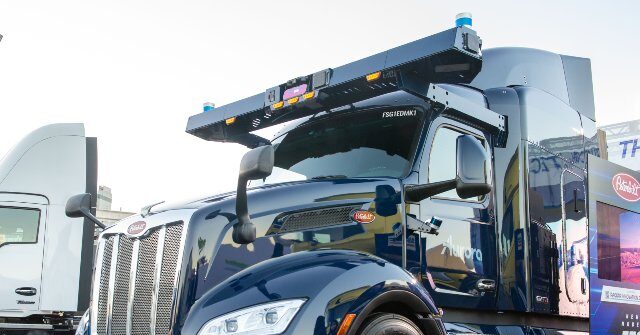
CNBC’s Phil LeBeau spent more than three hours riding in an autonomous semi truck through Texas, watching the vehicle navigate highway traffic with nobody behind the wheel. Some experts believe 3.5 million truck driving jobs will be at risk if the technoloy is widely adopted over the next few years.
CNBC reports that Aurora Innovation arranged the ride, putting LeBeau in the cab alongside founder and CEO Chris Urmson for a route that ran along Interstate 45 between Houston and Dallas and I-20 between Fort Worth and El Paso, ending with a completed freight run in Palmer, Texas. Most of the three hours on I-45 passed without incident. The truck pulled off the highway once, for less than a minute, to reset hazard lights that had switched on for unclear reasons. The bigger disruption came from other truckers, several of whom did visible double takes once they realized no one was driving.
Urmson explained the sensor setup that keeps the truck on the road. “It’s using lasers, radar, and cameras to look all around it and see the other cars, see the other trucks on the road, and figure out how to drive safely,” he said.

Aurora runs 20 driverless trucks now and wants that fleet at 200 by the end of the year. The company started testing its autonomous technology on public roads in 2021 and has logged more than 3 million miles since, most of them with a human safety operator still in the seat. Urmson said the vehicle went through heavy vetting before commercial deployment. “We put this through 15 million tests before we put it out on the road,” he said, adding, “We’ve got millions of miles of experience.”
Money is the harder story. Aurora lost more than $800 million in 2025 and is aiming for positive free cash flow by 2028. Urmson pointed to the company’s track record of hitting its own deadlines as the reason to trust that number. “We’ve been able to put out timelines and we’ve basically hit those timelines,” he said.
The pitch to trucking companies comes down to cost, speed, and labor. Autonomous trucks can run up to 20 hours a day, since they aren’t bound by the federal hours-of-service rules that force human drivers to take rest breaks. “We can help them save on fuel economy,” Urmson said, adding, “We can move goods more quickly and then we can fill the need when they can’t hire amazing drivers for their teams.”
Wall Street likes the math. Morgan Stanley transportation analyst Ravi Shanker estimated that “an autonomous fleet should be nearly 7.5X as profitable as a human-driven fleet today.” Bank of America ran the comparison in dollars, estimating that “Aurora services will cost ~$0.85 per mile versus approximately $1.30 per mile for human driver wages and benefits, before considering indirect labour costs.”
The Department of Transportation counts roughly 3.5 million Class 8 semitrucks on U.S. roads, a market big enough that Kodiak AI, Gatik and Tesla are all chasing similar autonomous driving technology.
Investor and podcaster Jason Calcanis pointed out the technology’s potential impact on truckers. “We’re not seeing massive job loss in white collar yet, but we will see it in real world jobs apparently. 3.5m in the USA alone… plus door dashers… and cabs/ridesharing, Going to be a wild 2028-2030.”
Not everyone in the industry thinks trucking companies will be quick to pull drivers out of the cab. Sean Wu, CEO of the online shipping marketplace uShip, argued that drivers do more than steer. “The drivers do more than just move the rig. There is judgement. There is customer service. There is protection,” Wu said. He added, “There is just a lot more to think about than ‘Hey they are moving a truck from point A to point B.’”
Read more at CNBC here.
Lucas Nolan is a reporter for Breitbart News covering issues of AI, free speech, and online censorship.
Read the full article here


