







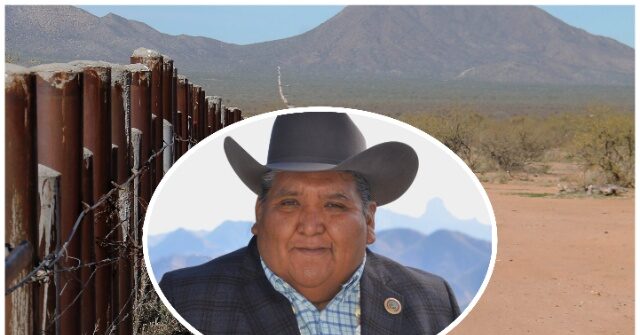
Officials of the Tohono O’odham tribe issued an update in the ongoing battle to stop the Trump administration from starting a 62-mile border infrastructure project within the narrow Roosevelt Easement between the southern boundary of the tribe’s reservation and the U.S. Mexico border. The tribe alleges armed, masked Customs and Border Protection (CBP) agents escorted border wall construction contractors through the reservation on Tuesday in violation of Tohono O’odham laws.
Earlier this week, the tribe announced the entry of approximately 20 masked, armed CBP agents from the Tucson Border Patrol Sector who entered the Tohono O’odham Nation to escort the border wall contractors. According to the tribe, the contractors began engaging in pre-construction activities on federal lands after using the reservation to access the Roosevelt Easement.
The tribe alleges that the contractors were trespassing on reservation lands according to the Tohono O’odham Code, Title 4, Chapter 2, “Civil Trespass; Removal and Exclusion of Nonmembers.” According to the tribe’s public announcement on Tuesday, the contractors began work at three sites within the Roosevelt Easement, using drill trucks to conduct soil sampling and other activities.
The latest developments in the tribe’s fight come after a federal judge denied a request for a preliminary injunction to stop the construction project, as a federal lawsuit makes its way through the court process.
According to tribal officials, the CBP team of officers sent to escort and provide security for the federal contractors involved in the project, known officially as Tucson 5, included a contingent of Border Patrol agents assigned to the agency’s BORTAC Tactical Team and several Bureau of Indian Affairs Officers. A tethered balloon is being used to provide additional monitoring of the project area according to the tribe.
As reported by Breitbart Texas, in early August, U.S. District Judge Richard Leon denied the tribe’s request to halt CBP’s plan to install a border wall along the 62-mile stretch within the easement, also known as the Roosevelt Reservation. The project will include the installation of additional border wall and smart technology, including lighting and camera suites.
In his ruling denying the request for a preliminary injunction, Leon rejected the assertion that the project would alter the established boundaries of the Tohono O’odham Reservation and the tribe’s lawsuit was “unlikely to succeed on the merits” of the case. The ruling, a major victory for the Trump administration, has resulted in a renewed push by CBP to complete the project
Prior to the alleged trespassing incident, U.S. Customs and Border Protection Commissioner Rodney Scott had announced that his agency would move forward with the project after the tribe’s injunction request was denied.
The Tohono O’odham tribe’s reservation consists of a 2.8-million-acre area along the U.S.-Mexico border in southern Arizona. The tribe has members on both sides of the border. According to the tribe, several thousand tribal members reside in seventeen communities in Mexico directly across the border from the reservation in the United States.
The tribe’s legal standing is hampered by the establishment of the Roosevelt Easement in 1907, which designates a 60-foot-wide strip of land as federal property. The easement set aside a strip of land to combat smuggling. The easement runs along the border adjacent to the 62-mile international boundary between the Tohono O’odham reservation and Mexico.
According to a source within the Department of Homeland Security, most equipment needed to complete the initial phases of the project has already been moved through the reservation and onto the federally owned Roosevelt Easement. According to the source, not authorized to speak to the media, CBP and the Border Patrol continue to engage with tribal officials to amicably address the tribe’s concerns, but remain determined to complete the project.
Funding for the project is provided by provisions in the One Big Beautiful Bill, which authorized $46.5 billion for border wall construction and border infrastructure improvements.
Randy Clark is a 32-year veteran of the United States Border Patrol. Before his retirement, he served as the Division Chief for Law Enforcement Operations, directing operations for nine Border Patrol Stations within the Del Rio, Texas, Sector. Follow him on X (formerly Twitter) @RandyClarkBBTX.
Read the full article here


