






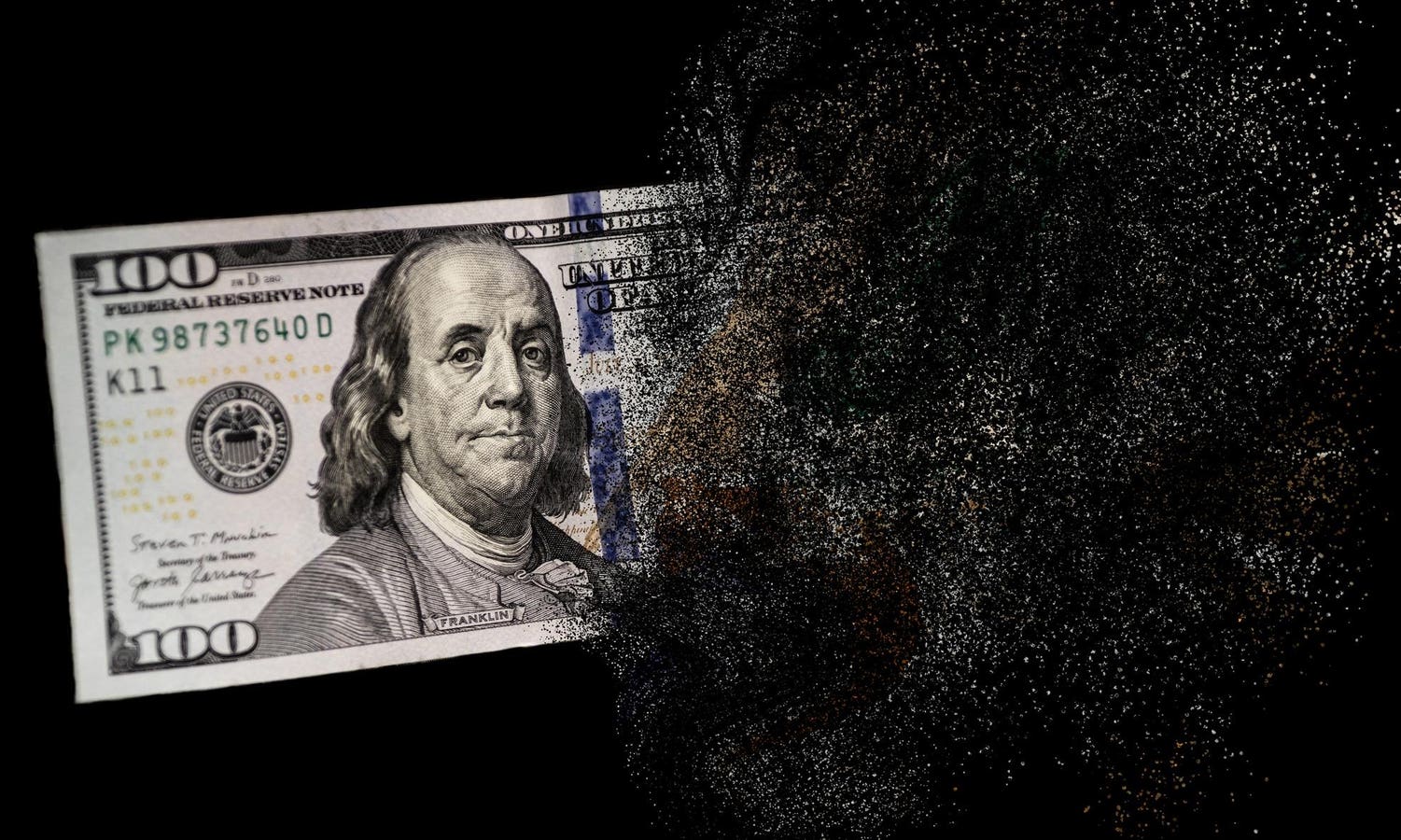
Vanishing 100 US dollar banknote
getty
U.S. debt has now climbed above the size of the entire economy — a threshold that signals higher borrowing costs, tighter financial conditions and a long stretch of elevated interest rates for households and investors. And while the last time America crossed this kind of fiscal line was during World War II, the forces driving today’s debt surge — and the consequences for markets — look very different.
During World War II, when the U.S. entered the conflict in 1941, the day after the Pearl Harbor attack, the country had a lot of work to do. Not only sending soldiers and providing for them but mobilizing for battle: building weapons, ships, tanks, uniforms, ammo, equipment and vehicles. Buying food, fuel and whatever else the war effort required.
All that cost a lot of money the government did not have sitting in a savings account, so it borrowed liberally until it eventually paid off the debt.
Debt Has Crossed A Critical Line
Below is a graph from the Federal Reserve Bank of St. Louis that shows the federal debt held by the public as a percentage of the U.S. gross domestic product. It covers Jan. 1, 1970, through Oct. 1, 2025, with the final date representing the end of the government’s 2025 fiscal year.
Federal debt held by the public as a percentage of GDP
Federal Reserve Bank of St. Louis
By the end of calendar 2025, debt held by the public was about $31.265 trillion, as the Treasury Department’s monthly statement showed. GDP over the preceding year was $31.216 trillion. The ratio of publicly held debt to GDP is now 100.16%. Under current conditions, that’s likely to continue, as the budget deficit this year is projected at $1.9 trillion, The Wall Street Journal reported.
Crossing A Line
“With debt now above 100% of GDP, it’s only a matter of time until we pass the all-time record of 106% reached in the immediate aftermath of World War II,” Maya MacGuineas, president of the nonprofit, nonpartisan Committee for a Responsible Federal Budget, said in prepared comments.
People talk about this ratio because economists use it to better understand the potential impact of debt on a country. The higher the debt, the higher the costs of making interest and principal payments on the borrowing. The more money that goes into debt service, the less is available for anything else.
All this has implications. In May 2024, Benn Steil, senior fellow and director of international economics, wrote for the Council on Foreign Relations that for the first time the U.S. was spending more on interest — not even principal, but interest — than the annual Defense Department budget.
“The likelihood of the U.S. actually defaulting on its debt is trivial, since the government prints the currency in which its debt is denominated,” Steil wrote. “But the alternatives to default under the path of continued high deficits all point toward lower living standards.” As he and many others have pointed out, as the government borrows more, the cost of money throughout the economy increases.
Why Excess Borrowing Becomes A Problem
The reason is fundamental. The more the government borrows from investors — whether individuals, companies or other governments — the more yields on Treasury instruments like the 10-year note rise. Investors want compensation for perceived increased risks. Higher yields mean lower prices for the investments. The lower the price, the more bonds the government has to sell to raise the sums needed to cover costs, including paying off the balances of the yields. That drives up borrowing costs in the form of even higher yields.
Treasury yields are not just direct costs for government borrowing. Most commercial interest rates comprise two parts: a risk-free basis and a risk premium. The higher the risk, the higher the premium. When the risk-free basis gets more expensive, so does the overall rate.
“As the government borrows more and more, the cost of money across the economy increases, crowding out private investment, reducing supply, increasing prices, and lowering growth. In the worst-case scenario, the country enters a debt spiral in which government borrowing and interest rates each keeps pushing the other up,” Steil wrote.
The Potential Impacts
The movement causes concern everywhere. How long is any of this sustainable? How will investors react? Will they continue to enable the ongoing bond sales that keep everything in place?
Here’s a reminder of what a fiscal crisis could look like, according to the CRFB. There are six categories of fiscal crisis, virtually all of which are a direct or indirect result of national debt:
- Financial — Confidence in short- and long-term bond issuance drops. Yields rise sharply. Traders grow wary of falling bond values and may panic internationally. Credit slows or freezes. Key financial institutions fail.
- Inflation — A government tries to manage exploding debt through monetization or other manipulative techniques, including pushing interest rates artificially low or using “financial repression,” any of which could drive rapidly rising inflation.
- Austerity — Historically, governments try to deal with debt through sharply increased taxes and heavily cut spending. The results are recessions and widespread economic pain.
- Currency — A country’s currency weakens when markets grow wary of its debt load. The U.S. dollar’s status as the primary global reserve currency provides major advantages that could erode.
- Default — Constitutionally, via the 14th Amendment, the U.S. is not allowed to default on its debt. But many things that happen aren’t supposed to under the Constitution. A default would be like having every single nuclear weapon set off simultaneously. The question is whether every living thing would be wiped out (maybe other than some cockroaches) or if the impact would be something merely unthinkably horrible.
- Gradual — “Living standards and fiscal and monetary flexibility could gradually erode in response to rising debt, potentially causing as much or more long-term damage than an acute crisis,” the CRFB wrote.
Read the full article here


