




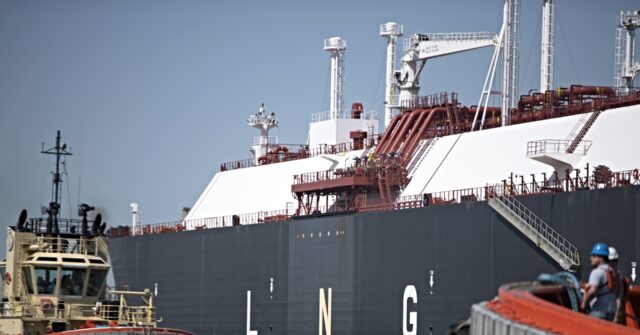
The United States emerged as India’s top supplier of liquified natural gas (LNG) in May, CNBC reported on Thursday, fulfilling a prediction by President Donald Trump last year that America would become a “leading supplier” to the country in the near future.
President Trump made the comments during a meeting with Indian Prime Minister Narendra Modi in February 2025, hoping to expand American exports to India overall but highlighting the energy sector, particularly LNG and petroleum, as sectors of high potential. While both leaders expressed interest in expanding these sales, the shift to American dominance in LNG accelerated dramatically this year following the eruption of hostilities between America and Iran, resulting in the Iranian terrorist regime attempting to shut down commercial maritime traffic in the Strait of Hormuz.
Citing the data firm Kpler, CNBC reported that India imported 900,000 tonnes of LNG to India in May, not just an increase in imports throughout the past year, but about triple the amount that India imported from America just one month prior. CNBC noted that this amount represented about 40 percent of all LNG India imported last month.
Prior to the expansion of American imports, India’s top LNG supplier was Qatar and the country shipped about 60 percent of its LNG through the Strait of Hormuz. As recently as 2025, Qatar was responsible for about 40 percent of India’s LNG imports. India had long relied on Gulf suppliers due to the lower shipping costs associated with the shorter distance between the exporting and receiving countries, even as some reports suggested that American LNG was, by base price, less expensive. The Iranian government’s attacks on random ships in the Strait of Hormuz and warning that it would blockade shipping there have reportedly made India reconsider the financial costs of buying American LNG.
“High freight costs helped prevent the U.S. from gaining a meaningful share in India’s gas market before the war. But being cut off from the Gulf made India more open to U.S. gas cargoes,” CNBC observed.
Qatar, in particular, has been among the most negatively impacted countries from the Strait of Hormuz disruptions as it lies on the Persian Gulf and is one of the region’s most prolific exporters of LNG. QatarEnergy, the country’s national fossil fuel company, dramatically canceled a host of contracts in March following the beginning of the America-Iran conflict, declaring force majeure – a legal clause asserting that the company cannot fulfill its contract obligations due to forces larger than itself.
On February 28, President Trump announced the launch of “Operation Epic Fury,” a military engagement to weaken the leadership of the Iranian terror state and its ability to threaten its neighbors. In response, the Iranian Islamic Revolutionary Guard Corps (IRGC) launched attacks on over a dozen neighboring countries, Qatar among them, and engaged in a campaign of piracy, attacking commercial ships in the Strait of Hormuz. QatarEnergy specifically cited “successive waves of Iranian attacks” on its facilities as the reason it could not fulfill its contracts.
As Qatar warned its buyers that it would not be able to supply the products it had agreed upon, Indian economic sectors especially vulnerable to LNG shortages warned that a prolonged disruption in the Strait of Hormuz could have large-scale consequences. In particular, the National Restaurant Association of India (NRAI) issued a statement warning in March that shortages of cooking gas could devastate restaurant owners.
“The restaurant industry is predominantly dependent on commercial LPG [liquefied petroleum gas] for its operations. Any disruption therein will lead to a catastrophic closure,” the NRAI observed at the time. The organization warned that restrictions on LNG could result in as much as $130 million in losses a day for the restaurant and hotel industries.
At the time, the Indian government assured concerned citizens there was “no need to panic” about the situation as it apparently worked behind the scenes to increase supplies of the American product.
That expansion of trade volume had been discussed long before “Operation Epic Fury,” however. In February 2025, President Trump met Prime Minister Narendra Modi in the White House and pitched him on American LNG, calling for America to soon become “a leading supplier of oil and gas to India.”
“I think last year, we purchased around $15 billion of US energy output. There is a good chance that this figure will go up to as much as $25 billion in the near future,” Indian Foreign Secretary Vikram Misri said following the summit, adding that the conversations between the two leaders “did focus considerably on the possibility of more energy purchases.”
The situation in the Strait of Hormuz, meanwhile, remained unclear on Thursday as the Iranian armed forces and U.S. Central Command (CENTCOM), the arm of the Pentagon operating in the Middle East, issued contradicting statements on whether ships were passing through.
Iran’s Khatam al-Anbia Central Headquarters (KCHQ) announced that the strait was “closed to the passage of all vessels” on Thursday as a result of American airstrikes on Iranian targets. CENTCOM issued a statement plainly retorting, “the Strait of Hormuz remains open for transit.”

Reports on Thursday suggested that at least three LNG tankers passed through the Strait on Thursday.
Two of the ships were reportedly bound for Southeast Asia, though reports did not specify if India was their ultimate destination.
Follow Frances Martel on Facebook and Twitter.
Read the full article here


