




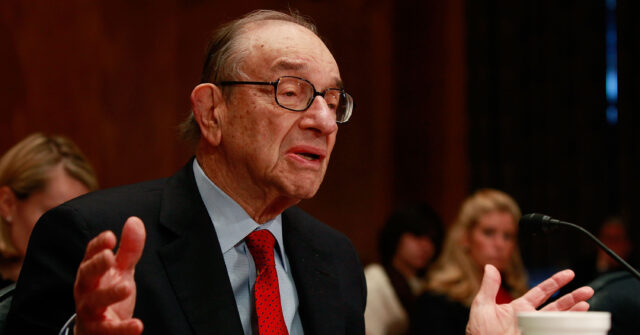
Alan Greenspan, who as Federal Reserve chairman for more than 18 years presided over the longest U.S. economic expansion then on record and won acclaim as the “Maestro” of American prosperity—only to share the blame for the crisis that followed his departure—died Monday at his home in Washington. He was 100.
The cause was complications of Parkinson’s disease, said his wife of 29 years, NBC News correspondent Andrea Mitchell. The couple married in 1997 and had no children; Ms. Mitchell is his only immediate survivor.
Across 18½ years and four presidents, from 1987 to 2006, Mr. Greenspan was treated as something close to infallible. Investors parsed his every utterance for clues on interest rates, and his briefcase was studied so closely that a bulging one gave rise to a Wall Street superstition known as the “Briefcase Indicator.” He could move markets with a phrase. On Dec. 5, 1996, two words—”irrational exuberance”—sent stocks sliding around the world.
His standing began to slip almost as soon as he left office. Housing prices, which he had declined to call a bubble, collapsed; mortgage securities turned toxic; and the financial system seized up in the deepest downturn since the Great Depression. Critics faulted his low interest rates and his faith that markets could police themselves.
“Those of us who have looked to the self-interest of lending institutions to protect shareholders’ equity, myself especially, are in a state of shocked disbelief,” Mr. Greenspan told Congress in October 2008. He later put it more plainly: “I made a mistake.”
The Financial Crisis Inquiry Commission was harsher, concluding that decades of deregulation “championed by former Federal Reserve chairman Alan Greenspan and others” had stripped away safeguards that might have averted the catastrophe.
From Juilliard to the Fed
Mr. Greenspan was an improbable financial celebrity. Born March 6, 1926, in the Washington Heights section of Manhattan, he was the only child of a stockbroker father and a mother who raised him after the couple divorced. He dropped out of the Juilliard School and played clarinet and saxophone professionally as a teenager—briefly alongside the future jazz great Stan Getz—before deciding he lacked the gift.
He studied economics at New York University, earned a doctorate there in 1977, and for nearly three decades ran an economic-forecasting firm, Townsend-Greenspan & Co., burrowing into arcane data—stuff like boxcar loadings, steel output, cotton prices—to read the economy’s direction. The habit never left him. As chairman he rose before dawn to soak in his bathtub and work through Fed staff memos.
His free-market convictions were forged in the circle around the novelist Ayn Rand, who nicknamed the somber, dark-suited young economist the “Undertaker” and persuaded him, he later wrote, that capitalism was not merely efficient but moral. He entered Republican politics as an adviser to Richard Nixon and served as President Gerald Ford’s chief economic adviser.
Black Monday and the boom
President Ronald Reagan named him to succeed Paul Volcker in 1987. The test came fast. On Oct. 19, 1987—”Black Monday,” two months into his term—the Dow Jones Industrial Average fell 22.6%, its worst single-day percentage drop. Mr. Greenspan flooded the system with cash, markets steadied, and a reputation was made.
He went on to dominate the central bank as few chairmen had. It became “intimidating to say anything other than, ‘Yes, sir, I support your proposal too,’” recalled Janet Yellen, a Fed governor under Mr. Greenspan who later ran the institution herself and served as Treasury secretary.
His record rested on two bold calls. In 1994 he doubled the Fed’s benchmark rate within a year to choke off inflation before it appeared, engineering a rare soft landing. Later in the decade, as unemployment fell below 4% for the first time since 1970, he resisted pressure to raise rates, arguing that a technology-driven surge in productivity would let the economy run hot without igniting prices. The expansion stretched past a decade.
A regulatory blind spot
In the late 1990s he joined officials from the Clinton White House in blocking Brooksley Born, the top U.S. commodities regulator, from overseeing the booming market in over-the-counter derivatives—instruments later blamed for spreading the 2008 contagion. Critics say that Greenspan’s confidence that financial markets could be largely self-regulating was his greatest weakness.
“He conducted monetary policy like a maestro,” said Alan Blinder, the Princeton economist and former Fed vice chairman. The regulatory record, Mr. Blinder said, “caused a lot of harm.”
Mr. Greenspan’s influence outlived the crisis. Kevin Warsh, whom President Trump installed as Fed chairman this spring, singled him out for praise at his swearing-in and has signaled a return to the kind of guarded communication—and the wager that artificial intelligence might revive 1990s-style growth without inflation—that defined the Greenspan years.
To the end, Mr. Greenspan thought the ledger was unfair. “I was praised for things I didn’t do,” he said in 2008. “I am now being blamed for things that I didn’t do.”
Read the full article here


