




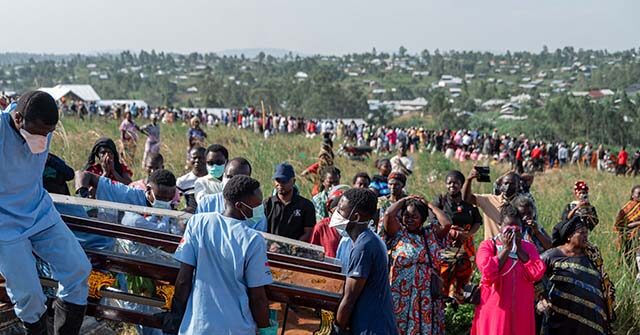
Jean Kaseya, director of the Africa Centers for Disease Control (Africa CDC) warned on Tuesday that the current outbreak of Ebola in the Democratic Republic of the Congo (DRC) could become the worst ever recorded since so many of the people who came into contact with Ebola victims have yet to be traced and tested.
“If we don’t stop the outbreak very soon it will be worse than what we had in West Africa and eastern DRC,” said Kaseya. The West Africa outbreak in 2014 killed over 11,000 people, while the 2018 outbreak in the Congo claimed almost 2,300 victims.
According to the latest update from the DRC health ministry, the current outbreak of the Ebola Bundibugyo strain includes 782 cases and 181 fatalities, which would not seem to be in a league with the horrifying death tolls from 2014 or 2018. However, one of the biggest problems with the current outbreak is that cases have been very difficult to diagnose and track due to political instability in the outbreak region and an often-uncooperative population.
Health officials fear the true number of cases and deaths could be much higher than the figures confirmed so far and, while the outbreak was officially declared one month ago, it began weeks or months before that.
On the matter of the uncooperative population in the eastern Congo, a gang of unknown assailants wielding bladed weapons reportedly removed a woman and her six-year-old daughter from a treatment center on Tuesday. It was the latest instance of people in the outbreak region using force to retrieve living or dead Ebola patients from isolation areas because they mistrust medical personnel, insist on performing their own funerals for the dead, or believe Ebola is caused by witchcraft.
“Until now we have not yet found the two people we are searching for. We are making a solemn appeal for them to go as soon as possible to an Ebola treatment center, as their return to the community risks worsening their health and, above all, infecting their relatives,” pleaded Dr. Lubambo Maboko Gaston, Ebola response manager for North Kivu province.
Lubambo said the child abducted by the gang had tested positive for Ebola, making her one of 67 confirmed cases in the province. About 90 percent of confirmed cases have been found in the neighboring Ituri province, where the outbreak evidently began.
The Associated Press (AP) noted on Wednesday that many residents of the eastern DRC are turning to “traditional healers” who use herbs and prayers, instead of hospitals and clinics, with “devastating consequences.”
Not only are these traditional remedies ineffective against Ebola, but the rituals involved tend to be group activities, turning healing ceremonies and funerals into super-spreader events.
“Some people still describe Ebola as something mysterious, spiritual, or brought by outsiders, rather than a disease that needs medical care. When people do not trust the health system, they often go first to traditional healers, faith leaders, or people they already know. The danger is that many only reach the hospital when they are already very sick,” lamented Onesphore Bangenza, an emergency response professional who works with aid group Mercy Corps.
“The challenge with Ebola is that it is so bad that some people can believe that there are supernatural powers behind it,” added Seventh-Day Adventist elder Vincent Isimbwa, a resident of the Ugandan village that gave the Bundibugyo strain its name during its first outbreak in 2007.
In a bitter irony, Congolese faith healers said one reason people turn to them is that Ebola is not 100-percent contagious or lethal and medications are not 100-percent effective, so villagers conclude that the medical community is not being honest with them about the spiritual dimensions of the disease.
“For us in African traditional societies, in most cases when you fall sick and you go to the hospitals and they give you some injections and there is no improvement, there and then you switch to your neighbor, or anybody, and say maybe he is the one bewitching you. Then you decide to go to the witch doctor,” said a faith healer in Bundibugyo who survived the 2007 outbreak.
An alliance of advocacy groups wrote a letter to the U.S. Biomedical Advanced Research and Development Authority (BARDA) urging it to work with Africa CDC and the World Health Organization (W.H.O.) to make an experimental treatment available to patients in the current outbreak.
The treatment, designated MBP134 and produced by a San Diego-based firm called Mapp Biopharmaceutical, was originally developed for the Sudan strain of Ebola. Laboratory studies have shown it could also be effective against the Bundibugyo strain, which currently has no vaccine.
In fact, Mapp researchers believe MBP134 could prove effective against all known strains of Ebola virus. The company has provided a limited number of doses for use with “high-risk individuals.”
W.H.O. has recommended two promising vaccine projects for priority development, one produced by the AIDS Vaccine Initiative and the other by Oxford University and the Serum Institute of India. Both projects are still far from being certified and deployed in the field, as they require months of further assessments before they can begin clinical trials.
Read the full article here


