








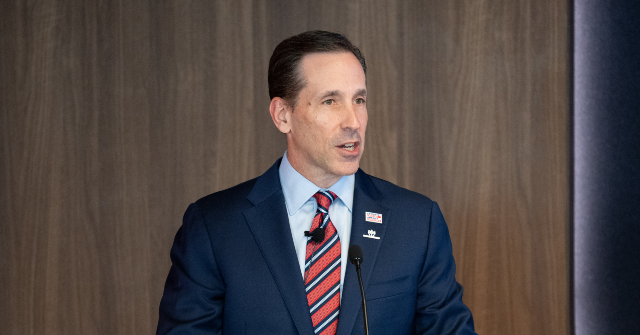
American Chemistry Council (ACC) President and CEO Chris Jahn said at the Council’s first policy summit on Thursday that there is a dire need to enact permitting reform, noting that the Empire State Building was permitted and built in only two years.
The ACC held its first conference, ACC Chemistry & Competitiveness: A Summit on Driving America’s Next 250 Years, hosting lawmakers and administration officials such as Sen. Pete Ricketts (R-NE), EPA Deputy Administrator David Fotouhi, and Deputy Secretary of the Interior Kate MacGregor, and many more. The policy summit discussed a myriad of topics that impact the chemical industry, such as permitting, trade, and regulations.
Jahn opened the conference, noting the need for Congress to get permitting reform across the board given how long it takes for businesses to get approval.
He emphasized that the Empire State Building only took two years to permit and build to completion.
Jahn noted that the chemical industry is “quiet, unseen, but indispensable” for America’s success.
“Even if you don’t think about chemistry, it is there for you,” Jahn said.
He argued that the United States cannot compete on the global stage without the chemical industry, including protecting health and the environment and promoting energy dominance. He added that the chemical industry is focused on bringing manufacturing back home.
The conference sought to discuss what are “practical solutions” to benefit the chemical industry and America overall, including permitting reform, streamlining onerous and outdated regulations, and more.
During one panel, he said that the number one thing Congress can do to help the chemical industry is to reform the Toxic Substances Control Act (TSCA), a law that addresses the production, importation, use, and disposal of specific chemicals such as asbestos, radon, and lead-based paint, among other substances.
Jahn said during a panel with Fotouhi and the Office of Management and Budget’s (OMB) Eli Nachmany that regulatory certainty is a major issue for chemical manufacturers. He also said that the Big Beautiful Bill’s provision to make the research and development tax credit permanent serves as a major boon to manufacturing.
Nachmany said that the Trump White House has a policy of removing 10 regulations for every one implemented and they have far exceeded that. He said that the Trump administration is slated to remove roughly $1 trillion in regulatory costs next year.
Read the full article here


