


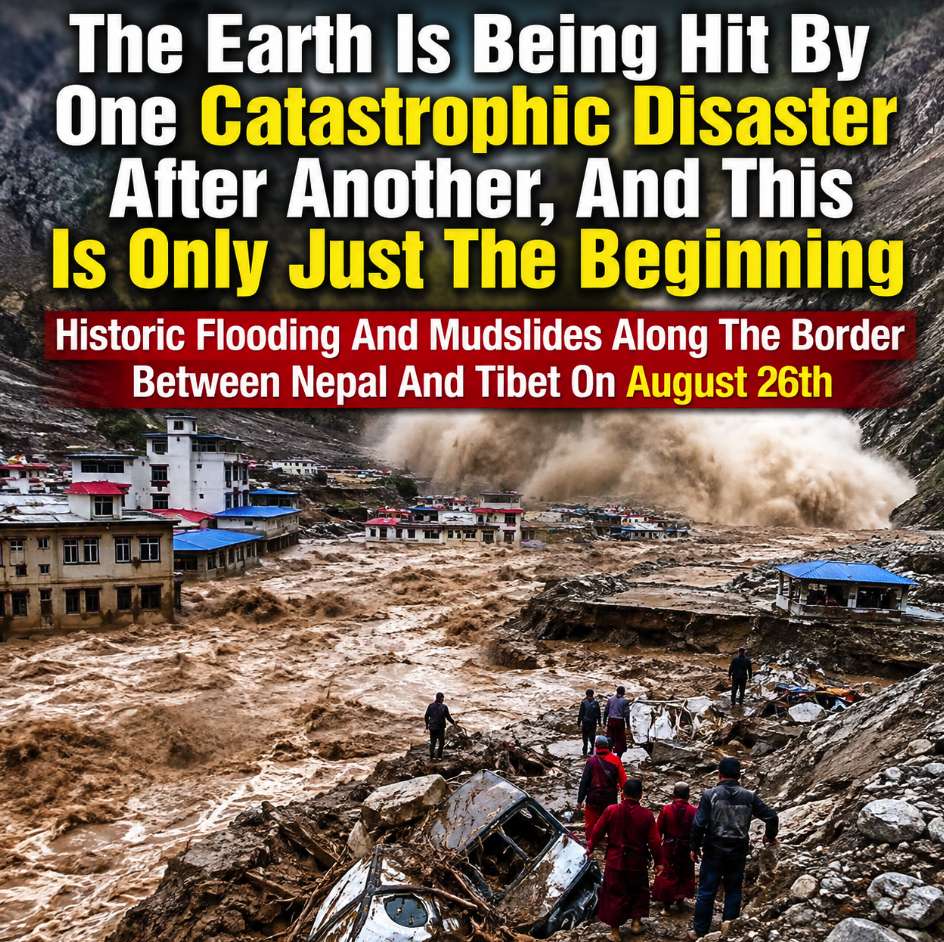
The absolutely devastating floods and mudslides that we just witnessed along the border between Nepal and Tibet look like something out of a science fiction movie. It is a tragedy of epic proportions, and it has made us forget all of the other catastrophic disasters that have been hitting our planet recently. Unfortunately, the victims in Nepal and Tibet will also soon be forgotten because more catastrophic disasters are on the way. We live at a time when global weather patterns have gone absolutely nuts, giant earthquakes are occurring with alarming regularity, the northern hemisphere is experiencing the worst wildfire season in history, and our overheating oceans threaten to kill billions of fish.
I have never seen anything quite like the disaster that just occurred along the border between Nepal and Tibet on Wednesday.
The footage that one camera captured is particularly horrifying…
Those people didn’t have a chance.
One moment they were normally living their lives, and the next moment they were gone.
Many that were swept away by the rushing waters didn’t even live in the region. In fact, we are being told that “hundreds of tourists” are missing…
Devastating flash floods and mudslides have wiped out buildings and bridges along the Nepal–Tibet border – with hundreds of tourists still missing.
In Nepal, houses and roads were swept away by rushing water and mudslides.
Meanwhile, officials in China–controlled Tibet said they feared ‘major casualties’.
We have seen flooding in Nepal and Tibet before, but this was different.
As the wall of water and mud rushed forward, it came slamming into homes and bridges…
Harrowing footage from the scene showed fast-flowing floodwater ripping through the streets and destroying everything – including homes and bridges – in its path.
River banks burst as walls of water came rushing through the densely populated areas, sweeping people underwater as others sought safety on higher ground.
Aerial footage showed floodwater completely consuming land near the Nepal-Tibet border, sending people running for their lives as buildings collapsed in seconds.
In the end, the final death toll will probably be in the thousands.
Originally, experts were telling us that a magnitude 4.4 earthquake triggered a gigantic ice avalanche which caused the sudden flooding…
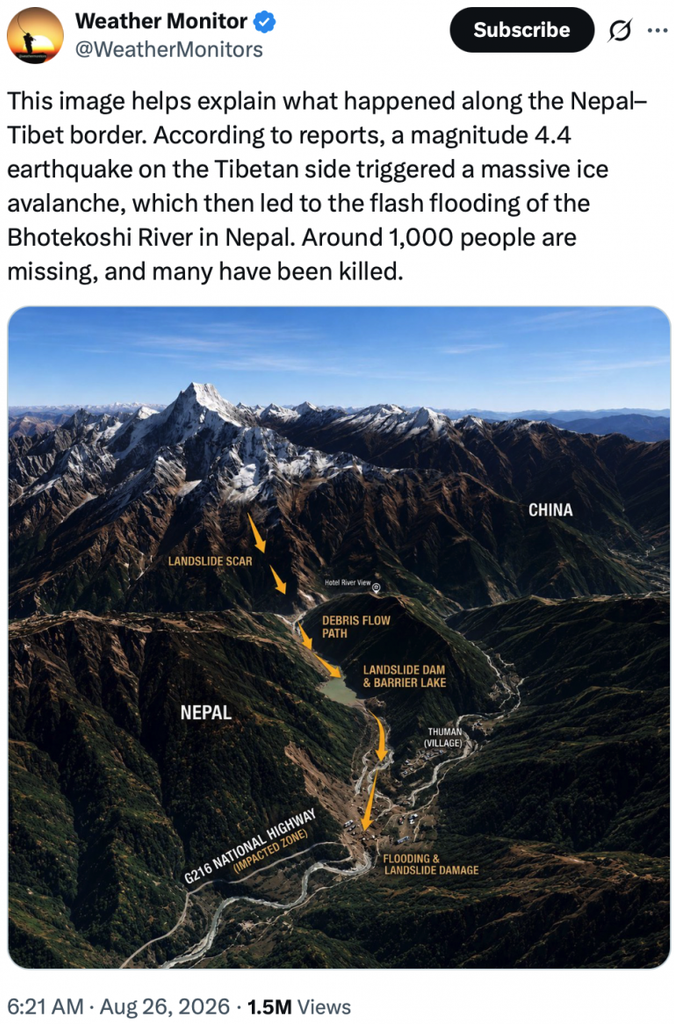
But later reports claimed that a landslide that occurred at 8:37 local time triggered the avalanche that created the flooding.
Apparently the huge earthquake that was detected was actually caused by the landslide…
Though the horrifying disaster is still unfolding, initial reports suggested the floods could be the result of an avalanche triggered by an earthquake, Nepal’s foreign minister Shisir Khanal told the country’s parliament Wednesday.
The United States Geological Survey (USGS) reported recording a 4.4 magnitude quake around the time the security footage was taken at the border.
However, USGS hours later clarified that the trembling detected was not an earthquake, but caused by the landslide itself, registering as the equivalent of a 5.2 magnitude quake.
But no matter how it started, nobody can deny that this was truly a historic disaster.
Meanwhile, we just witnessed a series of 13 eruptions at Mount Anak Krakatau…
The Center for Volcanology and Geological Hazard Mitigation (PVMBG) recorded 13 eruptions from Mount Anak Krakatau in South Lampung Regency, Lampung Province.
The height of the eruptions varied from 50 to 300 meters from the summit of Mount Anak Krakatau, from 12:00 p.m. to 6:00 p.m. Jakarta time.
Suwarno, Head of the Mount Anak Krakatau Monitoring Post in Hargopancuran, Rajabasa District, stated on Wednesday that the volcano remains volatile, so further eruptions are still possible.
This should deeply concern all of us, because one of the largest volcanic eruptions in recorded history occurred there in 1883…
Between 19 May and 21 October 1883, the volcanic island of Krakatoa (located in the Sunda Strait, then part of the Dutch East Indies—modern-day Indonesia) began erupting, lasting more than five months. On 27 August, the island had its most significant eruption, which destroyed over 70% of the island and its surrounding archipelago, the island collapsing into a caldera. The eruption of 27 August had an estimated volcanic explosivity index of 6, and is one of the deadliest and most destructive volcanic events in recorded history; the third explosion of that day, that occurred at 10:02 a.m., remains the loudest-known sound in history.
The explosion was heard 3,110 kilometres (1,930 mi) away in Perth, Western Australia, and Rodrigues near Mauritius, 4,800 kilometres (3,000 mi) away.[3] The acoustic pressure wave circled the globe more than three times.[4]: 63 At least 36,417 deaths are attributed to the eruption and the tsunamis it created. Significant additional effects were felt worldwide in the days and weeks after the volcano’s eruption. Additional seismic activity was reported until February 1884, but any reports after October 1883 were dismissed by Rogier Verbeek’s subsequent investigation into the eruption.
That gigantic eruption caused a volcanic winter that lasted for about a year.
Our oceans could actually use a cooling trend right now, because they are hotter than ever.
In fact, average global ocean temperatures just hit the highest level ever recorded…
As a record-breaking El Niño builds in the Pacific and large swaths of the globe’s oceans are affected by marine heat waves, a significant record has fallen.
According to data from the Copernicus Climate Change Service, average global sea surface temperatures have reached a new high, rising to nearly 70 degrees Fahrenheit late last week — potentially for the first time in millennia.
This mark surpassed the previous record set in March 2024.
This is crazy.
On August 22nd, we broke the record that had been established in March 2024…
The daily average sea surface temperature across the extra-polar global ocean, between 60°S and 60°N, reached 21.1°C (70°F) on August 22, 2026, the highest value in the Copernicus Climate Pulse record beginning in 1979. The reading exceeded the previous daily record of 21.09°C (69.96°F), set in March 2024, and came in August, although temperatures across the domain normally reach their annual maximum in March and April.
If global ocean temperatures are going to set an all-time record, it is supposed to happen in either March of April.
For it to happen so late in the year is extremely strange.
Many want to blame humans for what is occurring, but scientists have discovered that the warming of our oceans actually gets worse the deeper than you go.
That suggests that whatever is warming our oceans is coming from underneath.
Currently, 42 percent of the Earth’s oceans are experiencing unusual marine heat waves…
According to NOAA data, 42 percent of the planet’s oceans are currently experiencing marine heat waves.
In the Pacific Ocean alone, marine heat waves cover an area that’s equivalent to nine times the size of the contiguous United States — greatly contributing to the new global sea surface temperature record.
So why is this important?
When the oceans get warmer, we tend to experience hotter temperatures, intense droughts, enormous storms and massive wildfires…
Hotter oceans exacerbate the sea level rise and extreme storms that threaten billions of people, as well as driving marine heatwaves that decimate sea life and undermine coastal livelihoods, scientists warned.
The northern hemisphere summer has already been hit by record-breaking heatwaves, drought and wildfires in Europe and North America, and intense rain and typhoons in Asia.
The ocean heat spike is being intensified by a fast developing El Niño event, which is set to be the hottest in at least a century. El Niño events are natural climate variations that raise global temperature and change weather patterns, with serious impacts around the world. The new El Niño has already delivered low monsoon rain in India, major wildfires in Indonesia and heightened fire concerns in Australia.
More importantly, when ocean temperatures rise to unusual levels, fish start dying in very large numbers.
One expert has warned that “the faster the ocean floor warms, the faster we lose fish”…
Chronic ocean heating is fuelling a “staggering and deeply concerning” loss of marine life, a study has found, with fish levels falling by 7.2% from as little as 0.1C of warming per decade.
Researchers examined the year-to-year change of 33,000 populations in the northern hemisphere between 1993 and 2021, and isolated the effect of the decadal rate of seabed warming from short shifts such as marine heatwaves. They found the drop in biomass from chronic heating to be as high as 19.8% in a single year.
“To put it simply, the faster the ocean floor warms, the faster we lose fish,” said Shahar Chaikin, a marine ecologist at the National Museum of Natural Sciences in Spain and the study’s lead author.
As our oceans warm, we could lose billions upon billions of fish.
That is really bad news, because the world is already facing very serious food shortages in the months ahead.
In 2026, global food production is being hammered from so many different directions.
We really are facing a “perfect storm”, and for those of us that live in the western world that means that food prices will soon go up even higher.
But for many of those that live in impoverished nations around the globe, a dramatic drop in global food production could be the difference between life and death.
Read the full article here