



Raising ‘a Fuss and a Holler’ About the Labor Market
Young American men had a hot, hot, hot summer in the labor market—as long as you count working as a hot summer.
A larger share of native-born men in their early twenties found themselves employed than in any of the previous five summers. They gained ground in construction, where employment among foreign-born workers was falling. They also became more likely to participate in the labor force and less likely to be unemployed.
This is an awkward development for the argument that there is no sign of improvement in employment for native-born workers. Especially since some of the supporting evidence turns up in the calculations of one of the economists making that argument.
Earlier this month, we took issue with claims that all the net job creation in the Trump economy was going to women. Various pundits and economists seemed to think this was a disaster from the perspective of the Trump administration, which they imagined to be attempting to construct a “male breadwinner economy.” Others just seemed to think it should hurt Trump if his economy was not benefiting men in the labor force.
So, we pointed out that the aggregate concealed gains by American-born men (while also indicating that MAGA was perfectly happy to see job gains for women). Between January 2025 and August 2026, the household survey showed native-born male employment rising while foreign-born male employment fell, largely offsetting the gains. A small net gain can conceal quite a lot of movement underneath it.
Konczal Builds a Straw Man and Then Burns It
Mike Konczal, a former top Biden administration economist, has now responded. Kind of. His response is not really to our point that native employment levels rose while foreign employment levels fell. It’s instead a reponse to a different point that he thinks we made.
“In response to my recent post on women gaining 101% of net payroll jobs under the Trump administration, commentators argued that this was largely about immigration, about native-born male workers taking jobs formerly held by deported immigrants and showing up as no net-new jobs. This turned out to be a total fabrication, it never happened, it’s fiction,” Konczal writes before spending several thousand words and ten charts attempting to prove his argument against a straw man.
But the “fabrication” is all on Konczal’s side. We had never argued that native-born men were taking jobs formerly held by deported immigrants. That’s a position he fabricated. Our argument was simpler: the change in the workforce composition had concealed the employment gains of native-born men. Which jobs they got or who formerly had them—if anyone—just wasn’t something we touched.
Unfortunately, Konczal doesn’t rest on knocking down the straw man. He goes on to claim “there is no employment or wage-growth boom for native-born workers in this data. I can’t find it.”
His principal support for this involves looking at the employment rates of native-born workers of prime working age, meaning those ages 25 through 54. Their employment rate—that is, the share of native-born prime-age workers who are employed—has weakened. His construction sector chart likewise shows little change in the share of prime-age native-born adults working in that industry, leading him to dismiss the proposed benefit as an “urban legend.”
That’s fine when considering prime working-age men. But what happened to the men who were too young to get into his prime-age chart?
Working All Summer, Just to Try to Earn a Dollar
We went back to the Census Bureau’s household-survey files and calculated employment rates for native-born men ages 20 through 24. We used the same underlying survey and equivalent population weights as Konczal, counting employed people as a share of the entire population in that group, including those who were not working.
Their employment rate averaged 71.1 percent from June through August, up from 68.2 percent last summer and 69.6 percent in the summer of 2024. It exceeded every comparable summer in our examination of 2021 through 2026.
The improvement strengthened as the summer progressed. Compared with the same month last year, the employment rate rose 1.9 percentage points in June, 3.2 points in July, and 3.7 points in August. Labor-force participation increased, while unemployment declined.
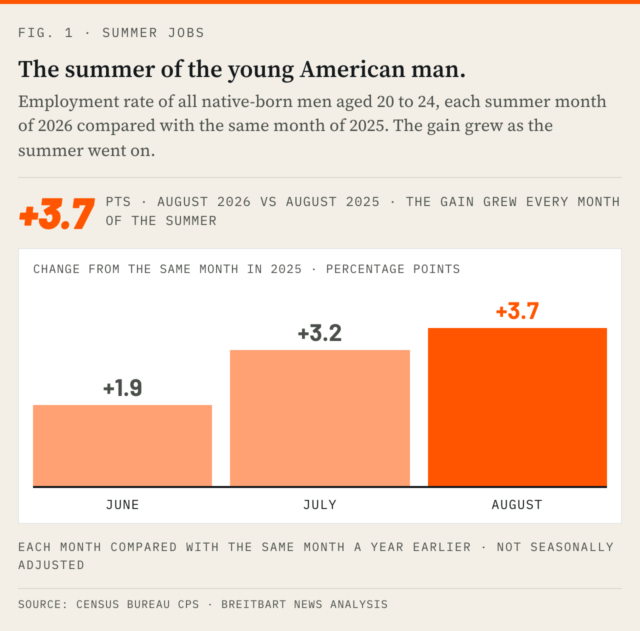
The eight-month average tells a similar story. January through August improved over 2025. So, the labor market has strengthened for young men.
The Construction Crew Missing from the Chart
It was a particularly good summer for young men looking to get into construction. This summer, approximately 938,000 native-born men ages 20 through 24 worked in the industry, compared with 802,000 last summer and 704,000 in the summer of 2024. Foreign-born construction employment, counting workers of both sexes ages 16 and older, fell from approximately 3.69 million in summer 2024 to 3.27 million this summer.
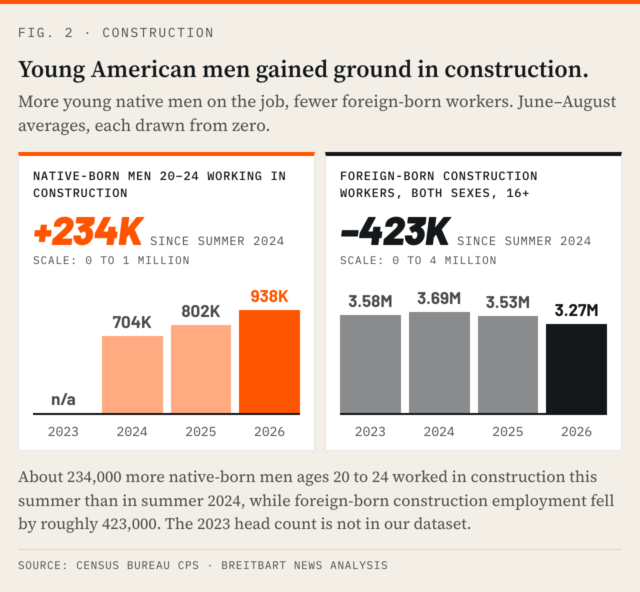
Those native gains survive Konczal’s preference for rates over levels. (He thinks the levels are distorted by measurement and estimation issues.) The share of all native-born men ages 20 through 24 employed in construction rose from 7.48 percent in summer 2024 to 9.43 percent this summer. It also exceeded the 7.98 percent recorded in summer 2023.
Evidence for this can be found in Konczal’s own construction calculations. His supplementary output includes native-born people ages 16 through 24, combining men and women. Their construction employment rate rose from 2.69 percent in 2024 to 3.23 percent in 2026, also exceeding 2023’s 2.95 percent.
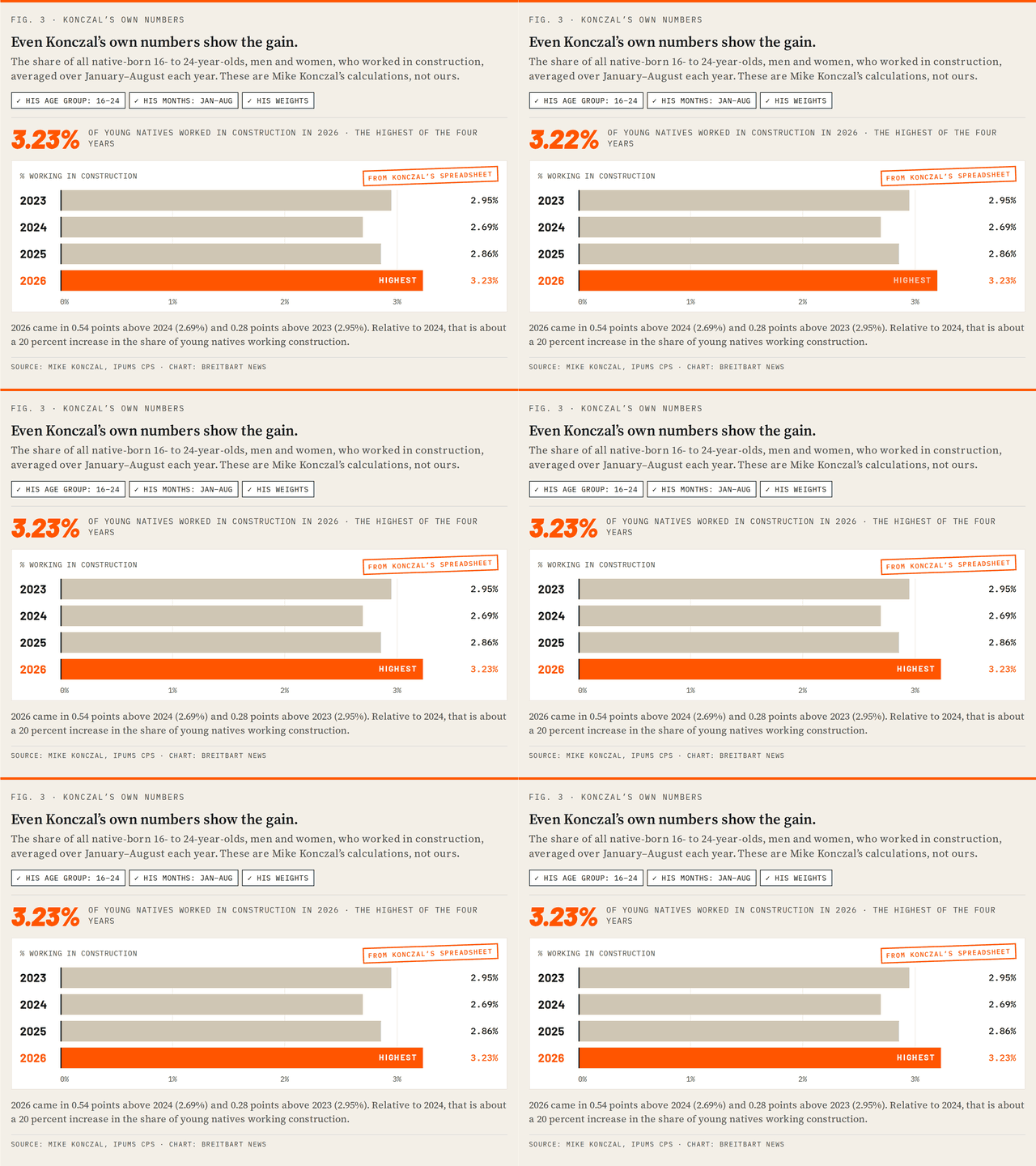
That comparison covers January through August in every year. It uses his age definition, his weights, and his averaging method. By his own calculation, young natives became more likely to work in construction.
Who Cares About Young Men, Anyway?
While there are perfectly respectable reasons to examine prime-age employment, a finding about those workers cannot stand in for a finding about all natives. Young people seeking an initial foothold may respond differently to an available construction or food-service job than workers with established careers and different wage expectations. Excluding them is consequential when the question concerns who might benefit from openings left by departing workers or otherwise benefit from a labor market with fewer foreign workers.
Note that these are survey estimates, just as Konczal’s are, and the narrower groups have greater sampling uncertainty, so our findings deserve some caution.
There is a reason to care particularly about opportunities for young men. In the Easterlin Baby Boom framework we have discussed before, young men’s economic prospects, measured against the living standards they hope to achieve, help shape decisions about marriage and children. A construction job that develops into a trade, steady earnings, and the confidence to establish a household could matter well beyond the next employment report. The baby boom happened because of the opportunities and prospects for young men created by a hot economy following the Great Depression and the Second World War.
For now, the evidence says young native-born men had a strong summer, with construction a conspicuous source of improvement. Unless you are the narrator of Eddie Cochran’s hit “Summertime Blues”—who famously resented having to work when he wanted to be out driving and going on dates with girls—it was a good time to be a young American man.
Read the full article here