


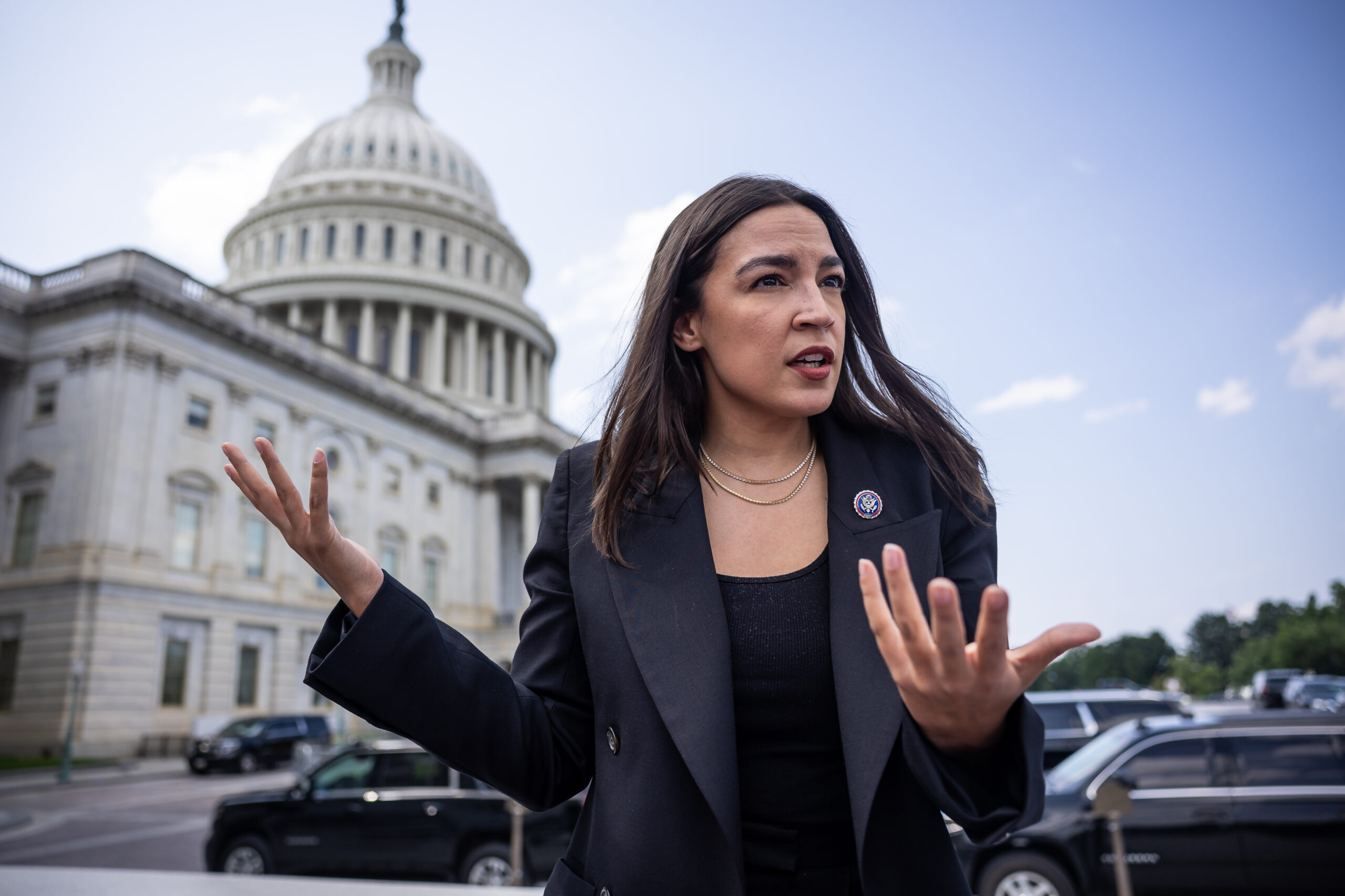
A group of 10 Democrats has signed on to Rep. Greg Casar’s (D-Texas) bill that would ban superintelligence and pause advanced AI development until a vetting regime could be stood up.
Reps. Alexandria Ocasio Cortez (D-N.Y.) and Ro Khanna (D-Calif.), both of whom are mulling a 2028 presidential run, are cosponsoring the bill, named the Ban Artificial Superintelligence Act.
Khanna, in a statement, noted that he convened a hearing this week on AI safety cooperation between the U.S. and China as ranking member of the House China Select Committee with AI experts who underscored the need for a verifiable pause on superintelligence.
AI superintelligence is an as-yet hypothetical form of the advanced technology that surpasses humans’ cognitive capabilities, but exactly when AI crosses the threshold into superintelligence remains contested. The bill would subject violators to a 20-year prison sentence.
The support from prominent progressives in the Democratic caucus comes as the party is navigating how they would approach AI regulation should they retake control of one or both chambers in November.
Other cosponsors include Reps. Analilia Mejia of New Jersey, Yassamin Ansari and Adelita Grijalva of Arizona, Val Hoyle of Oregon, Stephen Lynch of Massachusetts, Chuy García of Illinois, Chris Deluzio of Pennsylvania and Nydia Velázquez of New York.
“We absolutely have to slow down and regulate the advancement of dangerous AI technologies that have the potential to spiral out-of-control and threaten humanity,” Ansari said.
To Lynch, a string of recent AI-led cyberbreaches has “shown us that the advanced forms of this are out of control,” he said in an interview. “We haven’t really solved that control problem yet, nor have we got the alignment problem right yet.”
Casar’s bill, introduced this week with Sen. Bernie Sanders (I-Vt.), is among the most stringent AI regulations proposed by either party.
Rather than focusing on bans as Casar and his progressive allies have done, centrist Democrats are looking to legislative proposals they say can address the technology’s risks without stifling innovation.
Read the full article here