


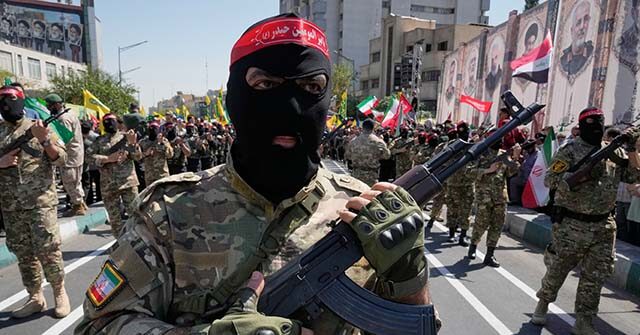
Iran’s military threatened “sustained, effective and painful” attacks on U.S. bases and interests across the Middle East if Washington strikes the Islamic Republic again, as President Donald Trump warned Sunday that “very big things” were coming as he weighs his next move against Tehran.
Iran’s Khatam al-Anbiya Central Headquarters, the military’s central operational command, warned that if the United States “commits any mistake” against Iran, “all its bases and interests in the region, without any limitation or consideration, will be targeted by sustained, effective and painful attacks.”
Regional countries that assist in another U.S. attack would also be treated as parties to the conflict and “can no longer expect restraint or civility from Iran’s powerful Armed Forces,” the command warned.
The escalating threats come at a potentially pivotal point in the nearly seven-month conflict, with Trump weighing further military action against Iran while leaving open the possibility of direct diplomacy as world leaders gather in New York for the United Nations General Assembly.
In a phone call Sunday with Fox News chief foreign correspondent Trey Yingst, Trump said he was in “deciding mode” over Iran and that “very big things are going to be happening in the not-so-distant future.”
Yingst said the president described the choices before him as wiping Iran out, allowing the country to “rot economically,” or making a deal.
“My question is, if and when do I blow the entire nation up?” Trump said. “They better behave.”
Iran’s military command, meanwhile, said it had received information indicating that Washington was preparing another attack, claiming the decision was made at a meeting in Europe with the “green light” of some regional countries. The command did not disclose what information supported the assertion.
Iranian officials have increasingly raised the prospect of renewed fighting in recent days. Mohsen Rezaei, secretary of Iran’s powerful Supreme National Security Council, said Saturday that another American strike was “very much on the cards” based on Tehran’s military assessments and declared Iran prepared for a “decisive war.”
At the same time, Rezaei said Qatar had conveyed Iran’s conditions for renewed negotiations to Washington and that Tehran was awaiting Trump’s response.
“Our conditions are an end to the war on all fronts, the release of our frozen funds and an end to the naval blockade,” Rezaei told Al Jazeera.
Iranian Parliament Speaker Mohammad Bagher Ghalibaf similarly cast military pressure and diplomacy as complementary rather than competing approaches.
“We must fight rationally and from a position of strength, and negotiate with confidence and pragmatism when the time is right,” Ghalibaf said.
Ghalibaf said Iran would not return to the previous negotiating framework or reopen the Strait of Hormuz until Tehran’s conditions are met, its claimed rights recognized and what he described as U.S. commitments fulfilled.
The demand to end the blockade comes as Washington continues tightening economic pressure on Tehran while expanding protected commercial traffic through the Strait of Hormuz.
U.S. Central Command chief Adm. Brad Cooper announced Saturday that American forces have supported the passage of more than one billion barrels of crude oil from Gulf partners through the strait in recent months while Iran has exported zero barrels through the waterway under what he called an “ironclad blockade.”
CENTCOM said Sunday that U.S. forces have now redirected 109 commercial vessels “to ensure total compliance” with the blockade.
The confrontation is unfolding amid heightened tensions elsewhere in the region, including renewed attacks by Iran-backed Houthi terrorists against Saudi Arabia.
The State Department warned Americans of the “potential for unforeseen escalation” in the Middle East following Houthi ballistic missile and drone attacks against the kingdom, including a missile launched toward Riyadh.
Trump told Yingst, however, that Washington remains in “constant communication” with the Houthis and said the group had agreed not to fight the United States.
The military escalation comes just as Trump and Iranian President Masoud Pezeshkian prepare to converge on New York for the United Nations General Assembly, providing a potential diplomatic opening even as Washington and Tehran trade increasingly severe threats.
Asked whether he would meet Pezeshkian on the sidelines of the gathering, Trump told Yingst he would “probably be open” to doing so.
Pezeshkian is expected to attend the General Assembly this week, while Trump is set to meet leaders from the six Gulf Cooperation Council states, with Iran expected to figure prominently in the discussions.
For now, Trump has given no indication which course he will take.
“He tells Fox News he’s in a ‘deciding mode,’” Yingst reported Sunday, “and that very big things are going to be happening in the not-so-distant future.”
Joshua Klein is a reporter for Breitbart News. Email him at [email protected]. Follow him on Twitter @JoshuaKlein.
Read the full article here