


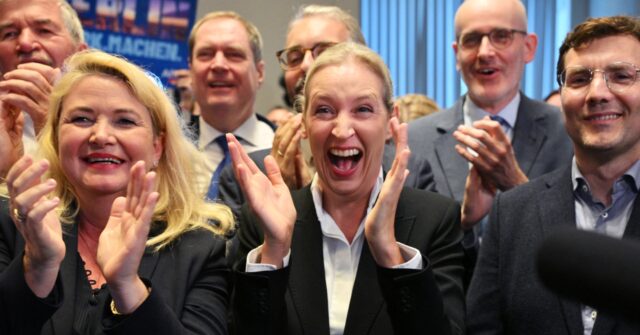
Exit polls for the Mecklenburg-Western Pomerania election suggest that the anti-mass-migration Alternative for Germany (AfD) party is on track for its second top-place finish in a state vote in less than a month.
According to German public broadcaster ZDF, the Alternative for Germany is currently leading in initial projections for the makeup of the state parliament in Mecklenburg-Western Pomerania. Die Welt reported that the AfD is projected to have won 38 per cent of the vote, followed by 36.5 per cent for the left-wing Social Democratic Party (SPD).
At present, both the far-left Die Linke (The Left) and Chancellor Merz’ Christian Democratic Union (CDU) are on course to surpass the five per cent threshold required to be allocated seats within the local parliament.
Should the CDU fail to meet such a threshold by the end of the count this evening, it could worsen the prospects of Merz remaining in power, which have faltered following his party’s disastrous defeat to the AfD in the Saxony-Anhalt local elections earlier this month.
Meanwhile, Die Linke is projected to have won the elections in Berlin with 26 per cent of the vote, followed by the CDU at 20 per cent.
Merz has reportedly been in crisis talks this afternoon at the CDU headquarters in Berlin as he looks to convince party bigwigs to continue to back his chancellorship.
Despite the second major defeat in a month, the Chancellor said on Sunday evening that he would not resign from his post.
In an address to the nation following the exit polls, Merz admitted that the result in Mecklenburg-Western Pomerania was a “disaster, but said: “Change takes strength. Not all of it will be applauded. In some areas the results will only appear after some time. We take on this responsibility, I take on this responsibility because I want to move our country forward.”
Since coming to power 16 months ago, Merz has seen his popularity continually decline, with his disapproval rate reaching a record high of 85 per cent following last month’s elections in Saxony-Anhalt.
For comparison, the previous record holder, former Chancellor Olaf Scholz, had a disapproval rate of 76 per cent prior to last year’s elections, when his left-wing Social Democratic Party (SPD) was resounding rejected by voters.
Despite this, Merz immediately moved to form a coalition with the election-losing Social Democrats, rather than partnering with the AfD, which he has branded as beyond the pale, thereby enacting a so-called firewall against cooperating with the populist party.
Yet, the absurd situation in which the election losers remain in power has confirmed to many that the political establishment –whether they lean left or right — is merely two sides of the same coin and will act in the service of their own power over the well-being of the country and its people.
The move also significantly hemmed in Merz’s ability to enact swift reforms, as votes in the Bundestag depend on the left-wing SPD, which opposes lower government spending, tax cuts, and reduced immigration, all of which remain top priorities for the German public.
This has left a lane open for the AfD to grow on the right; however, the 13-year-old party is now dominating at the national level, holding a lead of 27 per cent to 20 per cent over Merz and the CDU and appears set to continue consolidating power at the state level.
AfD co-leader Tino Chrupalla hailed the “sensational result” for his party in Mecklenburg-Western Pomerania, which he said, “clearly gave the AfD a mandate to govern.” However, it the SPD may be in a position to form a minority coalition government to keep the AfD out, as also appears possible in Saxony-Anhalt.
Chrupalla also said that Chancellor Merz should resign and provide some “relief” to the country.
Follow Kurt Zindulka on X: Follow @KurtZindulka or e-mail to: [email protected]
Read the full article here