


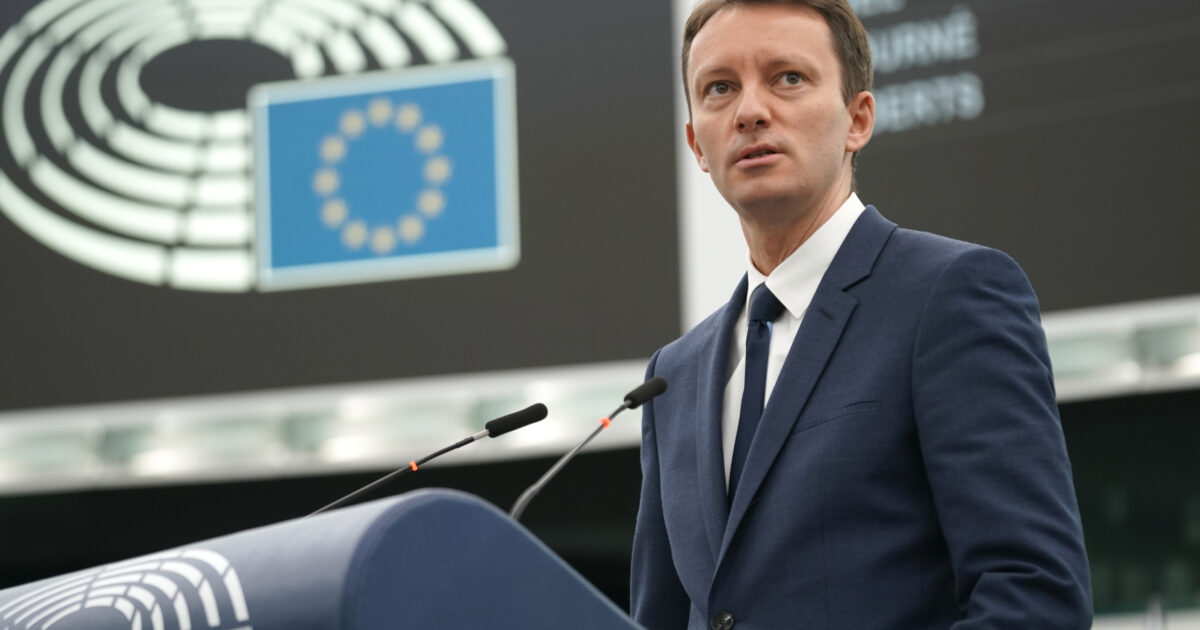
After months of political deadlock, Romania’s globalist President Nicușor Dan has reached for one of Romania’s most deeply embedded Brussels politicians, nominating Liberal MEP Siegfried Mureșan as prime minister despite the absence of a clear parliamentary majority.
The choice has sharpened an already bitter argument over whether Romania’s next government should answer first to voters at home or to the fiscal, political and institutional demands coming from the European Union.
Mureșan, according to reports from the Romanian sovereigntist press, now has ten days to assemble a cabinet and seek Parliament’s confidence. His nomination follows two failed attempts by Dan to install a government, extending a political crisis that began when the previous coalition collapsed in May.
The symbolism, for Romania’s right-of-center opposition, could hardly be clearer. Instead of bringing AUR — the country’s largest opposition force — into government negotiations on equal terms, the presidency has returned to a politician whose career and political identity are closely tied to the European Parliament and the machinery of Brussels.
George Simion put AUR’s answer in deliberately nationalist terms. “We don’t vote for Germany, France or three roses. Only Romania,” he wrote after Mureșan’s nomination, using the German and French flags alongside symbols widely interpreted as a reference to PSD.
The message wasn’t subtle. Simion’s argument is that Romania’s government should be built around Romanian political consent rather than around combinations shaped by the preferences of Berlin, Paris, Brussels or the traditional parties that have dominated government since the fall of communism.
Earlier Thursday, the AUR leader said directly that “it cannot be done without AUR” and accused Dan of keeping the party away from power despite its willingness to govern. Simion blamed the president for prolonging the crisis and argued that demonizing AUR had become an excuse for preserving the old political architecture.
The nomination therefore reinforces the political fault line that has widened since Romania’s extraordinary 2024 presidential crisis. That election was annulled by the Constitutional Court after intelligence reports alleged foreign interference, campaign-financing irregularities and manipulation surrounding the surprise first-round victory of Călin Georgescu.
The annulment remains one of the most divisive events in modern Romanian politics. Georgescu and his supporters regard it as proof that institutions were willing to overturn an electoral result once voters moved decisively outside the established pro-EU consensus; the Constitutional Court said the intervention was necessary because the integrity of the electoral process had been compromised.
Nicușor Dan subsequently won the rerun presidential election, giving him a legal electoral mandate. Yet the earlier cancellation continues to weigh heavily on public trust, particularly within the sovereigntist camp, where the episode is treated as a warning about the limits of acceptable political dissent when voters challenge Romania’s established Euro-Atlantic direction.
Mureșan’s nomination lands within this unresolved dispute. He is not simply another PNL politician: he has spent years at the center of EU budget negotiations and recently emphasized that crucial decisions about Romania’s future financing are being negotiated at European level.
Mureșan himself argues that this Brussels experience is precisely what Romania needs. He has said the country requires “competent” representation during negotiations over the EU’s next seven-year budget and has presented his role in defending Romanian funding inside the European Parliament as evidence of his suitability for government.
Critics in the national conservative camp see the same résumé very differently. Their concern is that Romania has become increasingly governed through a system in which domestic budgets, public-sector reform, state-company policy and investment priorities are tied to conditions negotiated with European institutions.
That leverage isn’t just theoretical. Romania is expected to lose roughly €770 million in EU recovery money because political paralysis prevented the completion of reforms required by the European Commission, including changes involving public-sector pay and state-owned companies.
Earlier this year, Brussels also released €2.25 billion in recovery funding only after Romania met dozens of agreed milestones involving taxation, pensions, healthcare, energy, transport, justice and other areas. Supporters call that system a mechanism ensuring reforms are actually implemented; critics argue it gives European institutions extraordinary influence over policies normally associated with national governments and parliaments.
Even the Social Democrat (PSD) leader Sorin Grindeanu reacted with hostility to the nomination. He accused Mureșan of recently campaigning in Brussels in ways that could cost Romania European funding and said it was difficult to understand why Dan had chosen him — allegations that reflect PSD’s political interpretation of Mureșan’s record rather than an established finding of wrongdoing.
Grindeanu also attacked the economic record of the outgoing governing arrangement, claiming Romania faced a budget hole exceeding 30 billion lei after citizens had already been asked to accept repeated sacrifices in the name of fiscal consolidation. Credit agencies have separately warned that continued instability and failure to control the deficit could threaten Romania’s investment-grade credit rating.
That puts Romanian voters in an increasingly familiar bind. Brussels demands fiscal reform before releasing portions of EU money, credit-rating agencies demand spending discipline, and national governments then present tax increases, wage restraint or restructuring as unavoidable necessities — while opposition parties ask how much room remains for Romanian voters to choose a substantially different economic course.
AUR has increasingly built its political challenge around precisely that question. Rather than rejecting European cooperation outright, the party frames sovereignty as the right of Romania to determine its own priorities on agriculture, taxation, energy, migration, foreign policy and public spending without treating Brussels preferences as automatically superior to domestic political choices. And the Romania people have appeared to place their trust in AUR as a result.
Romania, INSCOP poll:
AUR-ECR: 38% (+1)
PNL-EPP: 20% (+4)
PSD-S&D: 18% (-2)
USR-RE: 10% (-3)
UDMR-EPP: 5% (+1)
S.O.S.RO-NI: 3%
SENS→G/EFA: 3% (+1)
POT-*: 2% (-2)+/- vs. 01-07 April 2026
Fieldwork: 11-14 May 2026
Sample size: 1,100➤ https://t.co/UhvC4YNJL2 pic.twitter.com/n4ZsnK7y23
— Europe Elects (@EuropeElects) May 18, 2026
Mureșan represents the opposite institutional tradition: Romania maximizing its influence by operating deeply inside EU structures and negotiating aggressively for money and influence from within them. His supporters regard that as realism for a country whose economy and development are deeply intertwined with the European Union.
The conflict, then, isn’t simply “pro-Europe” versus “anti-Europe.” It is increasingly about what kind of Europe Romania belongs to — one in which national elections retain broad freedom to change policy, or one in which membership comes with increasingly detailed fiscal, regulatory and institutional conditions.
That question has acquired extra force because of the 2024 election annulment. For Georgescu’s supporters, the cancellation shattered confidence that Romania’s institutions would tolerate a sovereigntist electoral breakthrough; supporters of the court’s decision counter that no democracy is obligated to ignore credible evidence that an election’s integrity has been compromised.
Now the same divide has resurfaced around the government itself. Dan has chosen a Brussels veteran backed by the traditional pro-EU center-right, while Simion is openly telling voters that AUR will not support a government it sees as representing Germany, France, PSD or the existing establishment rather than “Romania.”
Mureșan still has to survive Parliament, and there is no guaranteed majority waiting for him. That means Romania’s political crisis remains unresolved even after the nomination — and the argument over Brussels, national sovereignty and AUR’s exclusion is likely to intensify rather than disappear.
The immediate question is whether Mureșan can build a government. The larger one is the question Romania has been wrestling with since the cancelled presidential election: how much authority should remain with Romanian voters and national institutions when so many consequential economic and political decisions are increasingly negotiated through Brussels, international markets and the Euro-Atlantic system?
Ad block users: Some site features may not work correctly while an ad blocker is enabled, because they break scripts and content this website depends on. If you can’t see comments below, for example, please disable your ad blocker.
Read the full article here