


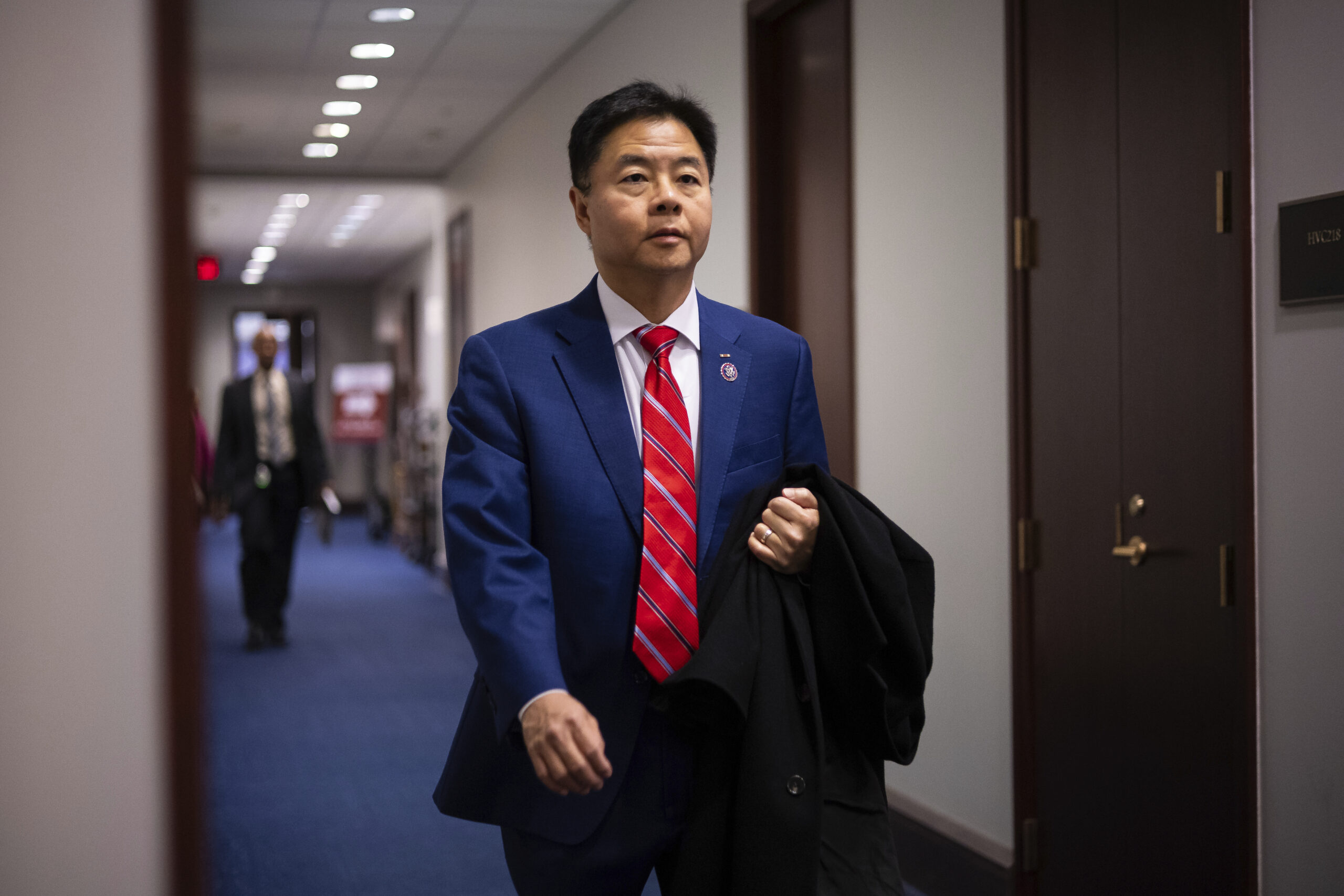
A key House Democrat involved in developing an artificial intelligence framework for his party called Wednesday for committee consideration of a bipartisan bill to regulate the most advanced AI models — even as he has held off on endorsing it.
Rep. Ted Lieu of California is a co-chair of House Democrats’ AI Commission, as well as vice-chair of the House Democratic Caucus. He has previously taken a careful approach to the FRONTIER Act, which is the only comprehensive AI safety legislation that has bipartisan support.
“I absolutely believe that the Energy and Commerce Committee needs to do a markup of that bill, but we’re going to go on vacation in a couple days because that was Speaker [Mike] Johnson’s [R-La.] choice,” Lieu said at a news conference Wednesday.
It’s the first time Lieu has said that the bill should move forward, explaining that he wants to “support the legislative process” as the commission works to release its own policy recommendations in the coming weeks.
Lieu appeared alongside other Democrats on Wednesday, including FRONTIER Act co-author Rep. Lori Trahan of Massachusetts. They gathered to demand Republican leaders facilitate a process for members to come together to discuss an AI regulatory framework amid growing threats that the technology is developing faster than humans can control it.
But Democrats have been divided over whether the answer on AI safety is to put guardrails on the technology or ban certain advancements altogether. They’ve also sparred internally over whether to preempt states from setting their own AI guardrails.
The FRONTIER Act, led by Trahan and Rep. Jay Obernolte (R-Calif.), would establish tiered requirements for AI labs that would include independent audits, incident reporting and risk-management frameworks.
Trahan made the case for her bill at the news conference as the product of many meetings with industry and members.
“Incident reporting — that’s mandatory, which, by the way, we don’t have today,” she said, saying it would have required transparency around this summer’s hacking incident by a rogue swarm of AI agents: “The only reason why we know about the Hugging Face incident is because OpenAI chose to tell us.”
She responded to concerns from others in her party who say her efforts with Obernolte simply do not go far enough to protect Americans from runaway AI technology, saying it was a meaningful compromise bill that has a path to become law.
“In a perfect world, if I had my way, writing that bill, would it look different? Absolutely,” she said. “I chose to legislate in the reality that we’re in right now, which is, we’re going to need this to be bipartisan. If we’re going to pass it tomorrow, we will likely need it to be bipartisan.”
Republicans have also been slow to galvanize around the Obernolte-Trahan proposal. In an interview Wednesday during the POLITICO Decoded Summit in Washington, Energy and Commerce Chair Brett Guthrie (R-Ky.) would not commit to putting the bill up for a markup but gave the bipartisan duo some credit: “Everybody says we need to do something, and nobody has put a product on the table except for Jay and Lori.”
Meanwhile, the Democratic AI Commission that is likely to recommend more aggressive controls on frontier models is still working through its process with no defined due date.
“We’re still taking input from stakeholders,” Lieu said, deferring to House Democratic Leader Hakeem Jeffries of New York on timing.
Read the full article here