


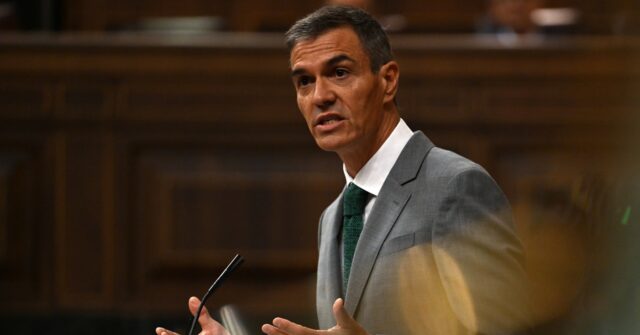
Socialist Prime Minister of Spain Pedro Sánchez on Thursday insisted before Congress there is no “solid proof” the government of Morocco drove the massive migrant invasion of Ceuta.
Sánchez appeared before the Spanish Congress to report on his administration’s widely-criticized handling of the late July invasion of the Spanish enclave city — which remains far-from-resolved over a month later. According to Spanish outlets, Sánchez spoke for roughly two and a half hours.
The prime minister’s appearance before Congress comes just days after the revelation of a bombshell report from the Spanish National Police accusing Moroccan government agents of coordinating the chaotic migrant invasion of Ceuta. The report directly contradicts repeated claims espoused by Sánchez over the past weeks affirming the Islamic government in Rabat played no role in the events.
Sánchez, however, affirmed to the Spanish lawmakers nothing can substantiate such accusations against Morocco.
FLASHBACK: Tens of Thousands of Migrants from Morocco Flood into Spanish Territory
Per the public broadcaster RTVE, the socialist stated, “No one has provided the government with evidence leading to the conclusion that the mass entry into Ceuta was orchestrated or carried out by Moroccan authorities.”
“If such solid evidence existed, we would act accordingly, with the full force required by the situation,” Sánchez claimed.
Sánchez further affirmed he “humbly” believes that there are members of the opposition and citizens who did not vote for the ruling leftists that “admit” his government “is not afraid to stand up to foreign powers when the situation calls for it.”
“Gentlemen, let us go about our work as we always have, armed with proven, verified facts,” he said, before referencing the ongoing conflict in Iran and the war in Iraq, when “others took us to participate in an illegal war with false evidence.”
Sánchez however, reportedly acknowledged that the “lack of control” by Moroccan Gendarmerie forces on July 30 remains to be clarified to determine “whether there was incompetence or inaction.” According to RTVE, the Spanish Prime Minister further defended Morocco’s “collaboration” in the return of about 90 percent of the tens of thousands of migrants that invaded Ceuta.
“It’s one of the fastest return processes in Europe. That’s not just my opinion, the European Commission has acknowledged it,” said.
The prime minister also insisted his government did not receive any warnings prior to the invasion that could have “foreseen” the scale of the events. Sánchez affirmed before Congress that the only reports received were warnings detailing a surge in migrants swimming their way into Ceuta.
“It is one thing to note that the number of people swimming across was increasing, and quite another to say that extreme precautions must be taken to anticipate the arrival of 70,000 people in Ceuta within a matter of hours. No report made that claim, at least none that reached the Spanish government,” he said.
Unnamed government sources affirmed to RTVE that the Spanish government will publish a dossier containing all the existing reports so “the public opinion can know” about them on Tuesday, September 9.
The sources further stated that Sánchez did not defend Morocco “just because,” attributing it to the required “prudence” in international relations. As such, the sources reportedly stated, the government cannot act “without evidence.”
Referring to reports directly accusing Morocco, the sources emphasized there is “no conclusive evidence” to attribute any responsibility to anyone.
In contrast, other unnamed government sources from the La Moncloa presidential palace reportedly affirmed to El País that “Pedro Sanchez knows that the majority of Spain’s population, including the left and many Socialist Workers’ Party workers, blame Morroco.”
Despite his insistence that there is no evidence to accuse Morocco of being behind the migrant invasion, Sánchez reportedly admitted it is “evident” Madrid must review its relationship with Rabat, and the cooperation between both countries must be “different.”
Read the full article here