


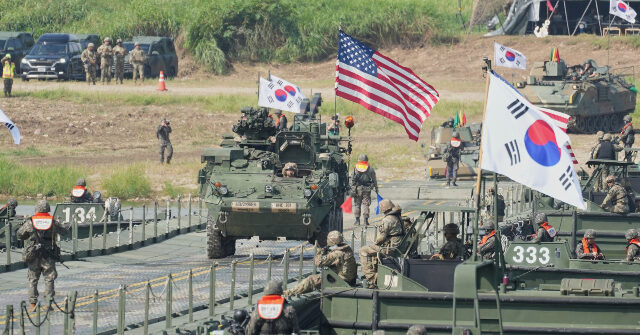
An unnamed official at the South Korean Unification Ministry told reporters on Friday that the government of leftist President Lee Jae-myung supports “direct” talks between President Donald Trump and North Korean communist dictator Kim Jong-un to facilitate an end to the 76-year-old Korean War.
The official made the remark in the context of President Trump announcing on Sunday that he had ordered a significant reduction in the time and scale of the Ulchi Freedom Shield exercises, which Seoul and Washington hold annually to prepare for any potential resumption of the Korean War. While the war began with the communist north invading the south in 1950, active hostilities ended in 1953 with the signing of an armistice agreement between the warring parties: South Korea and America on one side and North Korea and China on the other. The armistice agreement did not end the war, as it does not constitute a peace treaty and did not result in either side’s surrender.
President Trump said on Sunday, in a message on his website Truth Social, that he considered the military exercises inappropriate in the context of Kim’s regime not actively threatening to use its nuclear weapons against the United States during Trump’s two terms in office. Trump and Kim have for years enjoyed a friendly personal relationship, which Kim’s sister Kim Yo-jong confirmed on Thursday remains “excellent.”
The South Korean government issued a diplomatic statement expressing surprise at the reduction of the military exercises but stating that Seoul would support any measures that bring the Koreas closer to peace.
Speaking to reporters on Friday, the Unification Ministry official said that his government believes that true peace is impossible so long as North Korea insists on building nuclear weapons. The official nonetheless called talks between Kim and Trump the best chance for movement towards an end to the war.
“What engine is there to move this forward, other than the resumption of dialogue between Washington and Pyongyang?” the official was quoted as saying, adding that such talks would be a “practical” answer to the “standstill.”
The official, according to the South Korean Yonhap News Agency, was optimistic, suggesting that such talks could lead to “tectonic plates shifting” in Korean politics and the replacement of the armistice agreement.
“Through US-North Korea dialogue, a broader initiative could begin to address the fundamental issue and seek to transform the unstable armistice system on the Korean Peninsula,” the Korea Herald quoted the official as saying.
“North Korea has said it will not meet President Trump if denuclearization is on the table, so if dialogue does take place, it would amount, even if only by force of circumstances, to North Korea gaining some form of recognition of its nuclear possession,” the official added.
Full denuclearization of North Korea is necessary for peace, the official insisted: “The nuclear car is speeding ahead. You have to make it stop first before you can put it in reverse. You cannot reverse while it is still moving.”
“We urge the North not to distort our commitment to peace on the Korean Peninsula and to join us in the journey of transforming the unstable armistice system into a peace regime for the benefit and security of both South and North Korea,” the official’s remarks concluded.
Ulchi Freedom Shield (the joint military exercises) was scheduled to last 11 days, but most activities will now conclude on its fifth day, on Friday. Related live drills, Yonhap reported, would now last seven days rather than the previously scheduled fourteen.
Trump described himself on Sunday as “not happy” with the war games.
“Based on my very good relationship with Kim Jong Un, of North Korea, I am not happy with the fact that the United States has, long ago, agreed to participate in Joint Military Exercises with South Korea,” Trump wrote on Truth Social. “These exercises are not only costly, with much of these costs paid for by the United States of America (as usual!), but send a signal that is totally inappropriate and hostile.”
Elsewhere in his statement, Trump called North Korea “unthreatening and respectful” while he has been president and added that, in addition to his friendly relationship with Kim, he was dissatisfied with his relationship with Lee’s government in Seoul.
“While somewhat unrelated (?), I recently asked the President of South Korea if they would like to join us in the Denuclearization of the Islamic Republic of Iran, and they said, ‘No thanks!’” he added.
The North Korean government did not respond to the overture for some days. On Thursday, it launched about a dozen short-range ballistic missiles (SRBMs) into the East Sea (Sea of Japan) in protest of the exercises. Pyongyang’s choice of an SRBM, which cannot reach U.S. territory, appeared to be a deliberate choice to threaten only its close neighbors.
Kim Yo-jong, who the dictator typically uses to threaten and insult perceived enemies, published two screeds on Wednesday and Thursday: one claiming that she did not care about the limited military exercises, and one commenting extensively on the limited military exercises she purportedly did not care about. The first confirmed that Kim Jong-un is still fond of Trump, but Kim Yo-jong wrote that she could neither confirm nor deny comments from Trump that day that he had been personally communicating with her brother.
“As for the news from Washington that shortly ago, there was a communication between the leaders of the DPRK [North Korea] and the U.S., I am not aware of it at all,” she wrote, “and perhaps it may be the only thing I do not know as regards the foreign policy of our supreme leadership.”
“I had already clarified several times that our head of state has good memories and feelings about Trump personally,” Kim continued. “The relationship between those two leaders is still excellent. It is well known to the world and not a matter to be surprised, I think.”
Elsewhere, she mocked South Korea as a “puppet” state that could not control its own military exercises.
“The plight of the ROK [South Korea], which is compelled to stop the ‘war games’ it liked very much, is visualizing the structure of the relation between master and servant called the ‘U.S.-ROK blood alliance’ of which they have boasted,” she declared.
Follow Frances Martel on Facebook and Twitter.
Read the full article here