
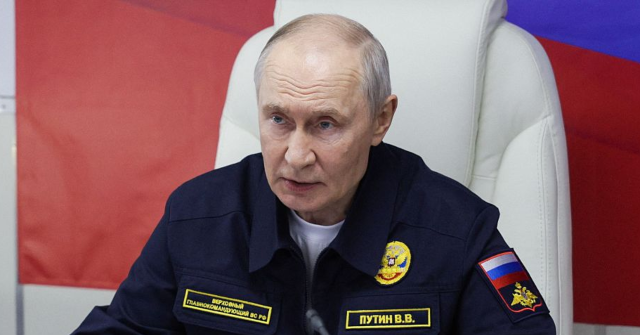
Russian President Vladimir Putin on Friday held a special meeting of the Russian Security Council to discuss securing and developing Russia’s assets in the Arctic Circle.
Those assets have grown more important now that China is using its “Ice Silk Road” strategy to avoid Iranian terrorism in the Strait of Hormuz by shipping goods through Russia’s Arctic route.
Russia’s state-run Tass news agency noted that the Russian Security Council has been meeting in person with unusual frequency this month. Participants include Prime Minister Mikhail Mishustin, the speakers of both houses of the Russian parliament, Security Council Deputy Chairman Dmitry Medvedev, Defense Minister Andrey Belousov, and Foreign Minister Sergey Lavrov.
The Security Council also includes the heads of both branches of the Russian security apparatus, Federal Security Service (FSB) director Alexander Bortnikov and Foreign Intelligence Service (SVR) director Sergey Naryshkin. The FSB is the successor to Russia’s feared Cold War-era secret police, the KGB.
“We have two issues on the agenda. The first is of a general military-political nature, while the second is more specific: it concerns the development strategy for the Russian Arctic and ensuring national security in the region. I propose we start with the second,” Putin told the assembled officials, before handing the meeting off to his Far Eastern envoy Yury Trutnev and Nikolay Patrushev, chairman of the Marine Board of the Russian Federation, a relatively new agency charged with implementing Russia’s maritime policies.
The Kremlin said that “some general matters of military and political nature were discussed,” in addition to Arctic issues.
A Chinese company called Sea Legend inaugurated regular shipping service along Russia’s Northern Sea Route and through the Arctic last week. Chinese Communist Party media quickly proclaimed the Arctic route to be a huge success, with bookings stacked up for the rest of the navigable season which will conclude in October.
China expert Gordon Chang told Fox News Digital on Thursday that China’s modest initial Arctic shipping route is testing the frigid waters for bigger projects to come.
“China has a major strategic push on the Arctic for various reasons. Arctic ice is melting, and this means that the Northern Sea Route, which hugs Russia’s north coast, does become viable at least for a few months in the summer,” he said.
“We need to be in the Arctic, and President Trump has authorized more icebreakers. We are woefully short in that department,” he added.
“The Arctic is a critical region for U.S. national security and the economy. As an Arctic nation, the United States will pursue its security and economic interests and ensure safety, stability, and prosperity in the face of growing competition from China and Russia,” a White House official responded.
China and Russia have been driven into a closer Arctic embrace by China’s difficulties with shipping through the Strait of Hormuz during the Iran crisis, coupled with Russia’s global isolation from its long and brutal war on Ukraine.
The two authoritarian powers have been looking for more ways to do business with each other, and the Hormuz crisis made China interested in leasing out the route Russia has chiseled through the polar ice. China also frets over losing free access to the Strait of Malacca, which lies between Indonesia, Malaysia, and Singapore.
Security analysts said Russia was initially reluctant to share, or sell, its hard-earned position in the Arctic, but China made some offers that were too lucrative to refuse.
China is now a 20-percent investor in Russia’s audacious Arctic LNG 2 gas pipeline project, which stalled out for more than two years before Beijing started throwing money and equipment at the North Pole. China’s massive purchases of Russian fossil fuels are keeping the Russian economy afloat, so Moscow was inclined to offer very good terms when Beijing expressed interest in using the Northern Sea Route — and because Russia has expanded that route to handle its oil shipments to Asia, there was plenty of room left over for Chinese cargo ships.
The Economist on Thursday noted that “seven of the eight countries with Arctic territory are Western democracies” and they are all worried about the eighth Arctic power, Russia, working closely with China on projects that “could be useful for future military purposes, such as operating submarines.”
China thinks it can overcome this resistance by presenting its Arctic shipping endeavors as an appealing alternative to terrorism-prone choke points like the Strait of Hormuz and Red Sea, the latter of which is menaced by Iran’s proxy in Yemen, the Houthis.
Japan and South Korea are interested in Arctic shipping as well, not only because it is more secure and shorter than Middle Eastern transits, but because the cold Arctic temperatures save money on shipping heat-sensitive goods such as electronic components, batteries, and electric vehicle (EV) parts. The downsides, in addition to the limited summer-fall shipping schedule, include very high insurance costs for Arctic passages and concerns about damage due to the unique and harsh polar environment.
Russia clearly knows it has some valuable polar real estate and a temporary edge in infrastructure, including icebreakers. For as long as Iran is making other countries nervous about using Middle Eastern trade routes, interest in Russia’s northernmost sea route is likely to remain high.
Read the full article here