


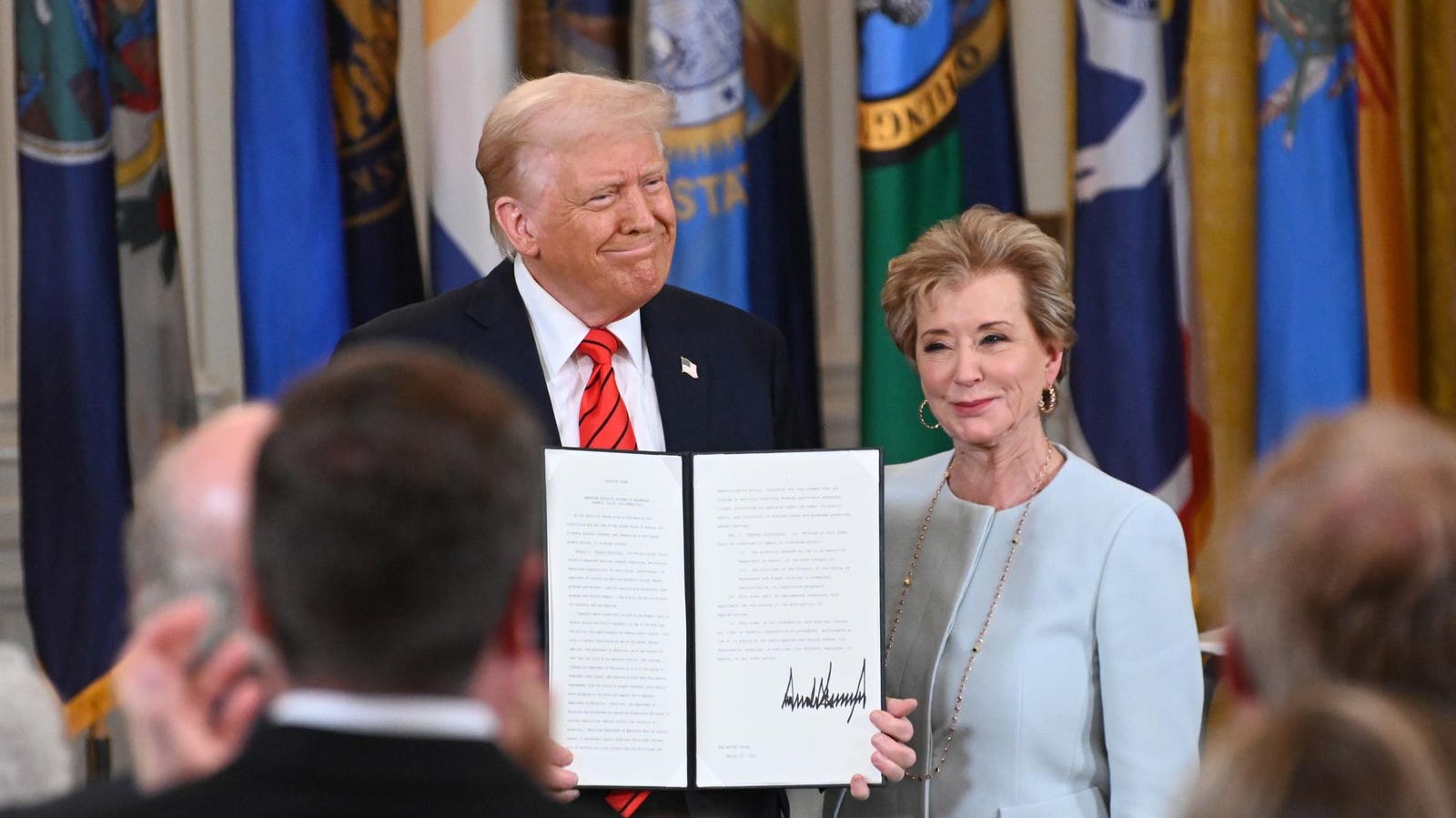
WASHINGTON, DC – U.S. President Donald Trump holding up a signed executive order poses with U.S. Education Secretary Linda McMahon at the White House on March 20, 2025. The Trump administration was pushing for new restrictions on student loan forgiveness under the PSLF program. (Photo by Chen Mengtong/China News Service/VCG via Getty Images)
China News Service via Getty Images
The Education Department cannot proceed with new regulations that could have cut off scores of borrowers from student loan forgiveness, said two courts on Tuesday. The long-awaited dual rulings over the Public Service Loan Forgiveness program, or PSLF, are a major win for borrowers, and a huge loss for the Trump administration. And student loans can now continue to be forgiven under the program.
“This is an important win for those who serve the public and for our democracy that proves, yet again, that the people and their lawyers are capable of reigning in the Trump-Vance administration’s lawlessness,” said Skye Perryman, President and CEO of Democracy Forward, one of the organizations that challenged the new rules, in a statement on Tuesday. “PSLF is a bipartisan promise to those who choose to work in public service, regardless of viewpoint, and the administration’s attempt to hold this congressionally-mandated program hostage was not just unlawful, but part of an alarming broader assault on those committed to public service. Democracy Forward is honored to work with this large coalition and grateful for their bravery in holding this administration accountable.”
The regulations, if enacted, would have given the department the power to unilaterally disqualify organizations from participating in the Public Service Loan Forgiveness program if they engaged in certain forms of disfavored activities. PSLF allows borrowers to get their student loans forgiven after making payments for at least 10 years while working in eligible nonprofit or public sector employment.
But the court rulings, while hugely significant, are not necessarily the end of the legal battle over student loan forgiveness. Here’s what the PSLF ruling means, and what borrowers with student loans enrolled in the program should know.
Trump Administration Sought To Cut Off Organizations From Student Loan Forgiveness
The Education Department’s new PSLF regulations, which were created to enact an executive order signed by President Donald Trump last year, would have given Secretary of Education Linda McMahon the authority and discretion to disqualify organizations from being eligible to participate in the PSLF program. By doing so, all employees of a targeted organization would become ineligible to receive student loan forgiveness under the program.
The criteria for PSLF disqualification would center on whether the organization’s activities have a “substantial illegal purpose.” Under the proposed rules, such activities could include facilitating certain forms of discrimination or the violation of federal immigration laws, providing certain medical services to transgender youth, and engaging in certain forms of protest.
When the department published the proposed regulations last fall, a wide array of nonprofit groups, labor unions, and state and municipal governments filed multiple legal challenges, arguing that the PSLF restrictions were nothing more than a pretext to coerce organizations that oppose the Trump administration’s policy goals. The groups also argued that the rules were blatantly illegal, as Congress never authorized the Education Department to disqualify otherwise-eligible PSLF employers under the criteria outlined in the Education Department’s regulations, and violated fundamental constitutional protections for speech, expression, and assembly.
The Education Department countered that the PSLF restrictions were not only perfectly legal, but were necessary in order to ensure that the government isn’t forgiving student loans based on illegal activities. The department also argued that the groups challenging the rules didn’t have standing to do so, as they could not demonstrate they have, or would be, harmed by the restrictions on student loan forgiveness.
“Because Plaintiffs cannot identify any actual or imminent loss of any Federal benefits, any investigation, or any enforcement action traceable to the Department, they do not have standing under Article III,” argued the department in an attempt to dismiss one of the lawsuits earlier this year. “Plaintiffs’ claims also fail on the merits. The Department promulgated the PSLF Final Rule pursuant to its broad authority to issue regulations governing the programs it administers and in doing so, properly discharged its obligation ‘to encourage borrowers to enter occupations that improve their communities and advance the public good while also guarding against the diversion of Federal benefits to organizations that harm their fellow Americans by engaging in illegal conduct.’”
Courts Block Student Loan Forgiveness Rule For PSLF
But on Tuesday, two separate federal district courts ruled that the Trump administration’s PSLF restrictions were unlawful.
“The final rule limits the definition of ‘qualifying employer’ to exclude certain section 501(c)(3) organizations based on the Secretary’s determination about the activities of the organization,” said the U.S. District Court for the District of Columbia in its ruling on one of the legal challenges led by the Robert F. Kennedy Center for Justice and Human Rights. “If, in the Secretary’s view, the section 501(c)(3) organization is one that ‘engage[s] in activities such that [it has] a substantial illegal purpose,’ then a borrower’s loan payments made while employed in a full-time job at the organization will no longer be credited under the program. 90 Fed. Reg. at 49001. That conflicts with the statute, which does not limit the program in that way or delegate authority to the to limit what counts as a ‘public service job.’”
“Congress unequivocally prescribed the requirements for PSLF-eligible public service jobs,” said the U.S. District Court for the District of Massachusetts in its separate ruling on two additional legal challenges brought by a broad group of nonprofit organizations, professional associations, and state and city governments led by the National Council of Nonprofits and the Commonwealth of Massachusetts. “The statute does not vest any discretionary authority in the Secretary to disqualify employers (and consequently borrowers) or to alter unambiguous requirements set forth” in “the repayment provision or the statutory definition of ‘public service jobs.’”
“Consequently, the Final Rule is unlawful because it permits the Secretary to disqualify statutorily eligible employers upon determining that they have a ‘substantial illegal purpose,” continued the court. “The Final Rule plainly contradicts the unambiguous text of the PSLF Statute and exceeds the scope of the Department’s authority because Congress does not require such a hurdle and did not specifically instruct the Department to impose it.”
Both courts vacated the rule. That means that the Trump administration’s proposed restrictions on student loan forgiveness under PSLF have been officially overturned, and the department must continue forgiving student loans under the program for all eligible borrowers working in qualifying employment who have met the program’s criteria.
Legal Battle Over Student Loan Forgiveness Under PSLF Isn’t Necessarily Over
While the new rulings over the Trump administration’s PSLF restrictions are a significant victory for borrowers, the legal battle may not be over. The Education Department is expected to appeal, which could lead to additional months of uncertainty for borrowers pursuing student loan forgiveness under the program.
In the meantime, though, no student loan forgiveness restrictions are in place for PSLF, and the department should continue forgiving student loans under the program. Following the dual court decisions, the new rules are vacated, and cannot go into effect on July 1 as planned. If the department appeals, though, a higher court could potentially revisit the recent rulings. Ultimately, borrowers hoping for student loan forgiveness under PSLF should keep an eye on the ongoing developments.
Read the full article here