


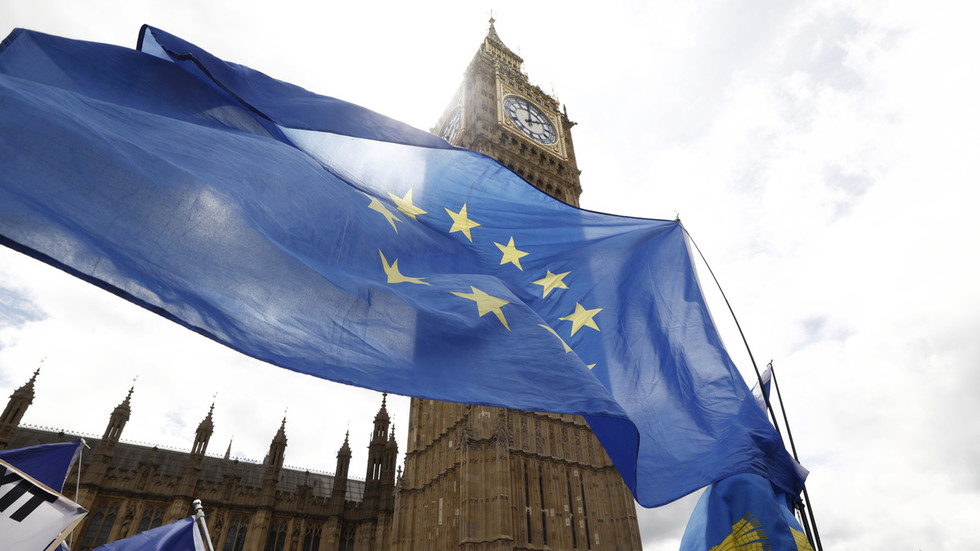
Mass immigration, elite contempt, stagnant living standards, and deep class division still drive the frustration that shook Britain in 2016
This week marks the tenth anniversary of the Brexit referendum – an event that has reshaped British politics over the past decade and may well continue to do so into the future.
Brexit had its origins in Britain’s complex relationship with the EU and its predecessor organization, the European Economic Community (EEC) – a relationship that has for decades been at the heart of British politics.
Since the 1950s, Britain has been divided over whether it should become a member of these European-based organizations, and the Conservative and Labour parties have always been split over the issue – with both right wing Conservatives and left-wing Labourites being strongly opposed to UK membership.
French President Charles de Gaulle, fearful that Britain would be a Trojan horse of American influence, vetoed two attempts by Britain to join the EEC in the 1960s.
In 1973, after de Gaulle’s death, Prime Minister Edward Heath, a moderate Conservative, arranged Britain’s belated entry into the EEC. When Harold Wilson became Labour prime minister in 1974, in response to pressure from the Labour left, he held a referendum a year later on whether Britain should remain a member – and 67% of UK voters decided that it should.
It is noteworthy that the 1975 referendum was conducted in a civilized manner, and that the arguments put forward by both sides were confined to the issue of EEC membership.

The EEC became the EU in 1993, and as it transformed itself from being an economic federation into an explicitly political and ideological bloc, Britain’s membership continued to be a controversial and divisive issue within UK politics.
Margaret Thatcher was always a lukewarm supporter of the EU – once describing it as “a European super-state exercising a new dominance from Brussels.” Thatcher refused to allow the British pound to be replaced by the euro, and engaged in a protracted war of attrition to prevent the EU from encroaching upon British sovereignty and independence. It was Thatcher’s dispute with her foreign secretary, Geoffrey Howe, over the EU that provoked his resignation, and led to the leadership challenge that deposed her as prime minister.
Tony Blair was an enthusiastic supporter of the EU and the vast expansion of its power and influence that occurred during New Labour’s term in office.
Fast-forward to David Cameron’s prime ministership in 2015. Cameron was then engaged in renegotiating the Maastricht Treaty – the foundational document of the EU that set out the terms governing Britain’s membership in the bloc. Right-wing Conservatives remained strongly opposed to Britain’s membership in the EU – and in order to obtain their support for his renegotiations, Cameron promised them that if he could not obtain an outcome they approved of, he would hold a referendum on whether Britain should leave the EU.
The EU refused to grant Cameron any concessions – and Cameron was obliged to hold a referendum, believing that it had no prospect of succeeding.
The Brexit referendum was set down for June 23, 2016 and Cameron, supported by Blair and a raft of politicians from both major parties, led the well-funded but poorly run and focused Remain campaign.
It soon became clear, however, that Brexit had become an issue around which deep-seated dissatisfaction with other, seemingly unrelated, issues – including mass immigration, the loss of British sovereignty, the faltering economy, the cost of living crisis, and ethnic diversity – galvanized.
A divide soon emerged between the impoverished working-class north of the country – opposed to immigration, woke ideologies, and wanting to preserve a culturally uniform and sovereign Britain – and the wealthy southeast, peopled by woke elites that had grown rich from globalization and had become accustomed to the benefits they enjoyed as a result of EU membership.
Long buried divisions within the Conservative and Labour parties re-emerged with renewed bitterness as the campaign got underway. Boris Johnson threw his lot in with the Leave campaign – thereby laying the basis for his election as prime minister in 2019. The Leave campaign also saw the emergence of Nigel Farage as an influential national political figure, and the Reform party has its origins in Farage’s Brexit campaign.
Dominic Cummings emerged from obscurity to run the successful Leave campaign – and on June 23, 2016, 52% of UK voters surprisingly voted to leave the EU. It was in the impoverished working class north that the Leave vote was by far the highest.
David Cameron, shocked by both the referendum result and the bitterness and division that he had unwittingly unleashed, immediately resigned as prime minister.
The divisions within British society conjured up by the Brexit referendum intensified over the next three years as the woke elites in the south joined forces with Remainer politicians (most notably Theresa May), the judiciary, the finance sector, the civil service, and most media organizations to sabotage the implementation of Britain’s departure from the EU.
Only after Boris Johnson’s election victory in 2019, on a platform of promising to “get Brexit done,” was Brexit finally implemented, four years after the referendum – and then only in a modified and partial form. Even today, Britain remains bound by the European Human Rights Act and a raft of EU legislation that had been incorporated into UK law.
Boris Johnson was never forgiven for implementing Brexit, and Remainer animosity played a large part in him subsequently being deposed as prime minister.
Brexit remains a live political issue in the UK today. In the recent leadership coup that saw Keir Starmer deposed as prime minister, Wes Streeting, one of Starmer’s challengers, advocated that Britain should rejoin the EU. And Andy Burnham – who will soon replace Starmer as prime minister – was forced to disavow his previous support for overturning the Brexit referendum result.
Most politicians, however, believe that the referendum result should be accepted, at least for the time being – notwithstanding that many would like to reverse it, and recent polls show that a majority of voters are now in favor of rejoining the EU.
Brexit may have receded somewhat into the background as a discrete political issue – but that is because the Brexit referendum itself exposed and highlighted those very issues – the cost-of-living crisis, mass immigration, woke ideologies, cultural diversity – that now completely dominate contemporary UK politics.
How then is the continuing impact of the Brexit referendum to be explained?
Remainer animosity – fostered by powerful elites – is perfectly explicable and it is not likely to go away any time soon. Nor is the rather stale debate about the economic consequences of Brexit likely to cease. But Brexit was never about economics – something that Cameron and most Remainers never understood – nor was it really about Britain leaving the EU.
The Brexit referendum was a catalyst that gave British voters who had been pauperized and culturally alienated by globalization a unique opportunity to express their mounting anger and dissatisfaction by the simple act of casting a vote in a referendum.
For these voters, the EU was a symbol of globalization and all its consequences – poverty for the working class, mass immigration, cultural diversity, and the dominance of woke ideologies. And what David Cameron did was give these voters, by voting yes or no to EU membership, an opportunity to vent their anger against globalization.
People who voted Remain were by and large those who had benefited from globalization and wholeheartedly embraced all of its consequences – economic, cultural, and ideological.
What the Brexit referendum did was dramatically expose, for the first time, the seemingly unbridgeable north/south class and ideological divide that is at the heart of contemporary British society. This divide still exists and has grown wider and more bitter over the past ten years – and that is why Brexit still resonates powerfully in Britain and will continue to do so into the future.
The statements, views and opinions expressed in this column are solely those of the author and do not necessarily represent those of RT.
Read the full article here