


The majority of Americans are in favor of the ceasefire deal between the United States and Iran, according to poll results shared by President Donald Trump on Monday.
The findings, originally published by top Republican pollster Fabrizio, Lee & Associates, showed that 67 percent of the 1,500 respondents surveyed from June 16 through 18 approve of the memorandum of understanding (MOU) that both countries signed last week.
Just 26 percent of respondents said they opposed the deal, and seven percent said they are “not sure,” according to the graph Trump shared on Truth Social, without a caption:
Another survey of 1,000 likely voters conducted on June 16 and 17 by Quantus found a 43 percent “strong” approval rating and a 13 percent “somewhat” approval rating for the MOU — a total of 56 percent support, 11 percent less than the latest Fabrizio, Lee & Associates poll.
A recent CBS News/YouGov poll also found that the vast majority of Americans want the U.S. to end the war with Iran now, with just 22 percent saying they are in favor of continuing the conflict until Iran gives up more on their side of the deal.
The full text of the MOU, signed remotely by Trump and Iranian President Masoud Pezeshkian, puts a 60-day ceasefire and negotiation framework into effect, though it requires complex international cooperation to finalize in the coming weeks and months.
On the U.S. side, the Trump administration has agreed to lift the naval blockade of Iran, work with regional partners to develop a mutually agreed plan with at least $300 billion for the country’s reconstruction and economic development, and terminate sanctions against the country.
Iran has agreed to reopen the Strait of Hormuz and has “reaffirm[ed] that it shall not procure or develop nuclear weapons.”
Iran notably does not have to give up its ballistic missile capabilities, according to the deal.
“If other countries have them, it’s a little bit unfair for them not to have some,” Trump said at the G7 forum the day he signed the MOU last week. “If Saudi Arabia and Qatar, and they all have some, I would say that in relative proportion, I think it’s OK. Am I going to let Saudi Arabia have missiles, but [Iran] can’t have them? It doesn’t work that way.”
Arguing that “missiles aren’t the problem” compared to Iran having nuclear weapons, Trump added that the Gulf nations “will address the nonnuclear issues, as we’ll be talking about the ballistic missiles.”
“And we’ll talk also about the terrorist proxies that they have that. We don’t want that to happen.”
Some of the aspects of the agreement come with deadlines for completion from 30 days to 60 days after the MOU’s signing.
“The United States of America and the Islamic Republic of Iran commit to negotiating and achieving the final deal in maximum 60 days extendable with mutual consent,” the document reads.
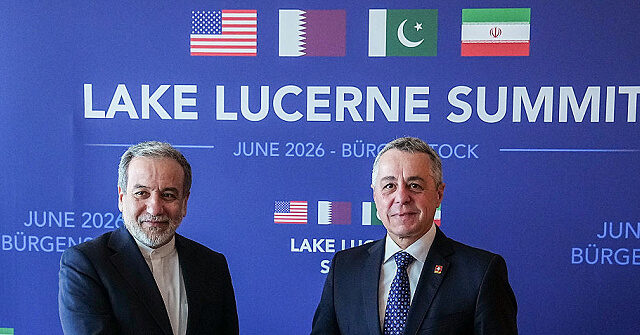
While Israel’s continued attacks on Lebanon threatened the peace deal, American and Iranian representatives gathered alongside mediation delegations from Pakistan and Qatar in Switzerland on Sunday.
The conversation ended that evening with “encouraging progress,” mediators Qatar and Pakistan reportedly said.
Olivia Rondeau is a politics reporter for Breitbart News based in Washington, DC. Find her on X/Twitter and Instagram.
Read the full article here