


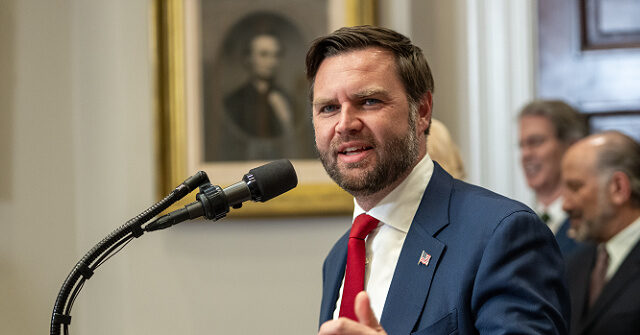
The White House confirmed on Thursday that Vice President JD Vance has delayed his trip to Switzerland for talks on the ongoing Iran peace deal.
The vice president had been scheduled to travel to Europe on Thursday to participate in a new round of negotiations for the Iran peace agreement that President Donald Trump signed this week. The White House confirmed the trip’s delay, highlighting statements made by the vice president during a press conference.
“As the Vice President said at his press conference, the plans for the upcoming technical talks have not been finalized, and the U.S. delegation has been prepared to depart at the first available opportunity,” the White House told the Hill.
“But the logistics of these negotiations have never been simple or predictable,” the statement continued. “As of now the Vice President is not departing tonight. We will let you know as soon as we have a concrete update about next steps. We look forward to beginning technical talks as soon as possible.”
As Breitbart News reported on Wednesday, the memorandum of understanding (MOU) that President Trump personally signed “lays out a broad plan to end the conflict and hash out a comprehensive deal within 60 days,” with the U.S. and Iran agreeing to immediately halt military operations while promising to withhold future attacks:
The deal also calls for winding down the U.S. naval blockade, reopening the Persian Gulf and the Strait of Hormuz to regular commercial shipping, and setting up a watchdog group to make sure both sides stick to the rules.
On top of that, the document says the U.S. will team up with regional partners to put together a massive $300 billion reconstruction and economic development package for Iran. Over time, the goal is to fully lift U.S., UN, and international sanctions. In the meantime, the agreement calls for waivers to clear the way for Iranian oil exports and banking transactions, alongside the release of frozen Iranian assets.
In exchange, Iran agreed that it will not pursue nuclear weapons and agreed to negotiate the future disposition of its enriched uranium stockpiles under the supervision of the International Atomic Energy Agency.
A recent poll from Quantus showed that the signed preliminary agreement has strong approval from a majority of Americans: 53 percent to 13 percent.
Read the full article here