


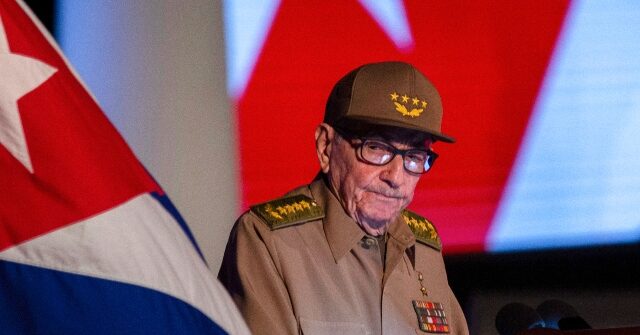
The Cuban Communist Party debuted a set of economic reforms on Thursday, allegedly intended to facilitate attracting foreign investment, that would make it easier for regime-approved individuals to create corporations or buy shares of existing entities – clearly a response to American sanctions targeting the Party’s most important money-making entities.
While mainstream media covering the announcement this week insisted on referring to the reforms as “unprecedented” and “historic,” in reality, the Cuban regime announces some form of allegedly “unprecedented” economic reform every few years as a ploy to attract international investment. In 2021, for example, the Cuban government claimed that it had legalized most “private” businesses, but only allies and members of the Party were allowed to then establish said “private” businesses. In March, dictator Raúl Castro’s grand-nephew Oscar Pérez-Oliva Fraga announced that the Party was encouraging Cuban exiles – who suffered under communist oppression, many of them tortured and starved – to invest in the survival of the Communist Party through business investments.
On Thursday, Cuban Prime Minister Manuel Marrero Cruz introduced a package of 176 “reforms” that Cuban officials insisted were necessary given the current economic “emergency,” calling them a “perfecting” of the economy. Marrero blamed the move on President Donald Trump taking measures to actually enforce the “embargo” that has existed, largely ignored by the United States for decades. Among the most effective measures the Trump administration has taken to limit American dollars going towards financing the oppression of the Cuban people by their government was the announcement in May of sanctions on the Grupo de Administración Empresarial (GAESA), a corporation run by the Cuban military that manages the regime’s tourism profits, remittances, and the Cuban slave doctor program. The sanctions prompted a dramatic reduction in foreign investment, most prominently the Spanish hotel giant Meliá announcing it would stop running 15 of its 34 hotels on the island.
“Life, reality, the dramatic situation that the world is living in, this unipolar world, forces us to do what we otherwise would have never done if we had had capital and if we had had the technology to do so,” the Cuban Communist Party newspaper Granma quoted Marrero as stating. The prime minister blamed “an unprecedented combination of coercive measures by the government of the United States” for interrupting fuel flows to Cuba and remittances, admitting Cuba cannot sustain its own economy without substantial largess from ideological allies and Cuban exiles forced to sustain their families from abroad.
According to the independent outlet Cubanet, the reforms include allowing companies and approved individuals to buy shares in Cuban companies, the facilitation of the “participation of foreign corporations” in the Cuban economy, and the more rapid creation of new Cuban corporations – clearly a move to create alternatives to GAESA and avoid the sanctions. In an apparent attempt to hide the totalitarian nature of the Cuban economy, the reforms would also allow the proliferation of Cuban corporations at the local and provincial level.
To ensure that Cuban citizens do not actually have access to this allegedly freer market, the reforms will also allow one individual to be the head of more than one corporation – elbowing out competition – and facilitate corporate restructuring, to bring corporations within the fold of a smaller number of people.
Cuban “president” Miguel Díaz-Canel, who is subordinate to dictator Raúl Castro, offered his own dramatic remarks on Thursday in favor of the reforms.
“Today, we face challenges of an enormous magnitude that demand unity, ideological firmness, courage, audacity, and creative resistance,” Díaz-Canel declared, according to Granma. “Reality imposes on us urgent and necessary changes. And when the people’s lives become so tough, the first duty of the Communist Party … is not to explain the crisis better, but change what needs to be changed to get out of it.”
The reforms do not reportedly include any increase in taxes on the Castro family or the small circle of elites who live lavish lives on the island, nor do they include any financial contributions by the Castros and their inner circle to humanitarian aid or any investment in infrastructure, hospitals, sanitation, or the power grid.
As it is a communist state, Cuba generates no meaningful profits and cannot fund itself without a parasitic relationship with a friendly state, such as the former Soviet Union or Venezuela. Following the arrest of former Venezuelan dictator Nicolás Maduro, Cuba lost a critical source of virtually free oil, ravaging the tourism industry as the country ran out of jet fuel and reliable electricity through generators. The Communist Party has invested almost nothing in maintaining the nation’s power grid, so regular Cubans have been enduring unreliable power and routine blackouts for years, but the lack of Venezuelan oil flowing in the country leveled the playing field with international tourists and hotels and other sites run by foreign corporations.
The Communist Party has attempted to reach out to critical ideological allies around the world, most prominently China and Russia, for financial support, but has received no meaningful backing.
Follow Frances Martel on Facebook and Twitter.
Read the full article here