


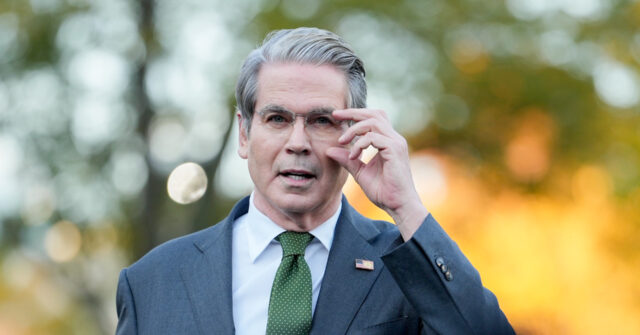
Treasury Secretary Scott Bessent on Friday delivered the Trump administration’s most sweeping statement yet of its economic-security doctrine, arguing that decades of bipartisan trade policy left the United States strategically dependent on foreign rivals and that the administration’s tariffs, industrial policies, and supply-chain measures are not a break with American tradition but an attempt to recover it.
The address, titled “While America Slept” and timed to the nation’s 250th anniversary, amounted to a comprehensive intellectual accounting of how the post-Cold War consensus on trade, globalization, and industrial policy had, in Bessent’s telling, eroded American sovereignty — and what the administration intends to do about it.
“A nation that cannot manufacture, mine, ship, or refine its needs gradually cedes its strength — and sovereignty — to others,” Bessent said. “That is a dangerous dependency for any country. It is an unacceptable one for the United States.”
The speech was notable as much for its philosophical ambition as for its policy content. Rather than defending specific tariff actions or trade measures on narrow economic grounds, Bessent challenged the underlying framework that has governed American economic thinking for a generation, the idea that cheaper goods and efficient supply chains were adequate measures of national prosperity.
“We measured abundance at the checkout counter rather than the factory gate,” he said. “We talked about GDP, but not enough about its composition.”
The address drew comparisons to Secretary of State Marco Rubio’s address to the Munich Security Conference in February, in which Rubio articulated a new framework for American foreign policy to a skeptical European audience. Where Rubio’s Munich speech was widely seen as the moment the administration’s foreign policy vision achieved doctrinal coherence, Bessent’s Reagan Institute address appeared to represent a similar crystallization on the economic side.
Bessent traced what he described as a series of compounding errors: the decision to treat trade policy as separate from national strategy; the extension of strategic trust to China through WTO accession and permanent normal trade relations; and the embrace of just-in-time supply chains that the pandemic exposed as brittle. The failures, he argued, were not accidental but philosophical — the product of a political class that had “preferred the comfort of old formulas.”
“The warning lights were glaring all around us,” he said. “Cheaper was always better. Offshoring was inevitable. Industrial policy was unfashionable. And strategic dependence was acceptable so long as the cost remained invisible.”
In enumerating the administration’s response, Bessent presented a series of executive actions — the America First Trade Policy memorandum, reciprocal tariff actions, Section 232 designations on critical minerals, an executive order on maritime dominance, and the Strategic Active Pharmaceutical Ingredients Reserve — not as isolated measures but as components of a unified strategic doctrine linking trade, industrial capacity, and national security.
Bessent was careful to distinguish the doctrine from protectionism or isolationism. “It does not mean retreating from the world,” he said. “On the contrary, it means engaging with it on stronger, fairer, and more sustainable terms.” The target, he said, was not interdependence as such but what he called dangerous overdependence — particularly on strategic adversaries.
“Manufacturing is more than output on a balance sheet,” he told the audience. “It is a reservoir of practical capability: engineers and welders, tool-and-die makers and logistics networks, plant managers and workers who know how to solve problems on the factory floor. When that ecosystem is strong, a country can adapt quickly. When it is hollowed out, adaptation becomes slower, more costly, and less certain.”
The speech closed with a sustained invocation of Reagan — “we don’t hide from our mistakes, we learn from them” — and an explicit callback to the former president’s “morning in America” formulation.
“While America slept, our vulnerabilities grew,” Bessent said. “But under President Trump’s leadership, we are alert to the risks we can no longer ignore — and attuned to the responsibilities we can no longer defer.”
Read the full article here