


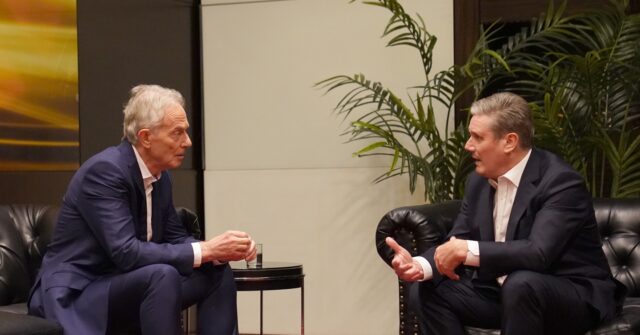
Former British Prime Minister Sir Tony Blair has accused his own Labour Party of being out of touch with reality and failing to understand the political realities facing the UK, such as the need to abandon the net-zero green agenda and to improve relations with U.S. President Donald Trump.
Agreeing many of the core critiques of the left-wing Labour Party government of Sir Keir Starmer made by those on the populist right, Sir Tony urged his party to grapple the hard truth that their “Quixotic” fantasist policies have failed and that what is needed more than a leadership change is a debate over core “soft-left” beliefs that should be abandoned in favour of “long-term strategic thinking”.
Commenting on the slow rolling Westminster psychodrama over the efforts by some to oust Starmer, Blair, who served as UK Prime Minister from 1997 to 2007 and whose smashing and remaking of the British constitution set the country up for many of the problems it faces today, argued that trying to remove the PM before the party can actually make its mind up over what policy direction it should take the country is “not a serious way of conducting ourselves.”
“It is one thing when in opposition to indulge this perennial delusion that when we lose seats to the right the country is really signalling it wants Labour to move left; it is dangerous to do it in government,” the former Labour leader wrote.
Blair said that while Labour is currently embroiled in a “rehash” of old political battles, such as whether to rejoin the European Union or to double down on welfarism and tax hikes, the party is missing the forest for the trees.
Principally, the former PM said that the British political establishment has to come to terms with the fact that it is a “middle power” in the global struggle between the United States, China, and potentially India in time. Blair argued that Britain and Europe share many of the same strategic goals as the United States, rather than those of Beijing, and therefore it would be a mistake to abandon the alliance, even when American presidents or American policy are unpopular in the eyes of the British public.
In contrast to the sky-is-falling response from much of the European establishment in response to President Trump, Blair argued that the Transatlantic alliance is not facing a “rupture” but rather a “reckoning”, in which the old continent is being “told some home truths which, if wise, we will wake up to”.
“Though American security strategy is couched in very ‘America First’ terms, it identifies the principal threats – in the Arctic from Russia; longer term, globally, from China; and in the Middle East from Iran – no differently from how Europe sees the world. President Trump has demanded increases in NATO spending not dissolution of the alliance,” he wrote.
Continuing, the former PM said that although President Trump may deliver the message in a “brutal” fashion, the White House’s message is not that the NATO alliance is over, but rather that America wants “bigger and better partners”.
“Europe needs to build economic competitivity and military capability. At present it is not succeeding in either as it should… We have forgotten an essential lesson not just of diplomacy but of power politics: if you want to play you have to be sat at the table. And bring something to the table,” he said.
Additionally, Blair was critical of the fumbled response to the conflict in Iran by Starmer’s government in London, which initially refused the basic request from the White House to use British military bases to refuel American planes as they confronted the Islamist regime in Tehran. Although Starmer later relented and allowed “defensive” operations by the U.S., the relationship with the Trump administration suffered greatly, valiant efforts from King Charles to smooth ripples, aside.
“I understand the reasons for refusal but it’s not the best way to treat our ally,” Blair said. “What’s done is done. None of these things can simply be reversed. But to repair our standing, all require leadership and commitment. For the American relationship, that means building defence capability and being prepared politically to argue for the alliance even when controversial, of which Iran is the latest example.”
Perhaps even more crucially for the lives of average Britons, the former Labour leader urged his party to abandon its obsession with the green agenda and the drive to cut carbon emissions to “net zero” by the middle of the century, noting that it would do little to dent global carbon output while only serving to increase the cost of electricity for the UK, its citizens, and its industries.
Seemingly taking a page out of the playbook of Nigel Farage, Mr Blair said that the British government must “prioritise cheaper energy and electrification over net zero and use what is left of our North Sea oil and gas resources,” which he said will be critical for the development of next-generation technologies, like AI. Furthermore, the former prime minister called for a “transformative programme for planning reform and deregulation” to spur economic growth and innovation.
“It is not inevitable we decline. Britain still has huge strengths, a highly talented people and a residual respect in the world. But we must show we understand how that world is changing and what our place in it should be. That requires, in turn, a fundamental change in our current politics,” Blair concluded.
Follow Kurt Zindulka on X: Follow @KurtZindulka or e-mail to: [email protected]
Read the full article here