


Conservatives continued to press for reforms during the latest negotiations to reauthorize Section 702 of the Foreign Intelligence Surveillance Act (FISA).
Section 702 is a surveillance authority meant to be used to spy on foreign adversaries. However, Americans’ private communications incidentally get surveilled without a warrant — contrary to the Fourth Amendment protections against warrantless surveillance.
The surveillance authority is set to expire on June 12, giving Congress just a few weeks to come to a solution — or potentially face another short-term extension.
A source familiar told Breitbart News that many conservatives continue to push for amendments that would drastically reform the surveillance authority and protect Americans’ privacy. Many of these amendments were offered in April during the last FISA reauthorization negotiations and are being offered for a long-term extension of Section 702.
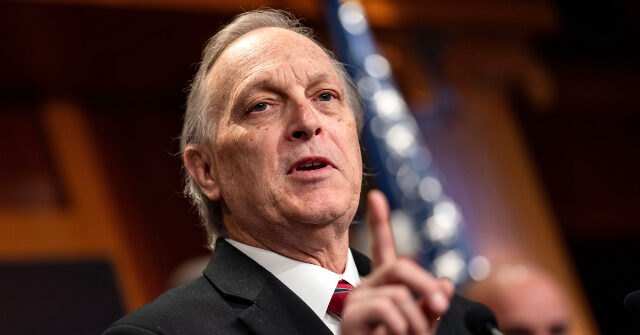
Rep. Andy Biggs (R-AZ) offered an amendment that would require a warrant to prevent so-called “backdoor” searches of Americans’ communications, with exceptions for probable cause or other exceptions to the warrant requirement. The exceptions cover exigent circumstances such as terrorism, cybersecurity, or an imminent foreign threat that the Trump administration and other administrations have put forward as examples of the importance of Section 702.
The last FISA reauthorization bill that passed through Congress, the Reforming Intelligence and Securing America Act (RISAA), included an overly broad definition of electronic communication service provider (ECSP). It updates the definition to include “any other service provider who has access to equipment that is being or may be used to transmit or store wire or electronic communications.”
This provision has been referred to by privacy advocates on both sides of the aisle as a “trojan horse” for “PATRIOT Act 2.0.”
Marc Zwillinger, a top FISA expert and one of the five handpicked FISA Court Amici, explained in 2024:
The new amendment would — notwithstanding these exclusions — still permit the government to compel the assistance of a wide range of additional entities and persons in conducting surveillance under FISA 702. The breadth of the new definition is obvious from the fact that the drafters felt compelled to exclude such ordinary places such as senior centers, hotels, and coffee shops. But for these specific exceptions, the scope of the new definition would cover them. That’s not a “narrow” change.
…
It also means that any U.S. business could have its communications (if one side is foreign) tapped by a landlord with access to office wiring, or the data centers where their computers reside, even if it eliminates the possibility that the same surveillance could be conducted with the assistance of hotels, restaurants, community centers, and other public retail establishments. For a specific hypothetical example of how this surveillance could occur, see our prior blog post.
A fix was passed by the Senate as part of the 2024 Intelligence Authorization Act but was stripped out in conference. Congress has yet to address this issue.
Rep. Mark Harris (R-NC) offered an amendment to repeal the overly broad definition.
Biggs also offered an amendment that would address some of the limitations of the effectiveness of the FISA Court’s amici curiae. Amici curiae play an important role in providing the FISA Court a perspective other than the government’s in cases implicating an Americans’ privacy and civil liberties. The Arizona congressman’s amendment mirrors the so-called “Lee-Leahy amendment” that passed through the Senate in 2020 by a vote of 77-19.
Rep. Warren Davidson (R-OH) also offered an amendment, the Fourth Amendment Is Not For Sale Act, to the FISA extension bill in April. That legislation would bar federal agencies such as the IRS, FBI, and others from evading privacy protection by purchasing Americans’ sensitive personal data from shadowy data brokers. Many of these agencies include geolocation, metadata, and internet browsing history, which can reveal intimate details about Americans’ private lives.
The Cato Institute’s Patrick Eddington wrote about how lawful gun purchasers often unwittingly get surveilled through Section 702:
Those incidentally collected American communications are retained in NSA databases for years and are warrantlessly searchable by the FBI through what critics have long called the “backdoor search” loophole. The Foreign Intelligence Surveillance Court (FISC) and multiple congressional oversight reports have documented thousands of such searches annually, many involving wholly domestic criminal investigations with no foreign intelligence nexus. One question that’s never been addressed is the extent to which the FISA Section 702 program may violate the Second Amendment rights of U.S. citizens.
When Americans buy a Glock pistol, a Beretta shotgun, or a box of Czech-made Sellier & Bellot ammunition at their local gun store, they likely assume the transaction is between them, the dealer, and perhaps the ATF’s background check system. What they almost certainly don’t know is that the business communications underpinning that entire supply chain—every email, phone call, and text between US importers and their foreign suppliers—is almost certainly being vacuumed up and stored under the Section 702 program. [Emphasis added]
Reps. Lauren Boebert (R-CO) and Eric Burlison (R-MO) wrote in an op-ed for Breitbart News about how federal agencies’ purchase of Americans’ data rivals a “formal [gun] registry.” They also wrote about the need to have a warrant requirement and to close the data broker loophole:
First, require a warrant before the FBI searches an American’s private communications. This failed by a single vote in 2024. The government now claims it conducts only a few thousand such searches a year. Great, the courts can handle that load. If the real number is higher, that proves exactly why the warrant requirement is necessary.
Second, close the data broker loophole. The bipartisan Wyden-Lee-Davidson bill, Rep. Andy Biggs’s Protect Liberty Act, and the Durbin-Lee SAFE Act would all reauthorize FISA while banning the federal government from buying Americans’ data without court orders. If collecting your location data directly would require a warrant, buying it from a broker should too.
A survey sponsored by Demand Progress and conducted by Data for Progress in March found that 37 percent of voters, including a plurality of Republican voters (42 percent) think that FISA should only be reauthorized with restrictions on law enforcement purchasing personal data through data brokers.
The source familiar said that conservatives are particularly worried that the so-called data broker loophole can undermine Second Amendment rights to surveil law-abiding gun owners and undermine First Amendment rights when it is used to surveil Americans based on their religious beliefs or other First Amendment-related activity.
Read the full article here