


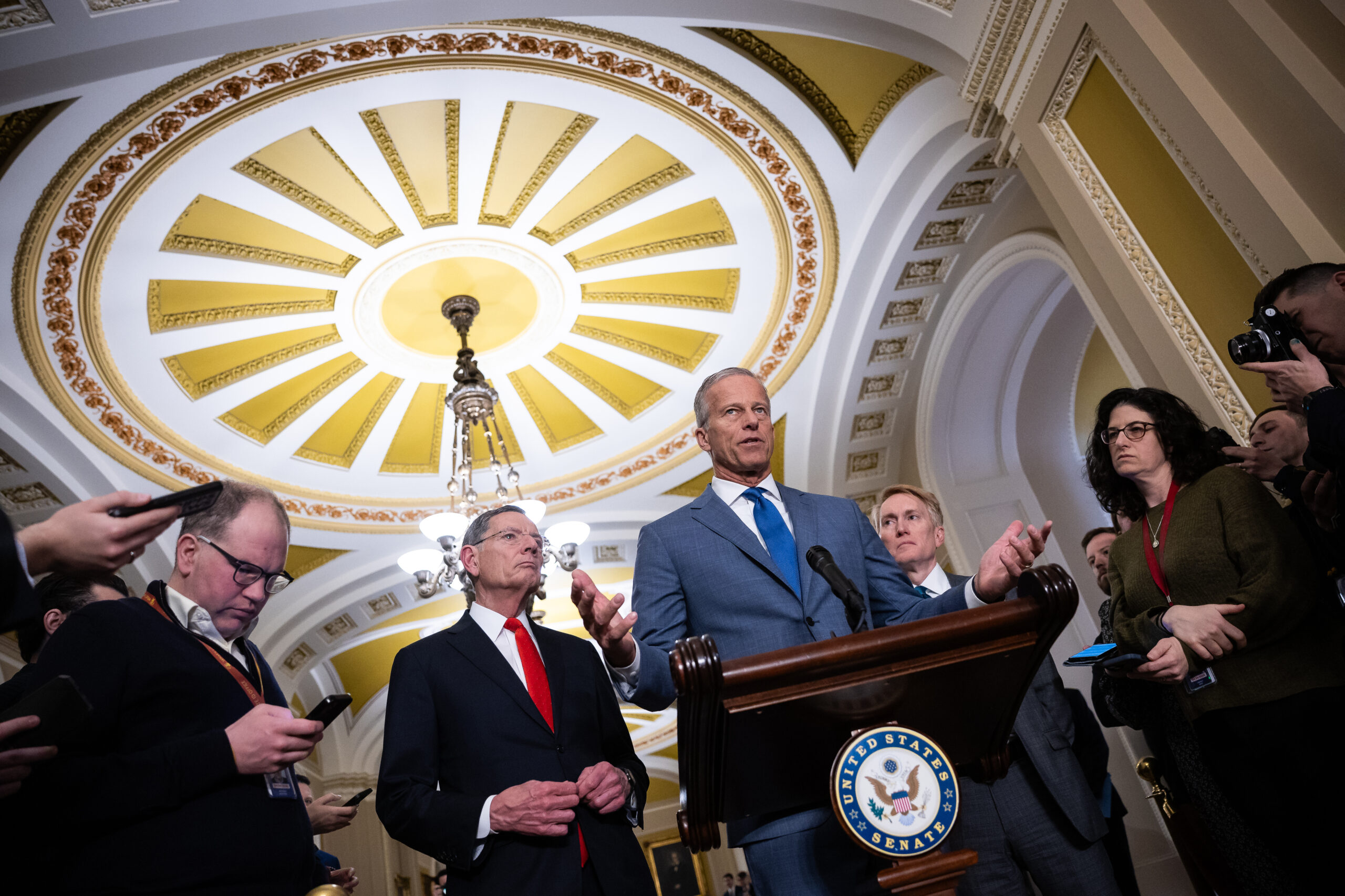
President Donald Trump sketched out his vision Tuesday night of Republican governance heading into the midterms. Congress is barely in the picture.
From a legislative perspective, Trump’s State of the Union address was notable for what it didn’t include. He gave Republicans a pass on trying to revive his global tariff campaign after a major Supreme Court setback. He didn’t demand another party-line domestic policy bill before November, and he even skipped a jab at one of his favorite punching bags, the Senate filibuster.
Instead, Trump used the bulk of the speech to lean into red-meat issues like illegal immigration and gender-affirming health care, while encouraging lawmakers to tackle a few relatively minor topics — many of which have already been churning behind the scenes for months.
“He wasn’t really pushing us to do anything we don’t [already] want to do,” Sen. Kevin Cramer (R-N.D.) said.
The upshot is that Trump’s prime-time address is unlikely to make more than a ripple in the congressional agenda over the coming months. It’s the reality, Republicans acknowledged Wednesday, of life in Washington right now: Despite its trifecta, the party’s legislative ambitions are being hemmed in by its barely-there majorities.
“I think we know what the agenda items are,” Rep. Ryan Mackenzie (R-Pa.) said. “Accomplishing those is going to be hard with a small majority.”
GOP leaders on Capitol Hill are vowing to focus on pocketbook issues heading into the midterms, as they try to convince skeptical voters the party is responding to lingering economic angst.
The Senate, for example, is expected to tee up a bipartisan housing bill at the end of this week, and Majority Leader John Thune hinted Wednesday that other measures, such as an energy permitting overhaul, could be on the chamber’s to-do list for the rest of this Congress.
But Trump showed only passing concern about lawmakers’ anxieties Tuesday, sending the message that the economy was on the rebound — asserting that prices were falling just fine and that last year’s GOP megabill did quite enough to address any voter concerns.
He mentioned “affordability” only to engage in a blame game — accusing Democrats of embracing that word “knowing full well that they caused and created the increased prices that all of our citizens had to endure.”
Instead, Trump pressed lawmakers to “codify” a drug pricing plan his administration negotiated with some pharmaceutical manufacturers and rolled out a retirement savings program that largely builds on a bipartisan law signed by his predecessor, Joe Biden. He also weighed in on the housing proposal, urging members to limit home purchases by institutional investors.
Those matters have already been percolating on Capitol Hill, with internal divisions among Republicans creating major obstacles in some cases.
“On our side, obviously, they’re not unanimous,” Thune said about the housing and drug proposals. “There are a lot of these things that are not just that clear cut.”
The situation in the House is even more tenuous. While the thin GOP majority there was able to eke through a partisan elections bill Trump highlighted Tuesday, they have had a harder time building support for another bill that earned a presidential endorsement: a ban on lawmaker stock-trading.
Speaker Mike Johnson, while not ruling anything out, acknowledged his “small margin” will affect what items on Trump’s wishlist, if any, ultimately make it to the president’s desk. Republicans can currently lose just one vote on party-line matters, and one GOP lawmaker, Rep. Tony Gonzales of Texas, is facing pressure to resign amid allegations of an affair with a subordinate who died by suicide.
“I’ve got effectively a zero-vote margin at the point that we are now, so I’ve got to have near-unanimity among Republican priorities,” Johnson said. “I would like to say we could do some bipartisan things, but it’ll be up to the Democrats.”
Rep. Mike Haridopolos (R-Fla.) characterized the House GOP as a “micromajority” Wednesday and questioned whether one of its members — Kentucky Rep. Thomas Massie, who frequently breaks with Trump — even still qualified as a Republican: “I don’t know what party he belongs to, but it’s not ours.”
Trump did use his bully pulpit Tuesday to urge Senate Republicans to act on the House-passed elections bill, the SAVE America Act, that would place new restrictions on the ability to vote. That included an apparent appeal to Thune, who was in the House chamber for the speech.
But Trump didn’t push to skirt the 60-vote legislative hurdle by forcing Democrats to hold the floor in a so-called “talking filibuster” to oppose the bill — as some conservatives personally lobbied Thune on the House floor Tuesday to do, the Senate leader acknowledged.
Thune said he has tentative plans to bring the bill to the floor sometime next month, so long as the Department of Homeland Security shutdown is resolved. But the lack of a sustained presidential push to upend existing filibuster rules makes it even more likely the legislation is likely to sputter out.
Thune, who has repeatedly warned about the potential pitfalls of the talking filibuster approach, said Wednesday it was “a very real possibility” the bill could be brought up under the usual approach that would allow Democrats to quickly block it.
The reality of Congress’ legislative morass isn’t stopping some Trump allies, who are either running for reelection or for another office, from trying to use his State of the Union speech as a springboard to action.
Sen. Lindsey Graham (R-S.C.), who has linked himself closely to Trump, said Wednesday that Republicans “need to legislate with the same spirit as President Trump’s speech.” And GOP Rep. Andy Biggs, who is running for governor of Arizona, touted his own legislation that he said aligns with Trump’s priorities.
“I urge House Leadership to quickly move my bills that align with his priorities,” he said in a statement. “The time to act is now.”
Some conservatives continue to urge Congress to pass another party-line policy bill under filibuster-skirting budget reconciliation rules to give the party a messaging boost before the midterms.
But others who listened to Trump’s speech Tuesday weren’t nearly so inspired. One House Republican granted anonymity to speak candidly quipped, “It was certainly light on details.”
A GOP senator, also granted anonymity, summed up the congressional agenda for the foreseeable future in one word: “Slow.”
Read the full article here