


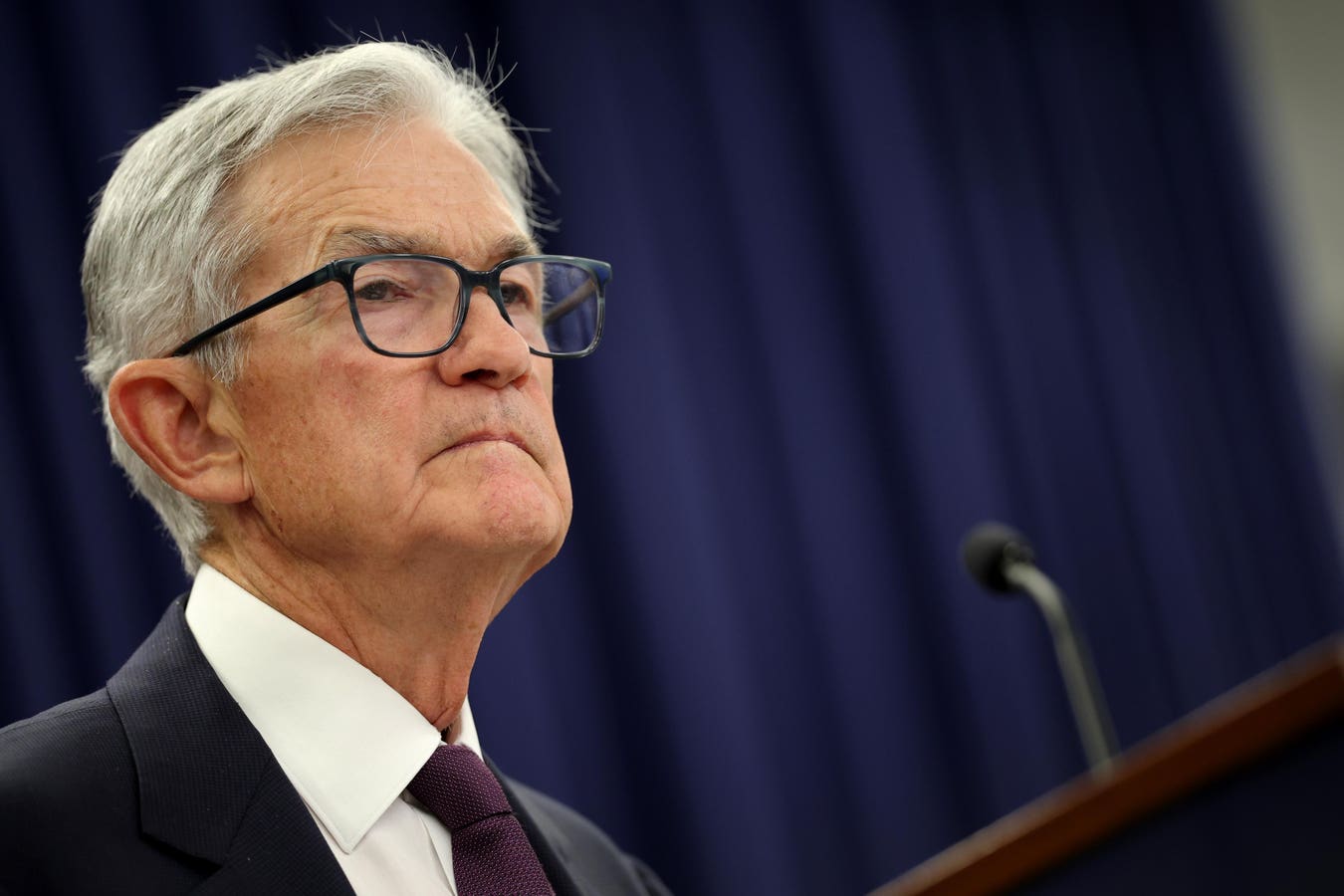
WASHINGTON, DC – JANUARY 28: Federal Reserve Chair Jerome Powell pauses while speaking during a press conference following the Federal Open Markets Committee meeting at the Federal Reserve on January 28, 2026 in Washington, DC. Powell announced that interest rates will remain steady at 3.5 – 3.75 percent. (Photo by Kevin Dietsch/Getty Images)
Getty Images
Many hoped, but few thought, that the Federal Reserve’s Federal Open Market Committee would cut the benchmark federal funds rate on Wednesday, Jan. 28. It didn’t.
Keeping things flat seems like the best choice. As always, the Fed faces its dual mandates for stable consumer prices that will grow at a relatively low and even rate, and for maximum employment, given current economic conditions. There’s too much unknown about the current state of the economy, global macroeconomic forces and markets, U.S. government spending, and the state of the domestic workforce.
However, the Trump administration wants lower interest rates for high growth, period. That clashes with the Fed’s monetary strategies based on its perception of its mandates. The coming months and next few years could be contentious and risky.
Inside The Fed’s Long-Run Dilemma
The FOMC reaffirmed a Jan. 24, 2012, statement on “Longer-Run Goals and Monetary Policy Strategy.” It reiterated the mandate, explaining how it works:
- “Employment, inflation, and long-term interest rates fluctuate over time in response to economic and financial disturbances.”
- “Monetary policy plays an important role in stabilizing the economy in response to these disturbances.”
- “The Committee’s primary means of adjusting the stance of monetary policy is through changes in the target range for the federal funds rate.”
- “The Committee is prepared to use its full range of tools to achieve its maximum employment and price stability goals, particularly if the federal funds rate is constrained by its effective lower bound.”
Fed decisions are frequently framed in broad economic and business terms, and that is important. However, ultimately, the dual congressional mandate is actually about consumers:
- Solid employment means consumers have money.
- Stable prices let consumers grow their wealth, spending and investing it.
- The lynchpin to it all is recognizing that 69% of gross domestic product, a rough though imperfect measure of the economy, is consumer spending.
If enough regular people don’t have the money to make purchases, or to afford the credit they might substitute when household incomes may not be enough (preferably for large purchases with long-term value), the economy can go into a tailspin.
The Economic Imbalance Driving Today’s Risks
Over the last 40-plus years, there’s been a growing imbalance in the nation’s economy. More money and wealth have moved into the hands of the already wealthy. Median household incomes haven’t come close to keeping up with inflation, even if things seem to have improved over the last few years.
Many of the problems are made invisible by the use of averages in economic data. People are told that things are better and there is no “affordability” issue. What averages don’t show is distribution of results. The top 25% of households are doing pretty well. They’ve seen regular large increases in their incomes. The top 10% alone is responsible for almost half of consumer spending. So long as they increase their spending, they mask the fundamental weakness of the economy.
The weakness is a large legacy gap in household income. Far more than half of households are struggling to at least some degree, a larger percentage is in much deeper trouble. Many people are overextended on credit; they can’t keep balancing themselves on borrowed money.
An Economy On Unsteady Ground
With the long-standing income/inflation gap and upward concentration of wealth having created a growing underclass, and the Trump administration’s trade and tariff policies the economy is unstable. No one knows what is going to happen. Projections by professional forecasters lean one way and then another.
Job prospects for 2026 are looking grim in many ways. The amount of time people are unemployed has been growing longer, but for the first time since 1948, this trend has started without the kickoff of a recession. Large companies are laying off people, including those in higher-level roles, either hiring overseas or using H-1B visas to replace American workers with lower-cost talent from other countries. Young people with college degrees face unemployment rates double the average.
The Wall Street Journal wrote that at a December 2025 meeting of CEOs organized by the Yale School of Management, two-thirds of those surveyed planned to at most maintain the existing workforces or, at worst, fire workers. Only a third planned to hire.
Does the Fed cut rates to encourage hiring? Although that is a dubious solution, as companies aren’t likely to hire more people until there is more buying. Is the result a concentration of even more assets — whether stocks, bonds, real estate or other choices — in the hands of wealthier people, building a greater rentier dynamic?
Do rate cuts increase inflation, causing unstable prices and another round of rising costs followed by higher interest rates to lower demand, as we saw in 2022 and 2023?
A Fed Split On The Path Forward
FOMC decisions have seen a regular division, with at least two voting members opposing the overall choice of what to do with interest rates. Disagreement over directions isn’t unknown, but it hasn’t been regular, at least in recent times.
Fueling the disagreements seems to be a small group of Trump appointees to the Fed who tend to want lower interest rates, something the president has insisted is necessary for “growth.” But growth for whom? How will this ultimately affect most people as well as the average economy? What will happen with unemployment trends?
The administration has tried to pressure Powell into leaving office before the end of his term in May. Trump has also wanted to fire Lisa Cook, although it’s unclear whether the Supreme Court will allow that.
Expect someone more pliant to become the next Fed chair. Will that person build and wield the influence among other members of the institution to bend decisions to Trump’s will and lower interest rates, no matter what? The next few years will be … interesting.
Read the full article here