


Trump Accounts Are an ‘Angel Round’ of Investment in America’s Youth
Bank of America announced Wednesday that it will match the federal government’s $1,000 contribution to Trump Accounts for eligible children of its 165,000 U.S. employees. The move makes BofA the latest in a rapidly expanding roster of major employers—including BlackRock, Intel, Charles Schwab, J.P. Morgan Chase, Charter Communications, Robinhood, SoFi, and Uber—that view these accounts as both competitive employee benefits and vehicles for generational wealth creation.
What began as Section 530A in last year’s One Big Beautiful Bill Act is evolving into something more substantial: a multi-layered wealth-building system combining government seed capital, corporate matching, philanthropic donations, and family savings. The speed at which private capital is flowing into the program suggests we may be witnessing the early stages of a structural shift in how American families accumulate wealth. America’s rising generation is about to experience something like an Angel round of venture capital investment.
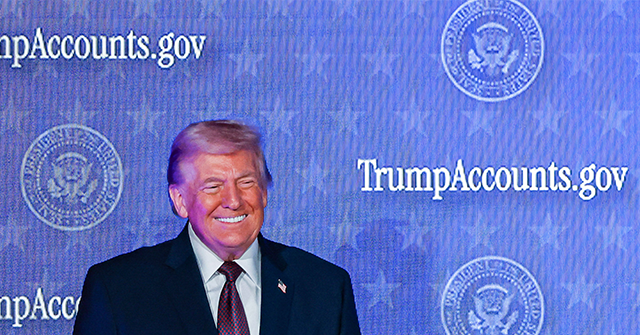
President Donald Trump arrives to speak during the Trump Accounts Launch Summit in Washington, DC, on January 28, 2026. (Valerie Plesch/Bloomberg via Getty Images)
The Basic Framework
Children born between January 1, 2025, and December 31, 2028, receive a one-time $1,000 federal contribution regardless of family income. No means testing, no phase-outs, no income caps. Parents establish accounts by filing IRS Form 4547 with their 2025 tax returns this season or later through TrumpAccounts.gov. The actual deposits begin July 4, 2026.
Families can contribute up to $5,000 annually (inflation-adjusted after 2027). Employers can add up to $2,500 per year, excluded from employees’ taxable income, that will count toward the $5000 family investment. The funds grow tax-deferred, invested in index funds tracking primarily U.S. equities. Distributions are locked until age 18, when account holders will be able to access some funds for home purchases, business formation, or education. The remainder automatically converts to traditional IRA treatment.
The mathematics of compound interest over decades make these accounts genuinely transformative. A child receiving the government’s $1,000 at birth plus modest annual contributions of $2,500 accumulates roughly $85,000 by age 18 at six percent annual returns. Left untouched until retirement at 65, that becomes approximately $1.2 million.
Competition Drives Employer Participation
Bank of New York Mellon became the first major financial institution to announce matching in December 2025. BlackRock followed in January 2026, then Charles Schwab, then a cascade of others. Charter Communications emphasized that matching “strengthens its commitment to its 100% U.S.-based employee workforce.”
The competitive dynamics are straightforward. When one major bank offers a $1,000 match and competitors don’t, that becomes a meaningful differentiator in recruiting and retention. The cost is modest—$1,000 per eligible child as a one-time expense. Bank of America is also implementing pretax payroll deduction for employee contributions, making it seamless for workers to add their own money.
If the current pace continues, Fortune 500 matching could become standard within 12-18 months. Companies will face pressure to match competitors. The mechanism that made 401(k)s ubiquitous—competitive necessity in the talent market—appears to be kicking in for Trump Accounts.
The Philanthropic Amplification
Beyond corporate matches, massive philanthropic capital is flowing in. Michael and Susan Dell pledged $6.25 billion—one of the largest donations in American history—to fund $250 accounts for 25 million children in middle-class zip codes. Ray Dalio and his wife Barbara are matching that $250 contribution for approximately 300,000 children in Connecticut.
States are joining too. Texas leaders have proposed adding $1,000 per account. Treasury Secretary Scott Bessent’s “50 State Challenge” envisions all states contributing. Even if only half participate at Texas’s level, millions of children would start with $2,000-$3,000 before any family or employer contributions. Just like in the private sector, states are likely to compete with each other to provide funding to attract residents, particularly in our current environment of low population growth.
Consider a child born in 2026 to Bank of America employees in Texas. Government: $1,000. Bank of America match: $1,000. Texas: $1,000. That’s $3,000 at birth before the family contributes anything. Add modest payroll deductions and employer contributions under the $5,000 annual cap, and the child could have $85,000-$100,000 by age 18.
The Political Economy of a Universal Wealth Program
The program’s universal structure—no income caps, everyone eligible—follows the Social Security model rather than means-tested welfare. This matters for political durability. Programs that exclude higher earners lose their support. Universal programs create constituencies spanning income levels. This makes it more likely that the program will be extended indefinitely, beyond the current 2028 sunset.
The investment requirement—index funds tracking U.S. companies—means every child with a Trump Account benefits directly when the S&P 500 rises, when corporate profits grow, when American businesses succeed. A generation watching their account balances rise with stock market gains will have fundamentally different attitudes toward economic policy. They’ll have skin in the game.
Perhaps most striking is the bipartisan intellectual support. Teresa Ghilarducci, a prominent left-wing economist, collaborated with Kevin Hassett, President Trump’s top economic adviser, on proposals that became Section 530A. Despite vastly different political worldviews, both recognized that wealth provides security and power in ways income alone cannot. The bottom half of Americans own just 2.5 percent of total wealth and roughly one percent of stocks and bonds. Trump Accounts attack that disparity through ownership, not redistribution.
This Is Just the Beginning
The next six months will determine whether this becomes embedded infrastructure or remains a niche program. Corporate adoption pace matters—if five more Fortune 500 companies announce matches this quarter, the cascade accelerates. State participation matters—if Florida, Ohio, and Georgia follow Texas, the program achieves critical mass. Participation rates matter—if enrollment becomes truly seamless, working-class families will participate at high rates.
Bank of America’s announcement suggests momentum is building rather than stalling. Major employers don’t adopt novel benefits without perceiving competitive advantage. The decision to implement full payroll deduction infrastructure indicates BofA sees long-term value.
The mathematical fundamentals are straightforward. Compound interest over decades turns modest contributions into substantial wealth. The question is whether the emerging infrastructure—government seed capital, corporate matching, philanthropic donations, state contributions, family savings—can deliver that mathematics to tens of millions of American children.
Based on the companies already committed and the scale of philanthropic capital flowing in, the early evidence points toward yes.
The Breitbart Business Digest will examine Trump Accounts in detail over the coming weeks, covering the specific mechanics of employer contributions, the tax advantages, the flexibility provisions at age 18, and what this means for retirement security and homeownership rates among the next generation of Americans.
Read the full article here