


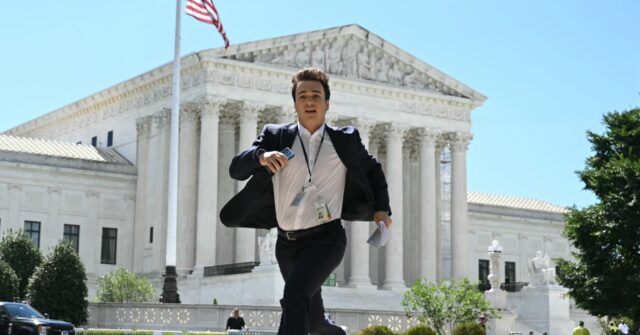
The Supreme Court on Friday did not issue a ruling on President Trump’s tariffs.
When the Supreme Court announced earlier this week that it would issue a ruling on Friday, many outside the court expected it would decide the tariff case. Instead, the court ruled on an unrelated criminal case.
The Court has not indicated when it will issue its decision on the tariff case. The delay leaves the tariffs in place while businesses and trading partners continue to operate under uncertainty about their legal status.
The Trump administration’s tariffs—applying to nearly every country around the globe—were imposed under the International Emergency Economic Powers Act of 1977, commonly called Ieepa (pronounced eye-EE-puh), a 1970s emergency-powers law that has historically been used for more limited purposes. A group of small businesses and states challenged the import duties, arguing that the statute does not authorize tariffs and that the Constitution assigns taxing power exclusively to Congress. Those arguments persuaded lower courts at both the district court and appeals court levels.
At a hearing in November, the justices of the Supreme Court appeared to be skeptical of the administration’s defense of the tariffs. Several justices appeared to doubt Ieepa, which does not explicitly mention tariffs, could be read to provide the president with the unilateral authority to impose taxes on nearly all imports.
Chief Justice John Roberts and several other justices, including those considered part of the conservative majority on the court, appeared to focus on the major-questions doctrine. That principle, which the Court used to strike down the Biden administration’s attempt to provide student loan relief, bars agencies from invoking ambiguous statutory phrases to claim major policymaking powers Congress never clearly granted. Roberts observed that treating a law about regulating foreign transactions during emergencies as authorization to impose unlimited tariffs—on any goods, from any country, at any level, for any duration—looked like “a misfit” between the statute’s language and the claimed authority.
Justice Barrett, who was appointed by President Trump, questioned whether the threats to the U.S. economy and national security could justify tariffs on allies.
“Is it your contention that every country needed to be tariffed because of threats to the defense and industrial base?” Barrett asked. “Spain? France? I mean, I could see it with some countries but explain to me why as many countries needed to be subject to the reciprocal tariff policy.”
A few justices, however, appeared to be open to the argument that although Ieepa did not explicitly mention tariffs, it did create a power to levy them. Justice Brett Kavanaugh said that “presumably Congress wants to give the president tools to respond to the emergency in an appropriate way” and questioned why Congress would withhold tariff power from the president while granting so many other powers over trade to respond to an emergency.
A couple of the conservative justices, including Barrett and Justice Neil Gorsuch, echoed the concerns of lower courts that the administration’s reading of Ieepa could amount to an unconstitutional delegation of legislative power to the executive branch. Justice Gorsuch said he worried that this grant of power would be difficult to reverse, calling it “a one-way ratchet toward the gradual but continual accretion of power in the executive branch and away from the people’s elected representatives.” It has been several decades since the Supreme Court struck down a law or policy under the so-called non-delegation doctrine.
The challenged tariffs include the so-called reciprocal tariffs that were placed on imports from nearly every trading partner in the spring, the tariffs on “bad actors” that were levied in August, and tariffs on China, Canada, and Mexico that were imposed in response to what the Trump administration views as a lack of cooperation in stemming the flow of fentanyl and its ingredients into the U.S.
Other tariffs imposed by the Trump administration, including tariffs on imported metals, were not challenged in the cases before the court. The legal authority for those tariffs did not rely on Ieepa.
Read the full article here