


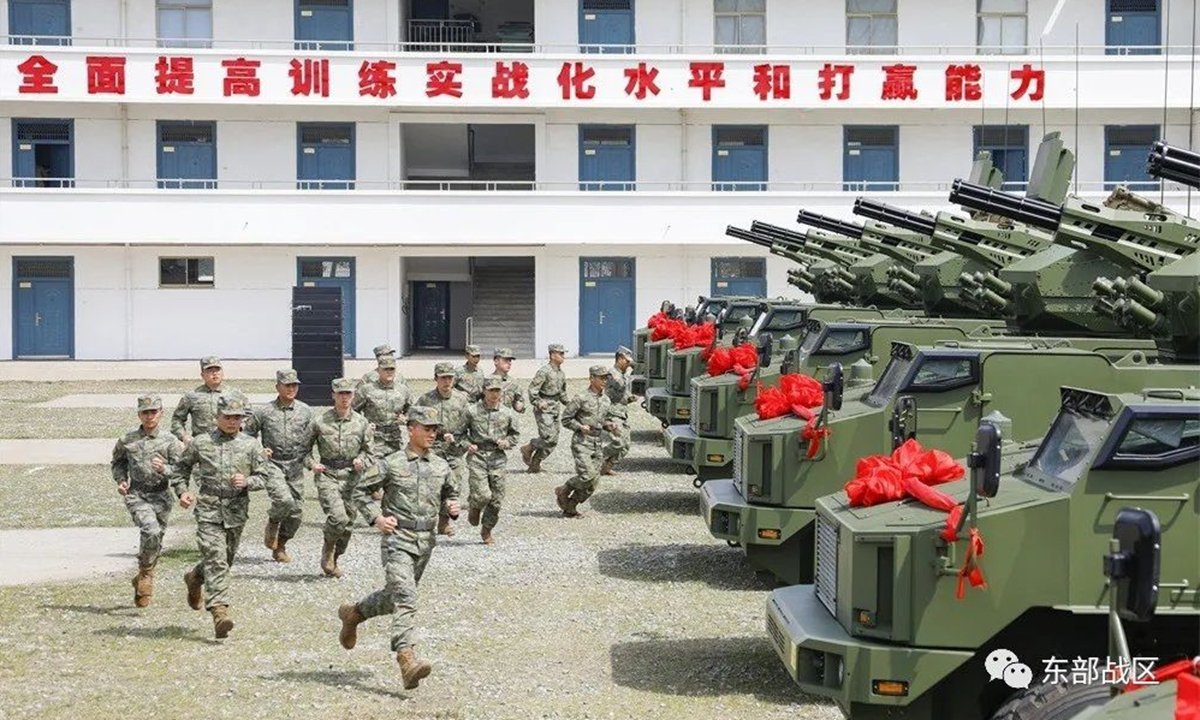
To achieve military parity with the United States, China believes the PLA must secure what it calls the “Three Superiorities”: information, air, and maritime power. Of these, information superiority is the most critical, as it underpins the ability to prosecute and win modern wars.
Beijing is rapidly expanding and modernizing the People’s Liberation Army (PLA), and although it is narrowing the gap with the United States, it still falls short across all three domains.
The task of securing this advantage falls to the People’s Liberation Army Strategic Support Force (PLASSF). Since 2000, when China launched its first military imaging satellites, and 2007, when it deployed its first over-the-horizon skywave radar, it has steadily expanded a sophisticated intelligence, surveillance, and reconnaissance (ISR) network.
That same year, China demonstrated a kinetic anti-satellite capability and has since acquired Russian-made jamming systems and high-powered dual-use radio transmitters capable of targeting U.S. communication and surveillance satellites.
In recent years, China has nearly doubled its satellite launches, fielding more than 260 on-orbit ISR systems, along with over-the-horizon radar able to detect targets 2,000 kilometers beyond its coastline.
At the same time, it has advanced counter-drone capabilities, developing AI-driven sensor fusion networks, the Hurricane-3000 microwave weapon that can disable electronics within 3,000 meters, and CETC’s “Yuanmo” system, which integrates operations across multiple domains.
These advances are supported by efforts to secure real-time connectivity and resilient battle networks through improvements in command, control, and communications. Electronic warfare has become a central focus, with significant investments in jamming, spoofing, and other methods designed to disrupt U.S. systems.
Despite these advances, China faces critical limitations. U.S. battle networks and advanced AESA radar systems retain a technological edge, particularly in electronic warfare resistance and target discrimination.
Chinese doctrine for information warfare remains largely theoretical and has not been tested in real combat against peer adversaries.
Seamless cross-domain integration, a requirement for China’s systems approach, has yet to be proven in contested electromagnetic environments where the U.S. excels.
These gaps mean that while China has made information dominance a priority and achieved significant progress, its ability to challenge U.S. superiority in this domain remains uncertain.
For China to achieve air superiority, the requirements include advanced fighter aircraft, long-range precision strike capabilities, integrated air defense systems, and counter-air capabilities to neutralize U.S. airpower.
China has made rapid progress in these areas, fielding operational fifth-generation fighters such as the J-20 “Mighty Dragon” and unveiling the sixth-generation J-36, which features a trijet, tailless design intended for air superiority missions.
China has also developed increasingly accurate ballistic and cruise missiles, improving from hundreds of meters of accuracy in the 1990s to within five to ten meters today.
These systems, supported by over-the-horizon intelligence, surveillance, and reconnaissance extending 2,000 kilometers beyond China’s coastline, pose a serious threat to forward-deployed U.S. air bases.
In terms of defense, the PLA’s integrated air defense network is anchored by the HQ-9B system, which can track up to 100 targets simultaneously and has a range of 250 kilometers, providing extensive coverage across key regions.
Despite these advances, critical gaps remain. The J-20 lacks internal air-to-ground bomb capacity, limiting its effectiveness as a multirole aircraft. Chinese pilots also remain culturally constrained by micromanagement from ground controllers, in stark contrast to U.S. pilots, who operate as autonomous battle-space managers.
Moreover, much of the PLA’s airpower strategy remains largely theoretical and untested, as seen in performance gaps revealed during China’s only recent combat experience, the Eastern Ladakh confrontation with India.
Maritime superiority for China rests on four pillars: anti-ship ballistic missiles that introduce a new threat dimension for U.S. carrier strike groups, advanced surface and submarine forces, area-denial and sea-control architectures, and the ability to project power beyond the First Island Chain.
Together, these capabilities are intended to hold adversary fleets at risk near China’s periphery while extending operational reach into the broader Pacific and Indian Oceans.
China has built the world’s largest navy by fleet size, with more than 370 combat vessels. Its surface fleet is anchored by eight Type 055 destroyers displacing roughly 12,000–13,000 tons, each with 112 vertical launch cells and advanced dual-band radars that approach the capability of U.S. cruisers.
The Fujian aircraft carrier marks a major technological leap: a conventionally powered ship of about 80,000–85,000 tons equipped with electromagnetic catapults, enabling launch of J-35 stealth fighters and KJ-600 airborne early-warning aircraft.
Undersea, China operates six Jin-class ballistic-missile submarines armed with JL-3 SLBMs with ranges exceeding 10,000 kilometers, while the Type 096 class under development is expected to feature enhanced stealth and 16–24 missile tubes. These platforms, combined with anti-ship ballistic and cruise missiles and expanding maritime ISR networks, strengthen both sea-denial and power-projection options.
Important limitations persist. Current submarines are widely assessed as noisy, comparable to 1980s Soviet boats, making them more detectable to U.S. forces.
Questions remain about shipbuilding quality, weapons-integration reliability, and missile performance against sophisticated countermeasures.
Fujian’s conventional power plant, unlike the nuclear propulsion used by U.S. and French carriers, constrains endurance and global reach.
More broadly, China still lacks deep-water operational experience and has yet to demonstrate the combat effectiveness of its integrated naval systems under high-end, contested conditions.
In sum, China has made significant advancements and continues to expand its military capabilities. Yet its overall firepower and wartime operability still lag behind that of the United States. The U.S., however, can only maintain this edge through sustained defense spending, research, and development.
Read the full article here