


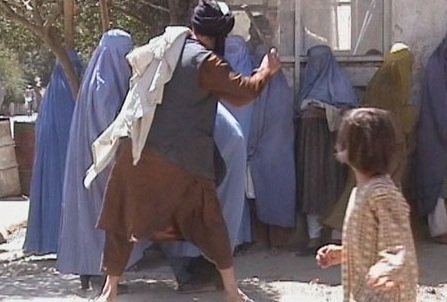
It probably comes as no surprise to conservatives, but liberals protesting in favor, need to be reminded that the damage jihadist extremists do to education can return a country to the Stone Age. This astounding devolution of human development can be attributed to a number of extremist policies.
Under jihadist regimes, women’s access to education is eliminated or heavily restricted. In Afghanistan, the Taliban banned girls from secondary school and university, and barred female teachers from working. In Syria and Iraq, ISIS limited women’s education to religious instruction and domestic tasks. These policies halve the skilled labor force and erase potential contributions from female scientists, engineers, and doctors.
Jihadist groups often treat subjects like physics, chemistry, biology, and evolution as heretical. Secular education is purged and replaced with religious indoctrination, often in madrassa-style schools. In ISIS-controlled areas, public education was replaced with a Shariah curriculum that banned history, art, and science entirely.
ISIS destroyed institutions like the University of Mosul, looting or burning science departments. Taliban raids on schools and universities have also led to the destruction of labs and the banning of textbooks deemed “un-Islamic.”
In Somalia, Al-Shabaab banned or strictly monitored internet cafes. Online access is restricted to prevent exposure to “infidel” knowledge, cutting entire populations off from global research, education, and collaboration.
Photography, television, scientific illustrations (like anatomical diagrams), and music are often banned. This makes it nearly impossible to teach biology or medicine, and suppresses artistic and visual expression, key components of innovation and design.
Groups like ISIS and AQAP have destroyed museums, ancient artifacts, and research libraries. This cultural erasure severs historical continuity and wipes out critical educational resources for future generations.
Rote memorization of religious texts is prioritized over analytical or creative thinking. Academic debate and critical inquiry are treated as dangerous or heretical. In Yemen, formerly secular universities are now ideologically policed and heavily censored.
Educated professionals flee jihadist-controlled areas. Those who remain face persecution, threats, or must abandon their fields. During ISIS rule in Raqqa, many doctors and engineers were executed or fled, leaving a vacuum of expertise.
In Somalia and Yemen, jihadist groups impose religion-only curricula. Subjects like psychology, philosophy, and modern literature are labeled “Western corruptions” and banned entirely.
The impact of extremist rule on technological progress is clear. Since the Taliban’s return to power in August 2021, Afghanistan’s technological and educational indicators have collapsed. University enrollment has dropped 53%, with over 100,000 women barred from higher education after the December 2022 ban. At the secondary level, 1.4 million girls, 80% of school-aged females, are now out of school.
Afghanistan’s scientific infrastructure has been dismantled. The Afghanistan Science Academy shut down after the Taliban takeover, triggering a mass exodus of scholars. Primary school enrollment fell from 6.8 million in 2019 to 5.7 million in 2022. Kabul University alone lost 24,000 students due to closures. Education funding has been redirected toward Taliban enforcement, not development.
Digital access is also crippled. Just 15% of Afghans have internet connectivity. Among women in Kabul, only 3% report having access, cutting half the potential workforce off from the digital economy. The literacy rate has stagnated at 43%, halting prior gains. Between 2001 and 2015, Afghanistan had grown from 8,000 to over 174,000 university students, one-third of them women by 2021. That progress has now been reversed.
The Islamic State’s territorial control in Iraq and Syria resulted in the systematic destruction of educational and research infrastructure. The University of Mosul, Iraq’s second-largest academic institution with thirty thousand students and 4,200 faculty members, was completely shuttered and later converted into military facilities. Seventy percent of the university’s infrastructure was damaged during the liberation battles, along with seventy-five percent of its electrical systems and forty-five percent of its water systems.
Educational curricula were overhauled to remove subjects deemed incompatible with ISIS ideology. Departments of archaeology, law, political science, science, mathematics, art, and music were shut down. The plus sign was banned in math for resembling a Christian symbol. Over one million university library books were burned, and hundreds of researchers were dismissed or fled. U.S.-educated scholars were often targeted for assassination.
In Syria, Al-Furat University in Raqqa was closed and reopened as an “Islamic University” with a stripped-down curriculum. Schools in Aleppo, Deir al-Zour, and Raqqa were shuttered pending ideological revision. Teachers under ISIS earned just $75–$90 per month, insufficient for basic needs.
In Somalia, Al-Shabaab has devastated education. The group systematically targets schools, teachers, and students, making normal instruction nearly impossible. Between 2015 and 2017, 1,572 boys were forcibly recruited, removing them from education and sending them into armed conflict.
This collapse in schooling has led to child labor and early marriage as families abandon hope in formal education. Teachers face ongoing threats, and schools often shut down during conflict. The few functioning universities in Al-Shabaab territory operate under extreme limitations.
In Yemen, the education crisis worsened after the Houthis seized territory in 2014. Around 4.5 million children now risk total educational loss. Of Yemen’s 15,826 schools, 12,240 sat empty due to a salary freeze, with 166,443 teachers unpaid for over a year.
The University of Science and Technology, previously ranked among Yemen’s leading institutions, was forced to relocate its headquarters from Sana’a to Aden due to prolonged Houthis’ control of its facilities and hospital. Educational salaries became subject to “war taxation” imposed by controlling authorities, further undermining the sustainability of academic institutions. Internet penetration remains limited throughout the country, with educational technology initiatives severely constrained by ongoing conflict.
While jihadist groups use technology such as drones, GPS, and encrypted social media platforms for propaganda and warfare, they do not promote their use for education, infrastructure, or scientific progress. Al-Shabaab, for instance, uses encrypted apps to recruit fighters but bans mobile phone use by women and schoolchildren.
And all of these wonderful losses of technology and education can be yours if you vote left.
Read the full article here