
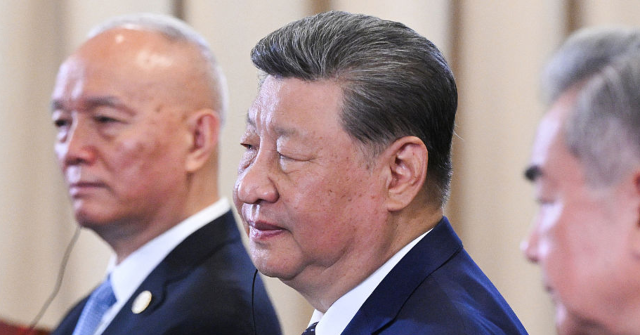
Iranian President Masoud Pezeshkian, who is subservient to missing “supreme leader” Mojtaba Khamenei, held an expected, but apparently brief, meeting with Chinese dictator Xi Jinping on Tuesday, one that state media coverage suggests Xi had little interest in holding.
Both presidents — along with other prominent Asian world leaders such as Indian Prime Minister Narendra Modi and Russian strongman Vladimir Putin — were in Bishkek, Kyrgyzstan, to attend the high-level annual summit of the Shanghai Cooperation Organization (SCO). The SCO is a Central Asian security coalition that Russia and China use largely to leverage their geopolitical influence. Iran is a member of the group and also uses the platform to advance its political interests.
When the summit began on Monday, political observers predicted that it would serve as a platform for anti-American powers such as Russia and China to offer Iran public diplomatic support in the face of its ongoing conflict with America, which has had many economic impacts as Washington imposed strict sanctions on the country. Putin and Xi did indeed meet with Pezeshkian, as well as Modi and several other Central Asian leaders, but the bold show of unity between Beijing and Tehran never materialized.
Instead, Iranian state media outlets published a photo showing a dour Xi Jinping — standing alongside Chinese Foreign Minister Wang Yi, grabbing at his own throat — apparently ambushed in a hallway by Pezeshkian and the Iranian delegation.
Iranian state media outlets described the encounter as a “brief meeting on the sidelines” and refused to offer any details on the nature of their discussion.
“According to the Iranian presidency, the two presidents met on Tuesday during the summit’s programs and held talks for several minutes,” the Islamic Republic News Agency (IRNA) reported. “No further details were released about the content of their conversation.”
The regime-linked Mehr News reported little more than the IRNA: “During the meeting, the two presidents discussed the bilateral ties in line with strengthening relations between Tehran and Beijing.”
Also confirming exchanges with the Chinese government was Iranian Foreign Minister Abbas Araghchi, who verified that he attended the SCO summit with Pezeshkian. In a message on social media, Araghchi described “talks with Eurasian, Chinese, and South Asian dignitaries” to argue Iran’s case in the conflict with America, but offered no details on any particular meeting.
Perhaps most tellingly, China’s state media organs have not at press time reported the meeting at all. The Xinhua News Agency, China’s flagship government news network, features large photos of Xi’s official meetings with the presidents of countries such as Kyrgyzstan and Uzbekistan, as well as featuring prominently his meeting with Putin. All appear to have been scheduled private meetings featuring a photo in front of the two nations’ flags, rather than the hallway candid published by Iranian state media.
Xi Jinping left the SCO summit on Tuesday en route to Egypt. His departure received more attention on the pages of Xinhua than his encounter with Pezeshkian.
Xi’s meeting with Pezeshkian marked a notable contrast with the Iranian president’s discussion at the summit with Indian Prime Minister Narendra Modi. Modi himself, an avid social media user, enthusiastically published photos with Pezeshkian in which he suggested India is interested in expanding trade with Iran.
China has been a longtime ally of the Iranian terror state and relies heavily on Iranian oil imports to meet its demand. Its geopolitical clout in the Middle East has declined significantly in the past two years due to its proximity to Iran and its vast terrorist network, which includes notoriously genocidal paramilitaries such as Hamas and Hezbollah. The Chinese Communist Party has additionally had to contend this year with disruptions in shipping through the Strait of Hormuz, which reports indicate have resulted in a dramatic decline in Iranian oil shipments to China. The Chinese Foreign Ministry has thus repeatedly advocated for an end to the conflict and forcefully demanded Iran stop disrupting global shipping, though its pleas have not resulted in any meaningful changes.
Xi’s recent diplomatic moves indicate that he intends to build up China’s diplomatic clout among other Middle Eastern nations, potentially at Iran’s expense. Xi arrived in Egypt on Tuesday for meetings with strongman Abdel Fattah al-Sisi that could result in expanded business in the country for China, but will likely also address how Iran’s belligerence has negatively affected Egypt’s economy. Prior to arriving, Xi published an editorial in Egyptian media emphasizing his hope that closer Chinese-Middle Eastern relations would benefit both sides.
“Today, China and Egypt have shared goals and common aspirations in upholding international order, championing fairness and justice, and practicing multilateralism,” Xi wrote. “We need to enhance mutual trust and serve as a model in carrying forward friendship. The friendship between our two countries was forged by the elder generations of our leaders. It is our honor and responsibility to carry forward, develop, and promote this friendship.”
Last week, before meeting Pezeshkian, Xi welcomed to Beijing King Abdullah II of Jordan, whose country Iran has repeatedly bombed in response to American military action against Iranian terrorists. The king and Xi signed multiple trade agreements and King Abdullah directly invited Chinese companies to invest in his country.
Follow Frances Martel on Facebook and Twitter.
Read the full article here