



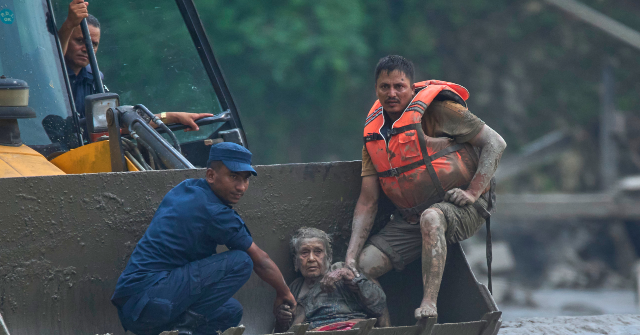
Rescue workers used an earthmover to rescue 97-year-old grandmother Gunmaya Bohra from last week’s terrifying flash flood in Nepal.
Bohra was trapped in the mud for almost nine hours before rescue workers found her and it took four hours to free her from the wreckage.

Video and photos of the amazing rescue on Thursday spread across Nepal and around the world, bringing hope to those who are still searching for survivors amid the wreckage. Eyewitnesses were astonished to see the elderly woman pulled alive from the wreckage of a flood that killed at least 700 others.
According to rescue workers, Bohra was inside an elderly care facility in the town of Kabilash when the flood struck, sweeping away homes and buildings all around her. The building she was in collapsed, but she survived and was trapped under the rubble. Once she was located and identified, members of her family rushed to the scene to help with the rescue effort.
“There has been so much tragedy but this is a remarkable experience. The patient cannot explain how she survived, everyone else in the home was killed. We will probably never know what happened. It is a miracle,” a medical official at the Kathmandu Trauma Center told the Times of London on Friday.
Workers clear debris in the aftermath of a flash flood in the Devighat area of Nuwakot district in Nepal, Friday, August 28, 2026. (AP Photo/Rajesh Kumar Singh)
The National on Sunday found Bohra recovering at Bir Hospital in Kathmandu, surrounded by her relatives, with her treatment covered by the government of Nepal. Among other challenges, her family must decide where the 97-year-old, who suffers from dementia in addition to trauma from the flood, will live after she is discharged from the hospital.
“She was slightly traumatized. She didn’t say anything to us for two or three days. Now she is fine,” her grandson Rasik Bohra said.
“Nothing happened to her, she is totally fine now. She was very strong. At the age of 97, she was very strong,” he added.
The younger Bohra is a student at Herald College Kathmandu. He said he traveled to the disaster area when he learned Kabilash had been wiped out by the flood and was overwhelmed by the scale of the devastation when he arrived. His missing grandmother was discovered when rescue workers saw her making small movements like shaking her head.
According to Rasik Bohra, several members of the family and people close to them are still missing, including his maternal uncle, some relatives on his mother’s side, and a friend of his father. He said more than 50 people from the area are still missing.
“There are so many people like me who are stuck. I feel very sad for them. I wish that the rescue teams could go there as soon as possible,” he said.
“We are in a very bad condition. I would like to tell the world to come together and help Nepal. I just pray for them. I just pray for Nepal,” he pleaded.

The official death toll from the flash flood exceeded 900 as of Monday morning, with 4,247 missing, including 592 foreign nationals. The U.S. State Department said around 85 Americans remained unaccounted for.
“We have activated from the State Department $3.6 million in emergency humanitarian assistance that includes up to three months of emergency food for up to 10,000 flood-affected households,” said State Department spokesman Tommy Pigott.
The U.S. Embassy in Nepal strongly recommended against travel to the affected area, and urged American residents to “follow evacuation orders and safety instructions from Nepali authorities.”
“Do not enter the disaster area independently to search for a missing person. Do not travel to the disaster area for any reason,” the embassy said.
“Hospitals in Kathmandu are usually better than in other areas, but they can be crowded, may lack some equipment or medicines, and often ask that you pay before treatment,” the embassy noted.
Read the full article here