






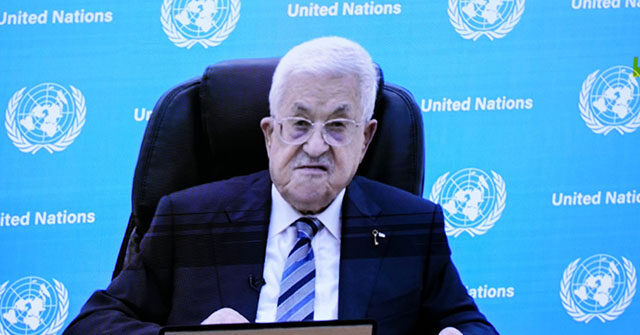
Palestinian Authority (PA) President Mahmoud Abbas, who has “observer” status at the United Nations but was denied a visa to attend the U.N. General Assembly (UNGA) in person by the U.S. government, delivered his address by pre-recorded video Thursday.
“For the second consecutive year, the Palestinian delegation was denied the entry visas required to reach New York and participate in the meetings of the United Nations General Assembly in person,” Abbas complained at the beginning of his address.
WATCH:

“We reject these unlawful punitive measures, and we reject the accusations and justifications on which they were based,” he said.
The State Department said the PA was denied a visa due to:
Actions at international organizations that undermine and contradict prior commitments in support of Security Council Resolution 242 and 338, taking actions to internationalize the Israeli-Palestinian Conflict including through the International Criminal Court (ICC) and International Court of Justice (ICJ), seeking to bypass negotiations through seeking unilateral recognition, and continuing to pay stipends to terrorists and to glorify acts of terrorism and terrorists in public pronouncements and school textbooks.
“If the PA wants to be treated as a partner, it must stop subsidising terror and stop using diplomatic theater as a substitute for serious governance,” Deputy U.N. Ambassador Tammy Bruce said on Friday when the decision to deny Abbas a visa was announced.
WATCH — President Trump Participates in a Multilateral Meeting with the Gulf Cooperation Council:

Abbas on Thursday argued that “the Palestinian people and its leadership should not be punished for demanding an end for the occupation, or for turning to the U.N., the International Court of Justice, and the International Criminal Court.”
“Denying the Palestinian delegation access to the U.N. headquarters is a violation of the United States’ obligations as the host country,” he asserted.
Abbas said the Palestinian people faced “one of the most dangerous times of its history,” following “long decades of historic injustice, uprooting asylum, seeking occupation, and the deprivation of its basic right to self-determination, freedom, and independence in the Gaza Strip.”
“Our people are being subjected at the hands of the Israeli occupation forces to killing, destruction, starvation, and attempts at displacement, as well as a genocidal war that has created an unprecedented humanitarian capacity,” he charged.
Like other Middle Eastern leaders at the U.N., Abbas offered not the slightest hint as to why the Israelis might have found it necessary to fight a war in Gaza, or who started the war. Abbas did not mention the terrorists of Hamas, or the events of October 7, 2023, a single time during his video address.
WATCH — Trump Defends U.S. as a “Sovereign Nation” — Slams “Anti-American” International Criminal Court:
“In the West Bank, including East Jerusalem, settler expansion is accelerating. The West Bank is being fragmented, and Jerusalem is being isolated and Judaized. Secular terrorism is being escalated under the protection of the occupying forces,” he continued.
Abbas accused Israel of “racial discrimination, ethnic cleansing, and state terrorism,” with an eye toward destroying “the two-state solution.”
Abbas said there was an “even greater danger ahead” that was even worse than Israel “undermining the two-state solution and preventing the realization of the Palestinian state,” namely a “malicious colonial scheme” for forcing the Palestinians to leave their “homeland.”
Abbas compared this impending scheme to the nakba or “disaster,” the Palestinian term for the population displacement that occurred after the Arab-Israeli War of 1948. As with the more recent Gaza war, Palestinians and their apologists prefer not to discuss who started that war, or what they were hoping to accomplish.
“The world has witnessed the tremendous cost in the Gaza Strip and the West Bank. So, what is the international community waiting for in order to protect the Palestinian people, ensure their continued presence on their land and the Israeli occupation, and implement the two-state solution on the basis of international legitimacy?” Abbas asked.
Abbas was elected to a four-year term in 2005 and remains in power 17 years later because he knows that if he permitted another election, he would be swept out of office by the bloodthirsty terrorist group he refused to name in his address. He refused to criticize Hamas in any way, instead placing all of the blame for hitches in the implementation of President Donald Trump’s 20-point peace plan on Israel.
WATCH — Man Kidnapped by Hamas: They Treated Me Better After Trump Was Elected, They Were Afraid of Him:
The closest Abbas came to acknowledging there might be some problems on the Palestinian side of the deal was when he demanded “the reunification of the Gaza Strip and the West Bank, including East Jerusalem, under the authority of the State of Palestine and its legitimate institutions, in accordance with the principle of one state, one government, one law, and one legitimate entity authorized to bear arms.”
The one “legitimate entity authorized to bear arms” Abbas has in mind is his own PA, but Hamas has proven extremely reluctant to give up its vast arsenal of guns and bombs, as stipulated by the 20-point plan. Abbas did not mention it, but Hamas is operating as an entirely separate entity from his authority, and on Thursday it demanded the international community simply ignore its disarmament obligations and force Israel to proceed with its concessions.
Abbas demanded more money for the Palestinians from the international community, “especially in the fields of education, health care, and vocational training,” but he lashed out at the European Union (EU) for not doing enough to stop Israeli settlements, even though the EU has been highly critical of them. He accused Israel of “dismantling Palestinian institutions” and depleting their financial resources, and expected the international community to reverse that process.
Abbas insisted the PA and other Palestinian institutions have made more progress toward clean and responsible government than the U.S. is willing to give them credit for and promised that a prospective Palestinian state would not become the security nightmare Israel fears.
“We reject terrorism and extremism in all their forms. We combat anti-Semitism, racism, and hatred. And we believe in a culture of peace, dialogue and coexistence. We seek a democratic Palestinian state that respects the rule of law and human rights — a non-militarized state that lives in security and peace alongside the state of Israel,” he said.
“The Palestinian people will not accept displacement, will not accept displacement and will not disappear,” he declared. “Neither military occupation nor settlement expansion and annexation, nor settler terrorism can be a solution or create lasting security. At the same time, we will not remain in waiting, nor will we accept whatever the governments of the Israeli occupying state decide for us.”
“Our vision for peace is clear: a Palestinian people remaining on its own land, determining its future for itself and the Palestinian state alongside the state of Israel, and a Palestinian-Israeli peace that paves the way to regional integration, cooperation, prosperity and security for everyone,” he said.
Abbas concluded by calling on “those countries that have not yet recognized the State of Palestine to do so,” and demanding “full membership in the United Nations,” which are the sort of pressure tactics that challenge the sincerity of his professed vision for peaceful and respectful co-existence with Israel.
Read the full article here


