




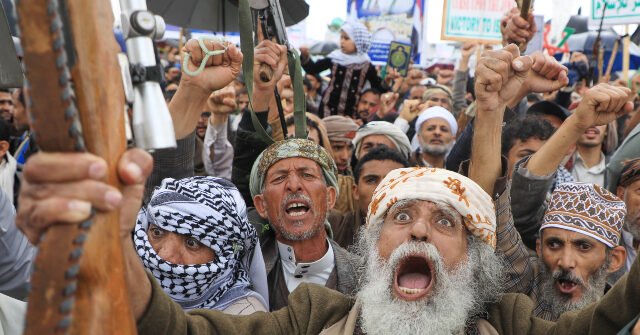
The Iran-backed Houthi insurgency in Yemen announced on Wednesday it has launched an operation called “Holy Jihad Battle” against Israel, working in concert with Iran and one of its other terrorist proxies, Hezbollah in Lebanon.
The Houthi military, which styles itself as the “Yemeni Armed Forces” or YAF even though it is not the legitimate government of Yemen, said its operation would continue “supporting and backing the fronts of resistance,” in line with the Houthis’ “religious, moral, and humanitarian duty” to its allies in the Iranian axis.
Houthi spokesman Brig. Gen. Yahya Saree said missiles were launched over the weekend at targets in southern Israel “in coordination with our mujahideen brothers in Iran, and Hezbollah in Lebanon.” Mujahideen means “holy warriors.”
Saree claimed the missile attack “successfully achieved its objectives, by the grace of Allah.”
The Israel Defense Forces (IDF) reported that two cruise missiles and a possible drone attack were launched from Yemen, all of them successfully intercepted .
The Houthis reportedly launched a third missile attack on Wednesday, but the extent of the strike was unknown at press time.
The Times of Israel (TOI) on Tuesday quoted military analysts who said the Houthis’ rather late entry into the Iran conflict, and the limited scope of their actions thus far, suggested they were taking “symbolic” potshots at Israel to demonstrate their loyalty to Iran, but might be reluctant to enter the war as fully as Hezbollah has.
“The Houthis are different – they are Zaidi Shiites who have existed in a state-like form for about a thousand years. They take Iranian strategic considerations into account. But their own strategic calculations come first,” said Nachum Shiloh, a research fellow at the Dayan Center at Tel Aviv University.
The Zaidis are a sect of Shia Islam, like the Alawites of Syria, that feels some connection to the Shiite theological center of Iran but also has major doctrinal differences, especially concerning the number of divinely inspired teachers who were supposed to follow in the footsteps of Muhammad, the founder of Islam.
The Shiites of Iran have the highest divine imam count in their teachings at 12, so their branch of the faith is sometimes referred to as “Twelver Islam.” The Zaidis recognize the smallest number of divine imams at five. The name of their sect is derived from the fifth divine imam, Zayd ibn Ali.
The Houthis are practitioners of Zaidi Islam, and they are also ethnically distinct, a clan from the northwestern part of Yemen that makes up about 35 percent of the national population. The Zaidi religion dominated Yemen for almost a thousand years until it was overthrown in 1962.
The Houthi insurgency began as a revivalist movement, determined to bring the true Zaidi faith back to power, but it has added other grievances to its militant ideology over the years. The Houthi movement now refers to itself as Ansar Allah, the “Army of Allah,” and follows the motto “Allahu Akbar, Death to the United States, Death to Israel, Curse the Jews, Victory for Islam.”
This background could help explain why the Houthis are allies and clients of Iran, which has provided the Houthi insurgency with a hefty inventory of missiles and other weapons, but there could be limits on how much damage the Houthis are willing to sustain on Tehran’s behalf.
“This war is about coming out in support of Iran, and [that] doesn’t generate the same level of domestic support that the Houthis’ involvement in the Gaza war did,” observed Allison Minor, director of the Project for Middle East Integration at the Atlantic Council.
The Houthis are also not well-positioned geographically to pose a major missile threat to Israel – but they are in a perfect position to threaten Red Sea shipping, as they did during the Gaza War. This would create problems for Israel, and even more problems for the Gulf Arab states, such as Saudi Arabia.
There is already a great deal of bad blood between the Houthis and the Saudis over the latter nation’s effort to lead an intervention into the Yemeni civil war, and the Houthis are much more of a threat to the Saudis than to Israel, in terms of ground forces and short-range weapons.
Read the full article here


