
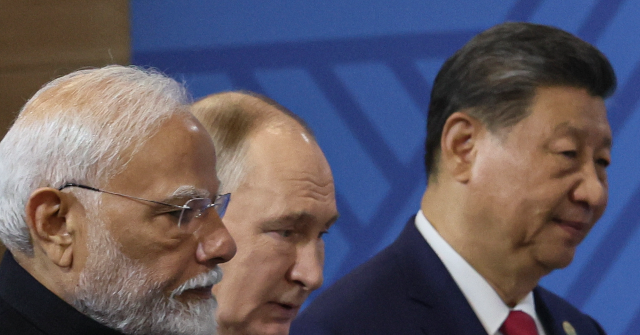
Iranian President Masoud Pezeshkian, who is subordinate to missing “supreme leader” Mojtaba Khamenei, left Tehran on Monday to participate in a regional summit in which he is expected to meet with the dictators of allied China and Russia, as well as Prime Minister Narendra Modi of India.
The event will give Pezeshkian the opportunity to make Iran’s case before its allies in person as Tehran struggles to maintain support from its previously most engaged backers. Iran is facing a growing economic blockade by the United States that President Donald Trump claimed to elevate to a full economic war last week, intending to destroy the terror state’s ability to pose a threat to America, Israel, or its Gulf Arab neighbors. That war follows months of military conflict that began with Trump’s Operation Epic Fury in February which eliminated longtime dictator Ali Khamenei.
Speaking before flying to the Shanghai Cooperation Organization (SCO) summit in Bishkek, Kyrgyzstan, on Monday, Pezeshkian announced that his goal is to convince fellow participants that Iran is not seeking war or a belligerent party, despite its extensive modern history as the world’s most prolific state sponsor of terrorism.
“We are not seeking war, and this is a clear message we have sent to the world. However, we will never stand idly by in the face of any aggression and will give a decisive response to the aggressors,” he said, according to the state-run Islamic Republic News Agency.
“The [SCO] meeting stands as a symbol of the existence of diverse and independent voices on the global stage at a time when some international institutions are seeking to create a single-voice environment in the world,” Pezeshkian continued, reportedly encouraging other participants to “join hands and work together to ensure the security, economic prosperity, and development of the region.”
The SCO is a security coalition primarily led by China but made up of a variety of countries in Central Asia. In addition to Russia, China, and India, countries such as Pakistan, Mongolia, Tajikistan, and Azerbaijan are expected to participate in the current summit.
Both the Russians and the Chinese have kept a distance from Iran’s war with America, condemning the United States for defending its interests against Iran while not offering any substantial support to the Iranian terror state. China has repeatedly suggested that Iran pursue diplomacy with America to lift the American blockade on Iranian shipping in the Strait of Hormuz, which has significantly harmed China’s access to Middle Eastern oil, but Iranian leaders have not appeared receptive to that message.
At press time, of the three largest countries in the SCO, Pezeshkian has only met with the leader of India, Prime Minister Narendra Modi. Modi published a photo of their meeting on social media and described a positive exchange with the Iranian leader.
“Reiterated our commitment to strengthening India’s long standing friendship with Iran across diverse sectors,” he wrote. “We want to expand and diversify our trade basket in the times to come. We had a discussion on the prevailing situation in the region. India will continue to support all efforts aimed at ensuring lasting peace.”
The meeting did not appear to result in any concrete discussion of how India, an American ally, could help Iran in its war.
Pezeshkian, according to the Iranian Foreign Ministry (IRNA), used his time with Modi to condemn America and blame the administration of President Donald Trump for the failures of multiple rounds of negotiations seeking an end to hostilities.
“Unfortunately, the Americans, instead of making use of diplomatic mechanisms, have chosen the path of war, insecurity, and imposing their will through force,” Pezeshkian reportedly told Modi.
“Unfortunately, the American side did not fulfill its commitments,” the Iranian president insisted. “Nevertheless, we continue to strive to realize the path of agreement and understanding, and we believe that the continuation of war is in the interest of neither of us, nor the region, nor humanity.”
IRNA claimed that Modi told Pezeshkian he thought that the Iranian president was a “peace-loving person” who could “play an effective role in achieving peace,” but the outlet did not indicate that Modi offered any direct Indian support for Iran’s agenda in the conflict.
Neither Putin nor Xi have met with Pezeshkian at press time, according to state reports. The two met with each other, however, prioritizing their countries and interests. According to the Russian news agency Tass, Putin touted the possibility of ending the need for Chinese and Russian citizens to have visas to visit each other’s countries. Putin also praised the SCO generally for becoming a “full-fledged international organization.”
The SCO this year is serving as a precursor for September’s BRICS (Brazil, Russia, India, China, and South Africa) high-level summit, scheduled to take place in New Delhi, India, on September 13. BRICS is similar in membership and objectives to the SCO but focused more directly on economic development and challenging American economic supremacy on the global stage. Iran is a full member of BRICS alongside the United Arab Emirates (UAE), one of the many Muslim Middle Eastern countries that Iran has repeatedly bombed in response to American military activities. As a result of Iran’s hostilities against other BRICS members, the bloc has struggled to maintain coherence and unity in its goal of weakening America’s global influence.
Follow Frances Martel on Facebook and Twitter.
Read the full article here